
Electrical Career Path Finder
Select your primary region of work to narrow down the recognized standards.
United Kingdom
Follows BS 7671 Wiring Regulations
United States
Follows NEC (National Electrical Code)
In the US, your choice depends heavily on whether you want to join a union.
Non-Union / Independent
Portable credentials, flexible hiring
Union (IBEW)
Strong benefits, local JATC training
Your Recommended Path
Walk into any electrical apprenticeship program or trade school, and you will see a stack of manuals. But who actually wrote those books? More importantly, who decides what an electrician needs to know before they are allowed to touch a live panel? The answer isn't one single government agency. It is a complex web of industry bodies, educational institutions, and safety organizations that compete and collaborate to define the standard.
If you are looking to enter the trade, or if you are an employer trying to verify credentials, understanding electrical training curriculum providers is crucial. You need to know which organization holds the authority in your specific region and specialty. In the UK, it’s very different from the US, and even within the US, the systems vary by state and union affiliation.
The UK Powerhouse: EAL and City & Guilds
In the United Kingdom, the landscape is dominated by two main players: the Electricity Association Ltd (EAL) and City & Guilds. These organizations don't just offer courses; they write the rulebook for how electricians are trained.
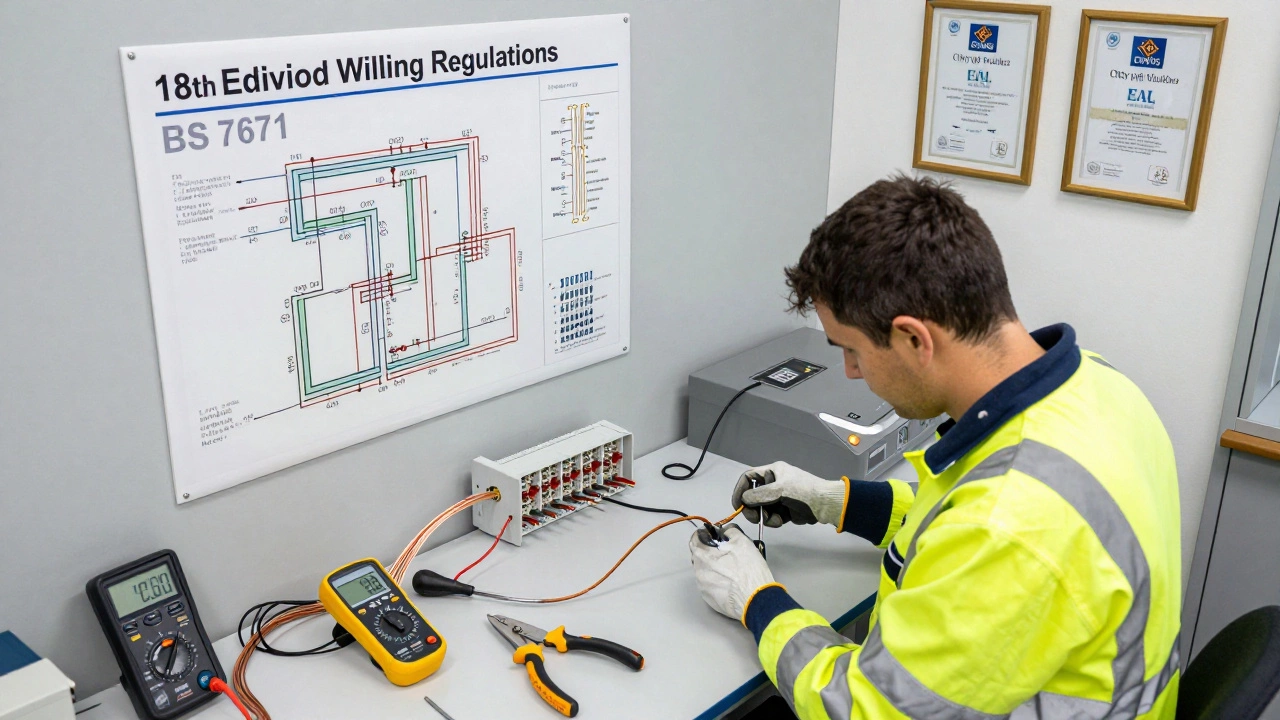
EAL (Electricity Association Ltd) is the primary body responsible for setting the technical standards and training curricula for the electrical contracting industry in the UK. When you hear about the "18th Edition" of the wiring regulations, EAL is heavily involved in updating the training materials that teach these rules. They provide the core technical content that ensures every apprentice learns the same safety protocols and installation methods.
However, EAL doesn't work alone. They partner with awarding organizations like City & Guilds and NPTC (National Proficiency Tests Council). City & Guilds provides the formal qualifications-the certificates you get at the end. Their curriculum is structured around NVQs (National Vocational Qualifications) and BTECs. If you are studying in Bristol or anywhere else in England, your college will likely use City & Guilds syllabi because employers recognize the brand.
The relationship works like this: EAL defines the technical requirements based on current industry needs and BS 7671 (the Wiring Regulations). City & Guilds then packages this into assessable units. This separation ensures that the training remains practical and up-to-date while maintaining academic rigor.
The US Standard: NCCER and NECA
Across the Atlantic, the system looks different. In the United States, there is no single federal body that dictates electrical training. Instead, the National Center for Construction Education and Research (NCCER) has become the de facto standard for non-union and many union programs.
NCCER is a nonprofit organization that develops standardized, competency-based training programs for the construction industry, including extensive modules for electrical workers. Their curriculum is modular. You start with core concepts-like safety and blueprint reading-and then move into specialty modules for residential wiring, industrial controls, or telecommunications.
Why do so many contractors choose NCCER? Because it is portable. If you learn the NCCER method in Texas, you can take that credential to Florida, and employers will understand exactly what you know. This consistency is vital in a country where licensing laws change from state to state.
But NCCER didn't create this vacuum. They were backed by NECA (National Electrical Contractors Association). NECA represents the business owners who hire electricians. They needed a way to ensure that new hires had baseline skills without spending years on the job learning the basics. So, NECA helped fund and shape the NCCER curriculum to meet real-world contractor needs.
The Union Route: IBEW and JATCs
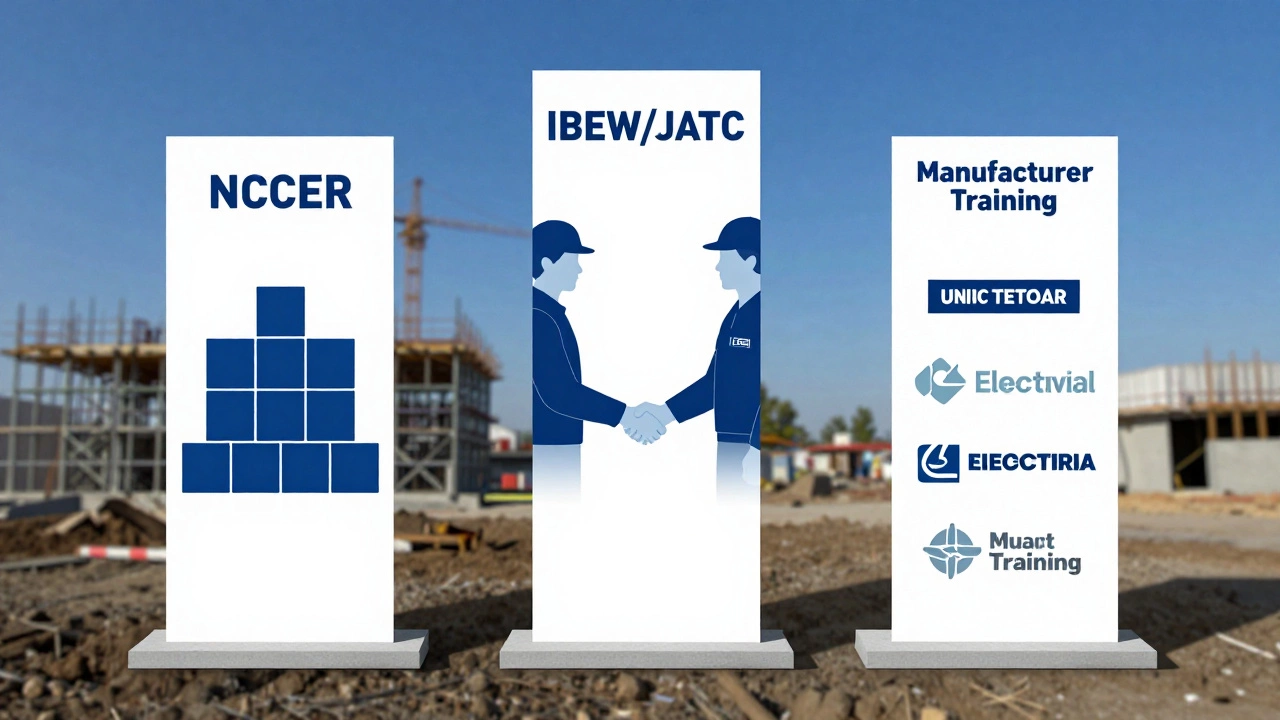
Not everyone follows the NCCER path. In the US, the International Brotherhood of Electrical Workers (IBEW) runs its own massive training infrastructure through Joint Apprenticeship and Training Committees (JATCs).
JATCs are local entities funded by both unions and employers. They design their own curricula, often in collaboration with community colleges. While some JATCs adopt NCCER materials, many have developed proprietary courseware over decades. This means an IBEW journeyman in New York might have learned from completely different textbooks than an NCCER-certified worker in Ohio.
The key difference here is control. JATCs tailor their training to the specific projects common in their region. If a city has lots of high-rise construction, the JATC curriculum will emphasize high-voltage systems and elevator wiring. If it’s a suburban area, it will focus on residential service entrances. This localized approach creates highly skilled workers but makes national mobility harder compared to the standardized NCCER model.
Specialty Curricula: Beyond General Wiring
General wiring is just the beginning. As technology evolves, specialized organizations step in to provide curriculum for niche areas. You won’t find advanced solar PV installation or smart home automation in a basic electrician textbook.
For renewable energy, the North American Board of Certified Energy Practitioners (NABCEP) sets the standard. While they are primarily a certifying body, their study guides effectively serve as the curriculum for solar training programs. Similarly, for low-voltage systems like fire alarms and security, the Fire Alarm School and various manufacturer-specific programs (like Honeywell or Siemens) provide the detailed technical training.
Manufacturers play a huge role here. Companies like Schneider Electric and Eaton offer free online courses and hands-on workshops for their specific products. An electrician might learn general theory from City & Guilds or NCCER, but they learn how to install a specific brand of switchgear directly from the manufacturer. This hybrid approach ensures that technicians are both broadly competent and specifically proficient.
| Organization | Primary Region | Curriculum Focus | Target Audience | |
|---|---|---|---|---|
| EAL / City & Guilds | UK | BS 7671 Compliance, NVQs | Apprentices, Contractors | |
| NCCER | USA (Global) | Competency-Based Modules | Non-Union, Small/Mid Contractors | |
| IBEW / JATC | USA | Local Project Needs, Union Standards | Union Apprentices | |
| NABCEP | North America | Solar PV Installation | Renewable Energy Techs |

How to Choose the Right Path
So, which organization should you trust? It depends entirely on where you want to work. If you are in the UK, ignore NCCER. Focus on finding a college approved by City & Guilds and ensuring they follow EAL guidelines. Your goal is to pass the AM2 Practical Assessment, which is the gold standard for proving competence.
If you are in the US, ask yourself: Do you want to join the union? If yes, apply to a local JATC. They will provide everything you need. If not, look for schools that use NCCER curriculum. It gives you a portable credential that employers across state lines will respect. Always check if the program includes hands-on lab time. Theory is useless if you can’t strip a wire properly.
Remember, the curriculum is only as good as the instructor. A great book taught by a disengaged teacher leads to poor skills. Look for programs where instructors are active professionals, not just academics. They bring current site challenges into the classroom, making the learning relevant and immediate.
The Future of Electrical Education
The field is changing fast. With the rise of electric vehicles, heat pumps, and smart grids, the old curriculum is becoming outdated. Organizations like EAL and NCCER are already updating their modules to include EV charger installation and battery storage systems. However, the pace of change is rapid. Many traditional programs struggle to keep up.
This gap creates opportunities for specialized bootcamps and manufacturer-led training. Don’t rely solely on your initial certification. Commit to continuous professional development (CPD). Attend seminars, read the latest updates to the wiring regulations, and take short courses on new technologies. The electrician who stops learning after getting their license will quickly fall behind.
Is NCCER recognized in the UK?
No, NCCER is primarily used in the US and some international markets. In the UK, you must follow City & Guilds or equivalent NVQ standards aligned with BS 7671. NCCER credentials are not accepted for legal compliance in British electrical work.
Who writes the US National Electrical Code (NEC)?
The NEC is published by NFPA (National Fire Protection Association). While it is not a training provider, it is the foundational document that all US electrical curricula must teach. NCCER and JATC courses are built around NEC compliance.
Can I become an electrician without formal training?
In most jurisdictions, no. Both the UK and US require formal apprenticeships or documented hours under supervision plus passing exams. Self-study is insufficient for legal licensing due to the high safety risks involved.
What is the difference between EAL and ELECSA?
EAL sets the training standards and technical guidelines. ELECSA is a competitor to NICEIC and is a certification scheme for electricians. They use similar underlying standards but operate as separate approval bodies for domestic and commercial installations.
Do manufacturers provide free training?
Yes, many major manufacturers like Siemens, ABB, and Schneider Electric offer free online courses and occasional hands-on workshops. These are excellent for staying current with specific product lines but do not replace core vocational qualifications.



Write a comment