

Welder Salary Calculator
Estimate your potential earnings as a professional welder in the UK based on your experience level, location, and certifications.
Your Estimated Salary
£22,000 - £28,000 per year
Note: Salaries based on UK market data from National Careers Service and industry reports. Entry-level positions start at £22k-£28k. With certification and experience, earnings can reach £35k-£45k+.
At 40, you might look in the mirror and wonder if it’s too late to pick up a welding torch. Maybe you’ve been in the same job for years. Maybe you’re tired of sitting at a desk. Maybe you just want to make something real with your hands. The truth? Welding isn’t a young person’s game. It’s a trade built on skill, patience, and steady hands - and those don’t disappear when you turn 40.
Welding doesn’t care how old you are - it cares if you show up
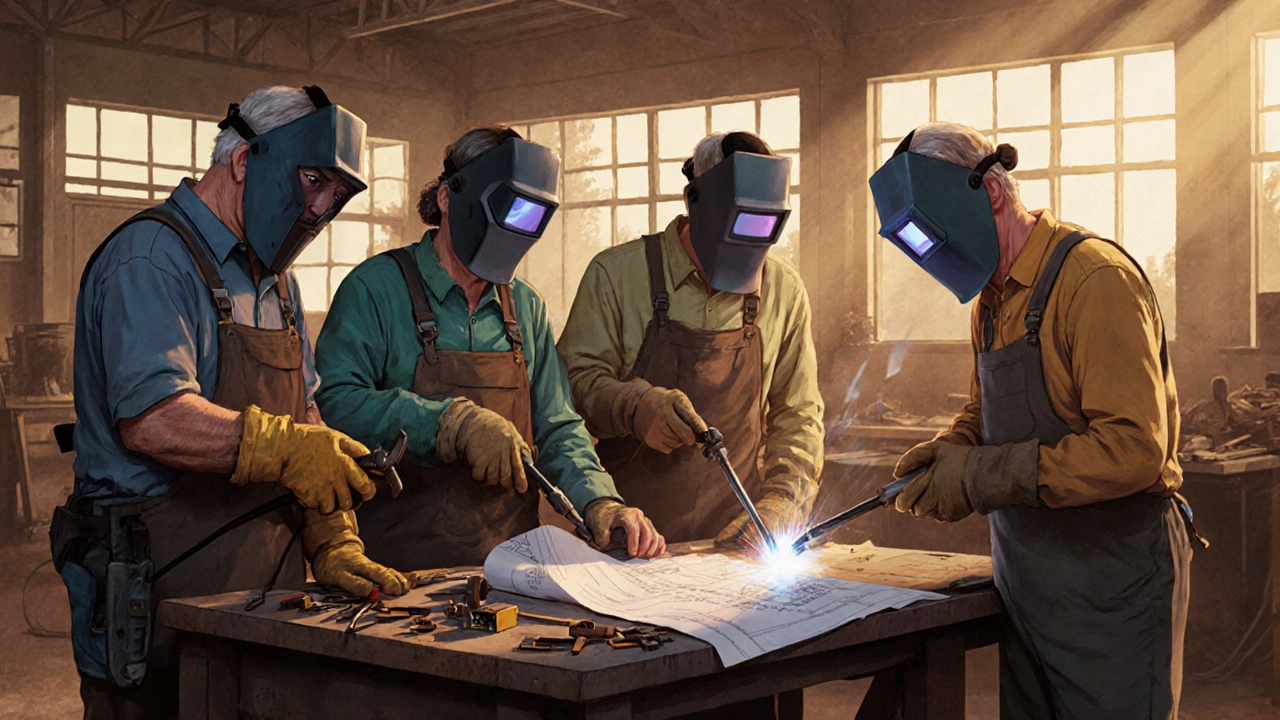
I’ve seen men and women in their 40s, 50s, and even 60s walk into welding schools with no prior experience. Some left corporate jobs. Others were laid off. A few just wanted to stop feeling stuck. What they all had in common? They showed up every day. They showed up tired. They showed up sore. And they showed up willing to get burned, bruised, and bored before they got good.
Welding isn’t about speed. It’s about control. It’s about understanding heat, metal, and how they react when pushed together. At 40, you likely have more focus than you did at 20. You know how to follow instructions. You don’t get distracted by noise or ego. That’s an advantage.
Physical demands? Yes - but manageable
Let’s be honest: welding is physical. You’ll stand for hours. You’ll lift heavy pieces of steel. You’ll work in awkward positions - overhead, on your knees, in tight corners. You’ll wear a heavy helmet and gloves. You’ll sweat under a heat lamp.
But here’s what most people don’t tell you: you don’t need to be an athlete. You need to be consistent. Most welding jobs don’t require Olympic-level strength. They require endurance. And endurance? That’s something you build over time - not in a gym, but on the job.
Many adult learners start with light-duty welding courses that focus on thin metals and smaller projects. These are perfect for building confidence and technique without overloading your body. As you get stronger, you naturally progress. Your body adapts. Your muscles remember. Your joints learn how to move safely.
One student I met at a Bristol training center was 47. He had knee replacements. He wore a back brace. He still graduated top of his class in pipe welding. Why? Because he worked smarter, not harder. He used proper posture. He took breaks. He listened to his body. That’s maturity. That’s wisdom.
Welding courses for adults are designed for people like you
Welding schools today aren’t the dusty, outdated shops of the 1980s. Modern vocational training centers - like those in Bristol, Manchester, or Leeds - offer structured programs that run 6 to 12 weeks. Most include:
- Basic shielded metal arc welding (SMAW)
- Gas metal arc welding (MIG)
- Tungsten inert gas welding (TIG)
- Safety protocols and PPE use
- Blueprint reading
- Hands-on practice with real industrial equipment
These aren’t theoretical classes. You’re welding real pipes, steel plates, and structural frames from day one. Instructors tailor feedback to your pace. No one rushes you. No one mocks you for being older. They’ve seen it all.
Many programs even offer flexible scheduling - evening classes, weekend modules, or part-time options. You can keep your current job while you train. Some employers even pay for training if you commit to working for them afterward.
Welding pays - and it pays well, even for beginners
Entry-level welders in the UK earn between £22,000 and £28,000 a year. With certification and experience, that jumps to £35,000-£45,000. Specialized welders - like those who work on offshore rigs, pipelines, or nuclear plants - can earn £60,000+.
And here’s the kicker: demand is rising. The UK needs more skilled welders. Bridges, wind turbines, hospitals, and trains all need welding. The National Careers Service reports a shortage of over 12,000 qualified welders across the country. That means jobs. That means opportunities. That means you won’t be competing with 20-year-olds for the same role - you’ll be filling a gap.
Real people, real stories
John, 43, was a warehouse supervisor. He hated the monotony. He took a 12-week welding course at a local college. Six months later, he was working on a shipyard in Southampton. His first paycheck was £2,500 - more than he’d made in a month before.
Sarah, 41, left her admin job after her company downsized. She’d always loved fixing things. She enrolled in a TIG welding course. Two years later, she runs her own small business repairing farm equipment. She hired two apprentices - both under 25.
These aren’t outliers. They’re typical. The average age of new welders in the UK is now 38. The trade is aging - and it’s looking to people like you to fill the next generation.
What you need to start
You don’t need a degree. You don’t need to be a genius. You don’t even need to have ever held a tool.
Here’s what you do need:
- Willingness to learn - not just to watch, but to do
- Good eyesight (glasses are fine - you’ll wear a helmet anyway)
- Basic hand-eye coordination
- Ability to follow safety rules
- Patience - your first 10 welds might look like spaghetti. That’s normal
Most courses cost between £1,500 and £3,500. Some local councils offer grants. Some charities help with fees for career changers. Check with your local college or the National Careers Service. You might be surprised how much help is out there.
What happens after you finish?
Graduation isn’t the end - it’s the starting line. Most schools help you get certified. The most common is the City & Guilds Level 2 in Welding. Some offer NVQs, which are nationally recognized.
After certification, you can:
- Work for a construction firm
- Join a fabrication shop
- Work on maintenance crews for factories
- Start your own small welding business
- Specialize in pipeline, ship, or pressure vessel welding
Many employers hire right out of school. Others offer apprenticeships - paid on-the-job training that leads to higher certifications. You’re not starting from zero. You’re starting with a credential that means something.
It’s not about age. It’s about readiness
People say, “I’m too old to start.” But what does that even mean? You’re not too old to learn. You’re too old to wait.
At 40, you’ve lived. You’ve failed. You’ve tried. You know what matters. You’re not chasing a dream - you’re building a future. And welding? It’s one of the few trades where your value goes up with time. The older you get, the more respect you earn. The more experience you have, the more you’re paid.
You don’t need to be 20 to learn welding. You just need to be ready.
Can someone over 40 really become a professional welder?
Yes. Many people start welding in their 40s and go on to have successful careers. Welding schools train adults every day. Employers value experience, reliability, and work ethic - qualities often stronger in older learners. With proper training and certification, you can work in construction, manufacturing, shipbuilding, or even start your own business.
Is welding physically too hard for someone my age?
It’s physically demanding, but not impossible. Most welding jobs don’t require extreme strength - they require endurance and technique. Many adult learners start with lighter materials and smaller projects. You’ll build strength over time. Proper posture, safety gear, and pacing make a huge difference. People with past injuries or conditions have successfully trained by working with instructors to adapt their approach.
How long does it take to learn welding?
You can learn the basics in 6 to 12 weeks through a full-time course. Becoming skilled enough for a job typically takes 6 to 12 months of consistent practice. Certification programs like City & Guilds Level 2 take about 12 weeks. Specialized skills - like TIG welding on stainless steel or pipe welding - take longer, but you’ll earn more as you gain them.
Are there financial aids or grants for adults learning welding?
Yes. Many local councils offer skills grants for career changers. The National Careers Service can help you find funding. Some colleges have reduced fees for adults over 25. Employers sometimes pay for training if you agree to work for them after. Check with your local college or job center - help is often available if you ask.
What’s the job outlook for welders in the UK right now?
Strong. The UK faces a shortage of over 12,000 qualified welders. Demand comes from infrastructure projects, renewable energy (wind turbines, solar farms), shipbuilding, and manufacturing. Welders with certifications are in high demand, especially in regions like the North East, Scotland, and the Midlands. Entry-level positions are easier to get now than they’ve been in decades.
Will I be the oldest person in my welding class?
Not necessarily. The average age of new welders in the UK is now 38. Many classes include people in their 40s and 50s. Instructors are used to teaching adults. You’ll find others who are also changing careers, recovering from job loss, or seeking purpose. You’re not alone - and you won’t be treated differently.
Next steps if you’re serious
Start by calling your local college or training center. Ask if they offer adult welding courses. Ask about funding. Ask if they have open days. Visit. Watch. Talk to students. Hold a welding glove. Smell the metal. Feel the heat.
Don’t wait for the perfect moment. There isn’t one. The best time to start was years ago. The second best time? Today.

Write a comment