
Grade A Hair Quality & Cost Tool
Estimated Total Investment
£0.00
Perform these standard vocational tests on your sample bundle. Select the result you observe.
Drop a lock into water. How does it behave?
Burn a tiny strand. What is the smell and residue?
Comb from tip to root. How is the resistance?
Stretch a single strand gently. Does it return to length?
Complete all four tests to see if your bundle meets Grade A standards.
Walk into any professional salon or hair extension studio, and you'll hear the term grade A hair thrown around like it's a universal standard. But here’s the truth: there is no single, legally binding definition of "Grade A" in the global hair industry. It’s a marketing label that means different things to different suppliers. For students on hairdressing courses in the UK, understanding what actually constitutes top-tier human hair isn't just about vocabulary-it’s about protecting your investment, understanding material costs, and mastering the craft of working with premium extensions and wigs.
If you’re studying NVQ Level 2 or Level 3 in Hairdressing, or perhaps aiming for an apprenticeship, knowing how to distinguish between genuine high-quality human hair and synthetic blends labeled as "premium" is a critical skill. This guide breaks down the real attributes of Grade A hair, why the price varies so wildly, and how to spot the difference when you’re buying practice materials or client stock.
What Actually Defines Grade A Human Hair?
At its core, Human Hair Extensions are classified by their source, processing level, and integrity. When suppliers claim "Grade A," they are usually referring to three specific criteria:
- Single Donor Source: The hair comes from one individual donor rather than being mixed from multiple sources. This ensures uniform texture, color, and cuticle direction.
- Unprocessed or Minimally Processed: The hair has not been bleached, dyed, or permed heavily. If it has been colored, it was done once, carefully, without stripping the natural pigment entirely.
- Intact Cuticles: The outer layer of the hair shaft (the cuticle) is intact and aligned in the same direction (usually root-to-tip). This prevents tangling and allows the hair to move naturally.
In contrast, "Grade B" or "Grade C" hair often involves mixing donors, heavy chemical processing, or reversed cuticles (where the cuticles point upward, causing friction and tangling). For a student practicing weaving or bonding techniques, Grade A hair behaves much more predictably, reducing frustration during technical exercises.
Why the Price Tag Varies So Much
You might see bundles of "Grade A" virgin Remy hair priced anywhere from £40 to £150 per bundle. Why such a huge gap? It comes down to origin and transparency.
| Grade | Source & Processing | Cuticle Status | Avg. Price per Bundle (UK) | Lifespan with Care |
|---|---|---|---|---|
| Grade A (Virgin) | Single donor, uncolored | Intact, aligned | £80 - £150+ | 1-3 years |
| Grade A (Remy) | Single donor, lightly processed | Intact, aligned | £50 - £90 | 6 months - 1 year |
| Grade B | Mixed donors, heavily dyed | Reversed or damaged | £20 - £40 | 3-6 months |
| Synthetic | Polyester/Fiber | N/A | £10 - £25 | 3-6 months |
True virgin hair-meaning it has never been chemically treated-is the most expensive because it retains its natural strength and elasticity. However, many "Grade A" products sold online are actually Remy hair that has been lightly tinted to match popular shades. This is still high quality, but it’s worth noting if you’re comparing prices against pure virgin stock.
How to Test Hair Quality Before You Buy
As a student or junior stylist, you won’t always have access to lab tests. Instead, rely on physical checks that mimic professional inspection methods. Here is a simple checklist you can use before purchasing practice bundles or client materials:
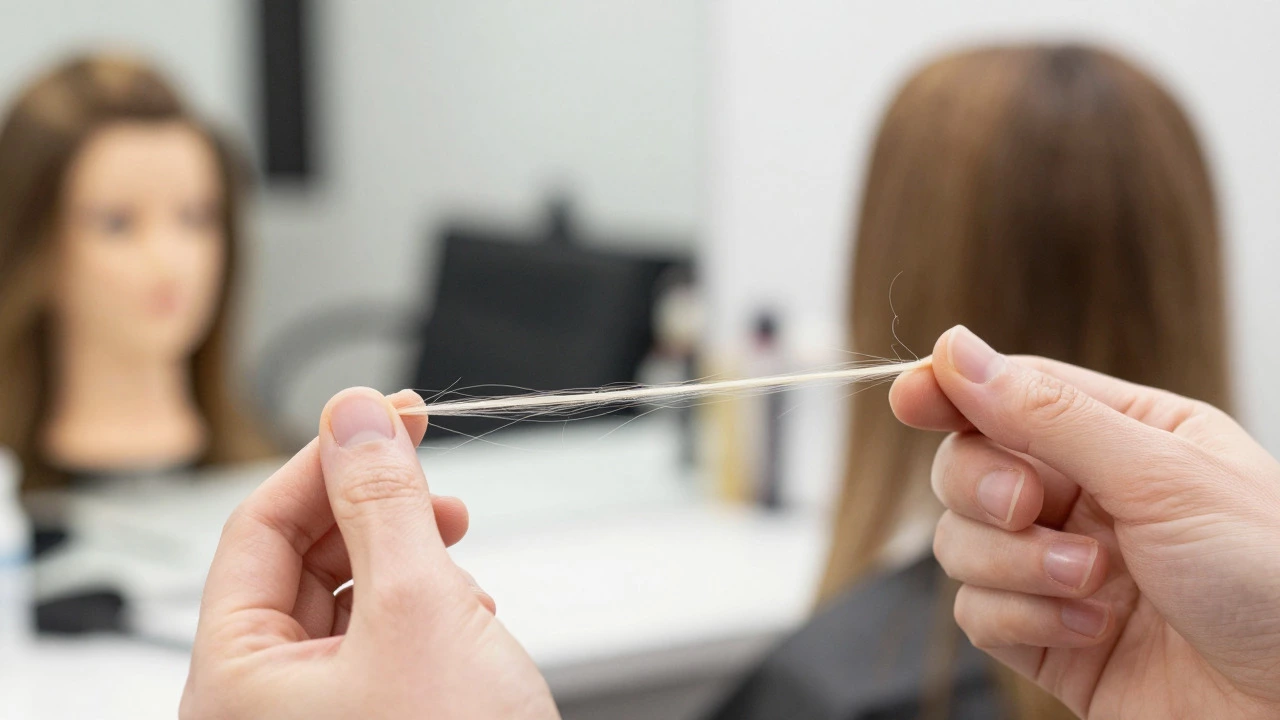
- The Water Test: Drop a small lock of hair into a glass of water. High-quality human hair with intact cuticles will sink slowly and settle at the bottom. Synthetic hair floats; low-grade human hair may clump together or float due to air trapped in damaged cuticles.
- The Burn Test: Take a tiny strand and hold it near a flame. Human hair burns slowly, smells like burnt feathers (keratin), and turns to ash. Synthetic hair melts, smells like plastic, and forms a hard bead.
- The Tangle Check: Gently comb the hair from tip to root. Grade A hair should slide through easily. If it snags significantly, the cuticles are likely reversed or damaged.
- Elasticity Test: Stretch a single strand gently. Good quality hair stretches slightly and returns to its original length. Poor quality hair snaps or doesn’t stretch at all.
These tests are standard in vocational training modules for Hair Extension Techniques. Mastering them helps you advise clients realistically about maintenance expectations.
Grade A Hair in Vocational Training Contexts
For those enrolled in NVQ Hairdressing courses or City & Guilds qualifications, understanding material grades is part of the commercial awareness unit. Trainers often use lower-grade hair for basic cutting practice to save costs, but advanced units involving braiding, weaving, and fusion require higher integrity materials to demonstrate proper technique.
When budgeting for personal practice kits, consider this hierarchy:
- Beginners: Start with mid-range Remy hair (Grade A/B hybrid) to learn handling without breaking the bank.
- Intermediate: Invest in true Grade A Remy hair for color correction and blending practice.
- Advanced/Apprentices: Use Virgin Grade A hair for client work simulations to ensure results meet professional standards.
Many training colleges in Bristol and other UK cities partner with local suppliers who offer student discounts on bulk purchases. Always ask if the hair is "single donor" explicitly, as "high quality" is too vague a term to rely on.
Common Misconceptions About "Best" Hair
One of the biggest myths is that darker hair is inherently better quality than lighter hair. In reality, blonde hair is often more delicate and prone to breakage if over-processed, while dark hair can hide imperfections in the cuticle structure. The "best" grade depends on the intended use: fine, light hair looks more natural for subtle blends, while thicker, darker hair offers durability for heavy styles.
Another misconception is that longer hair is always higher grade. Length is determined by the donor’s natural hair length, not its quality. A 12-inch bundle can be superior in integrity to a 24-inch bundle if the shorter one is virgin and the longer one is heavily re-texturized.
Maintenance Extends the Life of Grade A Hair
Even the best Grade A hair will degrade if treated poorly. For students learning aftercare advice, emphasize these points to clients:
- Use sulfate-free shampoos to preserve moisture.
- Avoid heat styling above 180°C (350°F) without heat protectant.
- Store hair in a silk bag to prevent friction damage.
- Wash extensions every 7-10 days, not daily.
Proper care can extend the life of Grade A hair from six months to over two years, making the initial higher investment worthwhile for both stylists and clients.
Is Grade A hair the same as virgin hair?
Not necessarily. Grade A refers to quality and cuticle alignment. Virgin hair is a subset of Grade A that has never been chemically processed. All virgin hair is Grade A, but not all Grade A hair is virgin.
Can I use synthetic hair for NVQ assessments?
It depends on the unit. Basic cutting and styling may allow synthetic mannequin heads, but extension and weaving units typically require human hair to test realistic tension and behavior. Always check your assessor’s guidelines.
Why does my Grade A hair tangle quickly?
If it tangles within weeks, it may not be true Grade A. Reversed cuticles or mixed donors cause friction. Ensure you bought from a reputable supplier and perform the water and burn tests to verify authenticity.
What is the difference between Remy and non-Remy hair?
Remy hair has cuticles kept intact and aligned in the same direction. Non-Remy hair has cuticles stripped or randomized, leading to faster tangling and a shorter lifespan. Remy is generally considered Grade A or B, while non-Remy is often Grade C.
Where can students find affordable Grade A hair for practice?
Look for bulk suppliers who offer student rates, or join local hairdressing forums where professionals sell off old client bundles. Avoid ultra-cheap online marketplaces unless reviews specifically mention cuticle integrity.



Write a comment