
Welding Math & Material Calculator
Project Parameters
Results
Estimated Weight
0.00 kg
Total Kerf Loss
0.0 mm
Use this for cutting diagonal supports.
You pick up a welding torch, and suddenly you’re not just making sparks fly-you’re solving equations. Or are you? If you’re considering welding courses in the UK or thinking about switching careers into this trade, you’ve probably heard the rumor: "Welding is basically geometry with fire." It sounds intimidating if your high school math class left you with a scar tissue memory of algebra. But here’s the truth: welding isn’t calculus. It’s practical arithmetic, spatial reasoning, and a bit of physics that you learn by doing, not by memorizing formulas.
The short answer is no, welding is not "a lot" of math in the academic sense. You won’t be deriving integrals on a whiteboard. However, it is full of numbers. Every weld requires specific settings, measurements, and material properties. Getting these wrong doesn’t just mean a bad grade; it means a weak joint that could fail under pressure. So, while you don’t need to be a mathematician, you do need to be comfortable with numbers. Let’s break down exactly what kind of math you’ll actually use on the job site.
The Daily Arithmetic of a Welder
Most of the math you’ll encounter as a welder is basic addition, subtraction, multiplication, and division. Think of it like cooking. You wouldn’t bake a cake without measuring the flour, right? Welding is similar. You measure metal lengths, calculate how much filler rod you need, and figure out travel speeds.
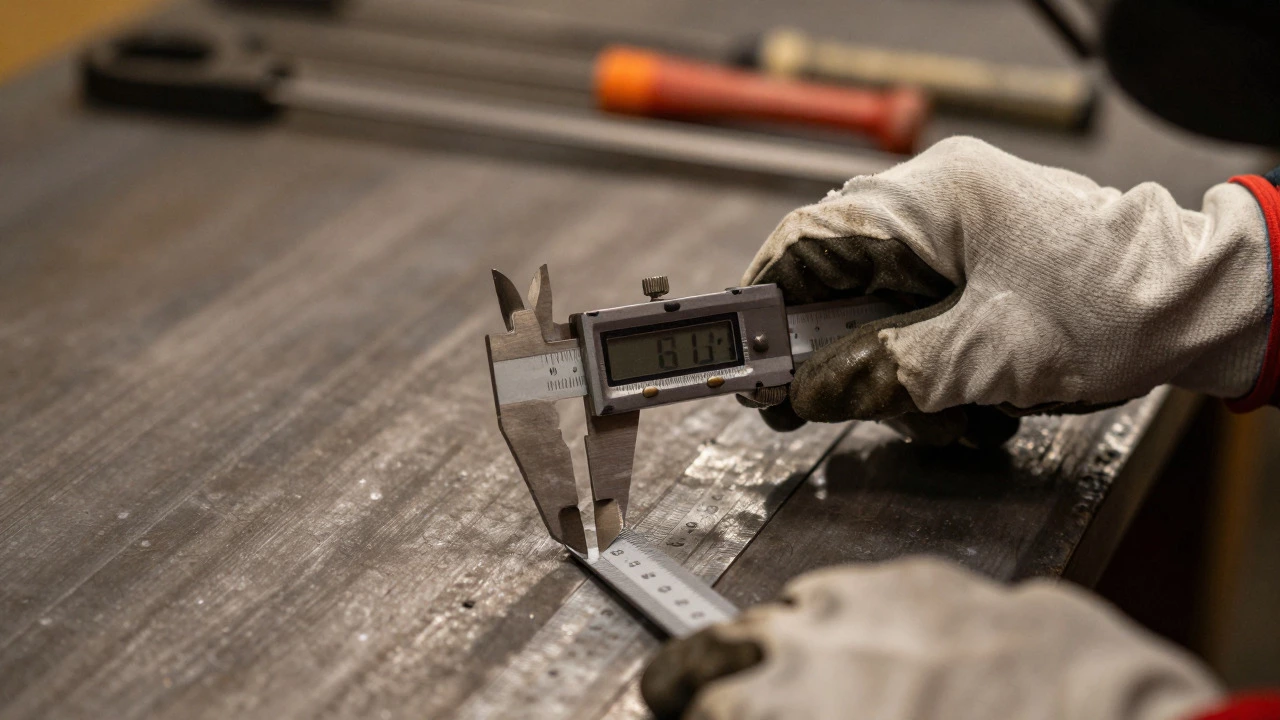
Consider a simple task: cutting a steel plate for a frame. If the frame needs to be 10 feet long but you have two pieces of 6-foot stock, you need to know that 6 + 6 = 12, which gives you 2 feet of scrap. That’s arithmetic. Now, add the kerf-the width of the cut made by the saw blade. If your plasma cutter removes 1/8 inch per cut, and you make four cuts, you lose half an inch total. Ignoring that half-inch might mean your final piece is too short. This is where precision matters more than complex theory.
- Measurement conversion: Switching between inches and millimeters is daily routine in the UK, especially when working with international standards or imported materials.
- Material estimation: Calculating weight based on volume and density to ensure transport limits aren’t exceeded.
- Cost calculation: Figuring out how many electrodes (welding rods) you need for a project to stay within budget.
This level of math is something most people can master quickly. It’s not about being a genius; it’s about being careful. A calculator is your best friend here. In fact, almost every professional welder carries one. There’s no shame in using tools to get the number right.
Geometry: Seeing in Three Dimensions
If arithmetic is the foundation, geometry is the structure. Welding is inherently three-dimensional. You’re often joining pieces of metal at angles that aren’t 90 degrees. This is where trigonometry comes in, but don’t panic. You don’t need to prove theorems; you need to understand shapes.
Imagine you’re building a pyramid-shaped roof support. You need to cut the edges so they fit together perfectly. This involves understanding angles, slopes, and hypotenuses. The Pythagorean theorem ($a^2 + b^2 = c^2$) is incredibly useful here. If you know two sides of a right-angled triangle, you can find the third. This helps you lay out cuts accurately before you even touch the torch.
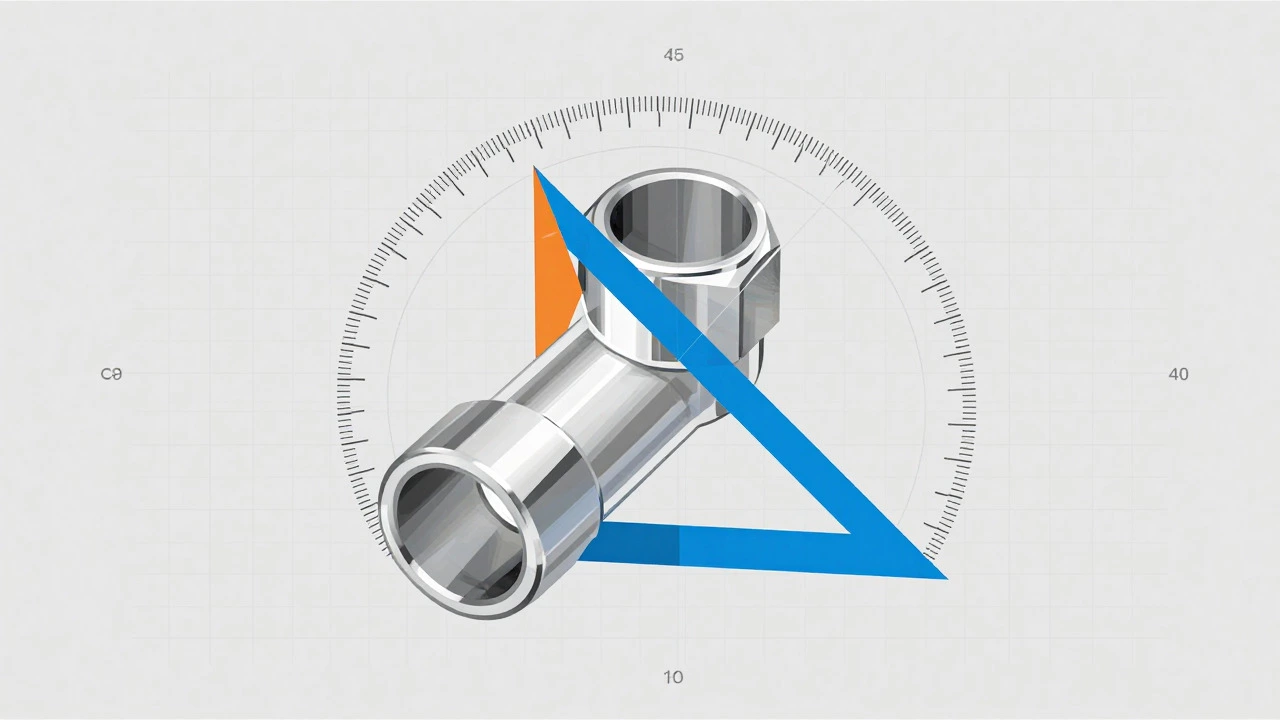
In pipefitting, which is a specialized branch of welding, geometry becomes even more critical. Pipes often meet at odd angles-45 degrees, 30 degrees, or custom bends. You need to visualize how these curves intersect. This skill, called "spatial awareness," is developed through practice and study in vocational training programs. You learn to read blueprints, which are essentially geometric maps of the final product. Understanding symbols for fillet welds, groove welds, and penetration depths is part of this visual language.
| Concept | Application in Welding | Math Level Required |
|---|---|---|
| Angles | Cutting bevels, fitting pipes, creating frames | Basic (Degrees, Protractor use) |
| Area & Volume | Calculating paint coverage, gas usage, metal weight | Intermediate (Formulas for circles, cylinders) |
| Trigonometry | Laying out complex joints, calculating offsets | Advanced (Sine, Cosine, Tangent) |
For most structural welders, knowing how to use a protractor and a speed square is enough. For pipeline welders or aerospace technicians, a deeper grasp of trigonometry is expected. This is why choosing the right welding courses matters. Some programs focus heavily on fabrication layout, while others stick to basic joinery.
Physics and Heat: The Invisible Variables
Welding is fundamentally about heat transfer. You’re melting metal, which changes its physical properties. This introduces elements of physics that feel like math because they involve variables and constants.
Key concepts include:
- Heat Input: Measured in joules per millimeter. Too much heat distorts the metal (warpage); too little results in poor fusion. You adjust voltage, amperage, and travel speed to control this.
- Thermal Expansion: Metal expands when heated and contracts when cooled. If you weld a long beam without accounting for this, it will twist or bow as it cools. Experienced welders sequence their welds to balance this contraction.
- Electrical Resistance: In MIG and TIG welding, electricity flows through the wire or tungsten electrode. Understanding Ohm’s Law (Voltage = Current × Resistance) helps troubleshoot issues like spatter or arc instability.
You don’t need to derive these laws, but you need to understand their effects. For example, if your weld pool looks sluggish, you might increase the voltage. If it’s splattering everywhere, you might decrease it. This trial-and-error process is guided by an intuitive understanding of physics. Over time, you develop a "feel" for the machine, reducing the need for conscious calculation.
Blueprint Reading: The Language of Construction
No welder works in isolation. They follow plans. Blueprints are detailed drawings that specify dimensions, tolerances, and weld types. Reading them is a skill that combines math and logic.
A blueprint might show a symbol indicating a fillet weld with a specific leg length (e.g., 6mm). You need to interpret this symbol and apply it correctly. Tolerances are also crucial. A dimension might be listed as 100mm ± 0.5mm. This means the final measurement must be between 99.5mm and 100.5mm. Missing this detail could cause parts to not fit together.
In the UK, standards like BS EN ISO 15607 define welding procedures. Understanding these codes requires attention to detail and the ability to cross-reference specifications. It’s less about solving equations and more about following precise instructions. This is a key part of any reputable NVQ Courses or apprenticeship program.
Does Math Matter for Career Progression?
If you’re happy sticking to simple straight seams, basic math is sufficient. But if you want to advance to roles like Welding Inspector, Engineer, or Fabrication Supervisor, your math skills need to grow.
Inspectors use non-destructive testing methods that involve statistical analysis. Engineers design structures that require load calculations and stress analysis. Supervisors manage budgets and schedules, requiring cost-benefit analysis. These roles demand a higher level of numeracy and technical knowledge.
Many employers value problem-solving abilities over raw math talent. Can you figure out why a joint cracked? Can you optimize a process to save time? These questions require logical thinking, which is closely related to mathematical reasoning. So, while you might not be writing equations, you are thinking like an engineer.
Do I need algebra for welding?
Not really. Basic algebra helps with understanding formulas for heat input or material strength, but most day-to-day tasks rely on arithmetic and geometry. You’ll rarely solve for 'x' on a construction site.
Is welding harder than plumbing math-wise?
Plumbing often involves more complex fluid dynamics and pressure calculations, especially in large systems. Welding focuses more on geometry and material properties. Both require strong math skills, but the application differs.
Can I learn welding if I’m bad at math?
Yes. Many successful welders weren’t math whizzes in school. The key is willingness to learn the specific calculations needed for the job. Practice makes perfect, and calculators help bridge the gap.
What math topics should I review before starting welding courses?
Focus on fractions, decimals, percentages, basic geometry (angles, areas, volumes), and unit conversions. Familiarity with reading scales and using measuring tools is also essential.
How important is trigonometry in welding?
It depends on your specialization. Structural welding uses minimal trigonometry. Pipefitting and aerospace welding require a solid understanding of sine, cosine, and tangent for accurate layout and fitting.

Write a comment