
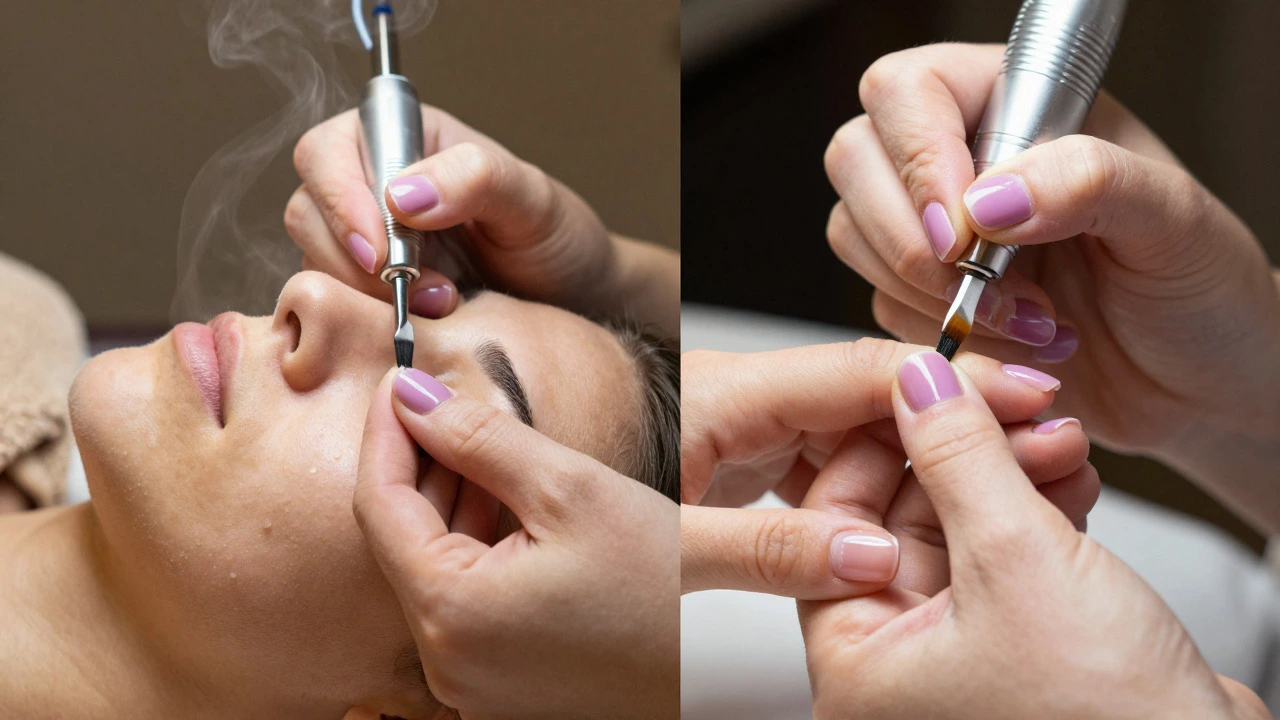
Esthetician vs Nail Tech: Career Fit Finder
This tool helps you weigh the key differences between these two salon careers. Answer each question honestly to see which path aligns best with you.
Why this result?
You’re standing in front of a mirror, wondering which career will actually make you happy. Do you want to spend hours perfecting the structure of a gel overlay, or do you prefer analyzing skin types and recommending serums? The choice between becoming an esthetician is a licensed professional who specializes in non-invasive skin care treatments, including facials, peels, and waxing. and a nail technician is a specialist trained in manicures, pedicures, and artificial nail applications using acrylics or gels. isn't just about aesthetics; it’s about your daily routine, your physical health, and your long-term earning potential.
Many people assume these roles are interchangeable because they both happen in a salon chair. But if you’ve ever tried to explain why you hate the smell of acetone but love the feel of warm towels, you know they are vastly different jobs. One focuses on the integumentary system’s surface (skin), while the other focuses on keratin structures (nails). Let’s break down exactly what separates these two paths so you can pick the one that fits your lifestyle.
Key Takeaways
- Estheticians focus on facial skin health, requiring deep knowledge of anatomy, chemistry, and skin conditions.
- Nail technicians focus on hand and foot care, requiring precision artistry and strong fine motor skills.
- Esthetics training typically takes longer (600+ hours) compared to nail tech programs (150-300 hours).
- Nail techs often earn more per hour due to product sales and faster service turnaround times.
- Both careers require ongoing education to keep up with new trends and regulations.
The Core Difference: Skin vs. Nails
At its heart, the difference lies in the material you are working with. An esthetician deals with living tissue that changes daily based on hormones, weather, and diet. A nail technician works with hard, inert plates that grow slowly and don’t react to your mood. This fundamental difference dictates everything from your tools to your client interactions.
When you sit down as an esthetician, your first step is usually a consultation. You ask about their sleep, their stress levels, and their current skincare routine. You might spot early signs of rosacea or hyperpigmentation. Your job is to treat the face as a canvas for health. In contrast, when a client sits for a nail appointment, the conversation is often about color preferences, shape, and design. While nail techs also check for fungal infections or ingrown nails, the primary goal is cosmetic enhancement rather than medical-grade skin analysis.
| Feature | Esthetician | Nail Technician |
|---|---|---|
| Primary Focus | Facial skin health & appearance | Hand & foot nail care |
| Typical Tools | Ultrasonic spatulas, steamers, microdermabrasion devices | E-files, drills, UV lamps, cuticle nippers |
| Training Duration | 600-1,200 hours | 150-300 hours |
| Physical Demand | Moderate (standing, arm fatigue) | High (repetitive strain, chemical exposure) |
| Average Hourly Wage (UK) | £12 - £18 | £10 - £15 + commission |
Training Pathways and Qualifications
If you’re in the UK, you’ll likely look at NVQ (National Vocational Qualification) levels for both professions. However, the depth of study varies significantly. An esthetics course usually requires an NVQ Level 2 or 3 in Beauty Therapy, with a specific focus on facial treatments. You’ll spend weeks studying the layers of the epidermis, dermis, and subcutaneous tissue. You need to understand pH levels, active ingredients like retinol and vitamin C, and how to perform extractions safely.
Nail technology, on the other hand, is often covered within broader beauty diplomas or as a standalone short course. The curriculum focuses heavily on sanitation, cuticle care, and the mechanics of applying extensions. You’ll learn about monomer liquid and polymer powder reactions, or how to cure gel systems under UV light. Because the scope is narrower, you can qualify faster, but you also have less room for error. A cracked acrylic set needs immediate fixing; a mild skin irritation can be managed with aftercare advice.
It’s worth noting that many salons prefer candidates who hold a full NVQ Level 3 in Beauty Therapy, even if they only plan to do nails. This shows you understand general hygiene and client care standards. If you’re starting from zero, look for colleges in Bristol or nearby areas that offer modular units. This allows you to try facial modules before committing to the full esthetics track.
Day-to-Day Life in the Salon
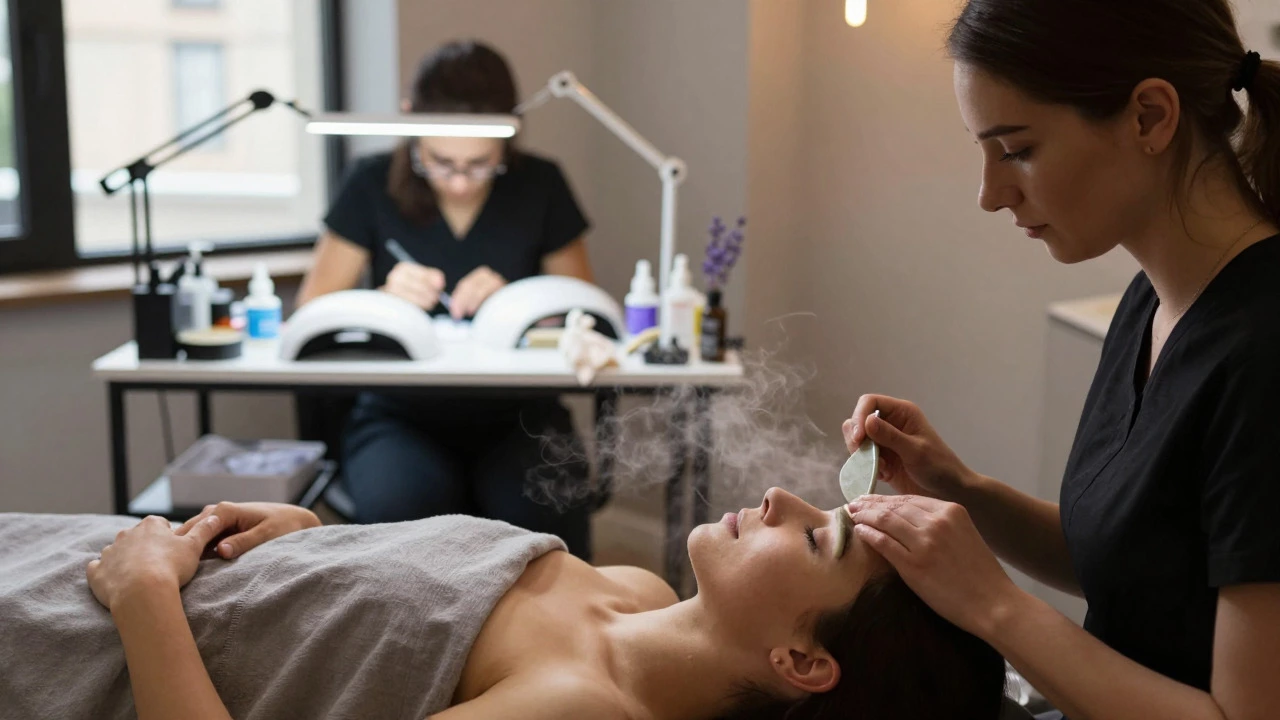
Imagine a typical Tuesday afternoon. As an esthetician, you’re performing a deep cleansing facial. You’re steaming the face, mapping out pores, and using a gua sha stone to de-puff the cheeks. The environment is quiet, smelling of eucalyptus and lavender. Your clients are often relaxed, maybe even falling asleep. It’s a calm, meditative process. Your hands move gently, focusing on pressure points and lymphatic drainage.
Now switch to the nail station. The air is filled with the whir of electric files and the sharp scent of acetone. You’re hunched over a small area, using a 0.5mm brush to apply gel polish. Precision is key here. If you get product on the cuticle, it lifts and looks messy. Your wrists are bent at awkward angles for hours. The pace is faster; you might see six to eight clients in a day compared to three to four for facials. It’s a high-energy, detail-oriented role that demands steady hands and quick decision-making.
Earning Potential and Career Growth
Money matters, right? In the UK, entry-level salaries for both roles hover around the national minimum wage or slightly above. However, the trajectory differs. Estheticians often command higher hourly rates for specialized treatments like LED light therapy or microneedling. These add-ons increase the ticket price without taking much extra time. Plus, estheticians sell high-margin skincare products. If you recommend a £40 serum and the client buys it, you might earn a 10-20% commission.
Nail technicians rely heavily on volume and product sales. Gel fills and enhancements take time, but the turnover is high. Many nail techs work on a commission-only basis, especially in independent salons. If you’re fast and efficient, you can earn more than a salaried esthetician. However, burnout is a real risk. The repetitive nature of filing and painting can lead to carpal tunnel syndrome if you don’t take breaks. Estheticians also face physical strain, particularly in the shoulders and back, but it’s less repetitive than the fine motor work of nail art.
For long-term growth, estheticians can pivot into clinical settings, such as working in dermatology clinics or plastic surgery recovery centers. They can also become educators or open their own spa suites. Nail technicians can specialize in luxury nail art, bridal services, or mobile home visits. Both paths allow for entrepreneurship, but the initial investment for a dedicated esthetics suite (with machines and lighting) is higher than a basic nail station.
Which Role Fits Your Personality?
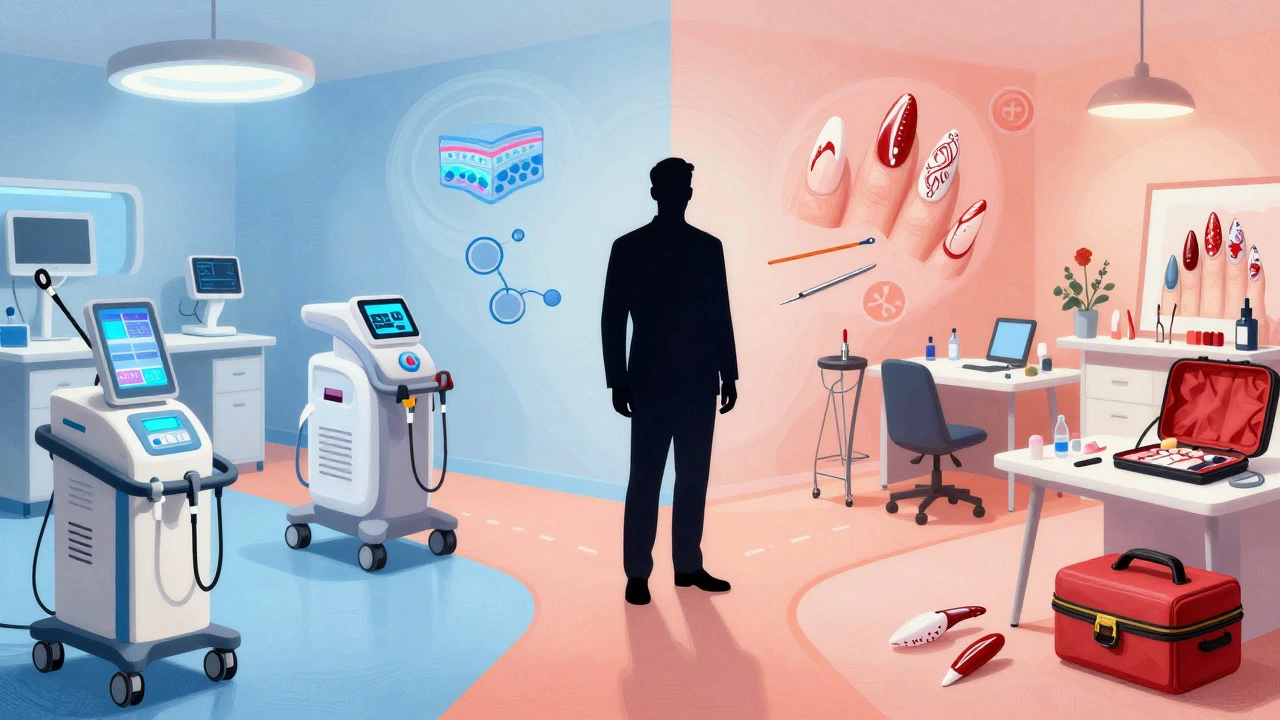
Be honest with yourself. Do you enjoy science and problem-solving? If you like figuring out why someone’s skin is breaking out and creating a custom treatment plan, esthetics is your lane. It appeals to those who are analytical, patient, and interested in biology.
Do you enjoy art and creativity? If you love mixing colors, creating intricate designs, and seeing a tangible transformation in a short time, nail tech might be better. It appeals to those who are artistic, detail-oriented, and comfortable with fast-paced environments.
Consider your physical limits too. If you have existing wrist issues or poor eyesight, the intense close-up work of nail tech could be exhausting. If you dislike the smell of chemicals, the constant exposure to formaldehyde and toluene in nail products might bother you more than the natural oils used in esthetics.
Frequently Asked Questions
Can I work as both an esthetician and a nail technician?
Yes, many professionals do both. It’s called being a multi-skilled beauty therapist. This increases your value to employers because you can cover more stations. However, you need to ensure you have separate qualifications for each specialty to stay compliant with local regulations.
Which career has better job security in the UK?
Both are resilient to economic downturns because they are considered discretionary but essential self-care. However, esthetics tends to have slightly higher retention rates because clients build long-term relationships with their facialist. Nail clients may switch providers more easily if prices change or styles trend differently.
How long does it take to get qualified in Bristol?
In Bristol, most colleges offer part-time evening classes. An NVQ Level 2 in Beauty Therapy takes about 1-2 years part-time. Full-time intensive courses can be completed in 6-9 months. Check with local providers like City College Bristol or private academies for current timetables.
Is nail tech harder to learn than esthetics?
Not necessarily. Esthetics requires more theoretical knowledge about skin science. Nail tech requires more manual dexterity and speed. If you have good hand-eye coordination, nail tech feels easier physically. If you enjoy reading and understanding biological processes, esthetics feels more natural mentally.
What are the health risks for each profession?
Nail techs face higher risks of respiratory irritation from dust and fumes, plus repetitive strain injuries. Estheticians face lower chemical risks but must be careful with electrical equipment and hot steam. Both need to practice strict hygiene to prevent cross-contamination among clients.



Write a comment