
Welding Math Anxiety Checker
Select a common welding task below to see exactly what kind of "math" is involved. This tool demonstrates that most entry-level welding requires only basic numeracy, not advanced algebra.
Production Welding
You will mostly follow visual guides and set machine parameters based on simple instructions provided by supervisors or procedure sheets. No calculations are typically performed by hand.
Key Takeaway from the Article:
Most successful welders thrive without solving quadratic equations. If you can read a tape measure and follow a recipe, you have the foundational numeracy needed for most entry-level jobs. Use tools like digital calipers and smartphone apps to handle complex conversions.
You’ve seen the sparks fly, heard the hum of the arc, and maybe even tried your hand at holding a torch steady. But there’s one thing standing between you and that shiny new welding certificate: the fear of numbers. You’re thinking, "I struggled with algebra in school, so how can I possibly calculate heat inputs or measure precise angles?" It’s a common worry, but here is the truth: being bad at math doesn’t disqualify you from becoming a skilled welder. In fact, many successful tradespeople thrive without ever needing to solve a quadratic equation.
The reality of modern welding is less about abstract mathematics and more about practical application, spatial awareness, and muscle memory. While you do need to understand basic measurements, the kind of math required is far simpler than what you might imagine. This guide breaks down exactly what mathematical skills are necessary, where they apply on the job, and how you can succeed in welding courses even if you consider yourself a "math person's nightmare."
The Myth of the Mathematical Welder
There is a persistent myth that welding is an engineering discipline requiring advanced calculus. That’s not quite right. Welding sits firmly in the category of skilled trades, which prioritize precision and consistency over theoretical complexity. When you look at the daily tasks of a structural welder or a pipe fitter, the calculations involved are almost entirely arithmetic-based. We are talking about addition, subtraction, multiplication, and division-mostly involving whole numbers or simple decimals.
Think about it this way: if you can follow a recipe, split a bill among friends, or estimate how much paint you need for a room, you already possess the foundational numeracy needed for most entry-level welding jobs. The difference is that in welding, accuracy matters more than speed. You aren’t solving problems under a ticking clock like in a classroom exam; you have time to measure twice before you cut once.
What Math Do You Actually Use?
To put your mind at ease, let’s look at the specific scenarios where numbers enter the picture. You won’t be deriving formulas. Instead, you will be reading tools and following instructions.
Measurement and Geometry: This is the biggest chunk of "math" you’ll encounter. You need to read tape measures accurately, often down to fractions of an inch or millimeters. If you are working with steel plates, you might need to calculate the area to determine material costs, but usually, the blueprint tells you the dimensions. Understanding basic shapes-circles, squares, triangles-is crucial for fitting parts together, but you don’t need to know the Pythagorean theorem by heart unless you are doing complex layout work, and even then, templates often do the heavy lifting.
Unit Conversion: Depending on where you work, you might switch between imperial (inches, feet) and metric (millimeters, meters) systems. This isn’t hard math; it’s just knowing that 1 inch equals 25.4 millimeters. Most digital calipers and modern measuring tapes have both scales printed on them, eliminating the need for mental conversion.
Welding Parameters: Here is where people get nervous. Amperage, voltage, and travel speed. Do you need to calculate these from scratch? Rarely. For most production welding, these settings are listed on a Procedure Qualification Record (PQR) or a Work Instruction sheet. Your job is to dial in the machine to match the specified numbers. If the sheet says 180 amps, you set the knob to 180. It’s data entry, not calculus.
Where Math Might Trip You Up
While the core work is manageable, there are specific areas where a lack of comfort with numbers can cause friction. Knowing these pitfalls helps you prepare rather than panic.
- Reading Blueprints: Blueprints use scale drawings. If a drawing says "1:10," every unit on the paper represents ten units in real life. If you struggle with ratios, this can be confusing initially. However, most junior welders start with full-scale drawings or direct measurement tasks until they build confidence.
- Heat Input Calculations: For specialized roles, like welding stainless steel for pharmaceutical pipes, you might need to calculate heat input using the formula: Heat Input = (Voltage × Current × 60) / Travel Speed. This looks intimidating, but it is straightforward multiplication and division. Many welders use smartphone apps that perform this calculation for them after entering three numbers.
- Fabrication Layout: If you move into fabrication rather than pure welding, you might need to mark out complex joints. This involves adding lengths together and subtracting for weld shrinkage. Again, this is basic arithmetic, but it requires attention to detail.
Tools That Do the Math for You
Technology has changed the game. You are no longer expected to carry a slide rule in your pocket. Modern workshops are equipped with tools that reduce the cognitive load of numerical tasks.
| Tool | Function | Math Skill Required | Assistance Available |
|---|---|---|---|
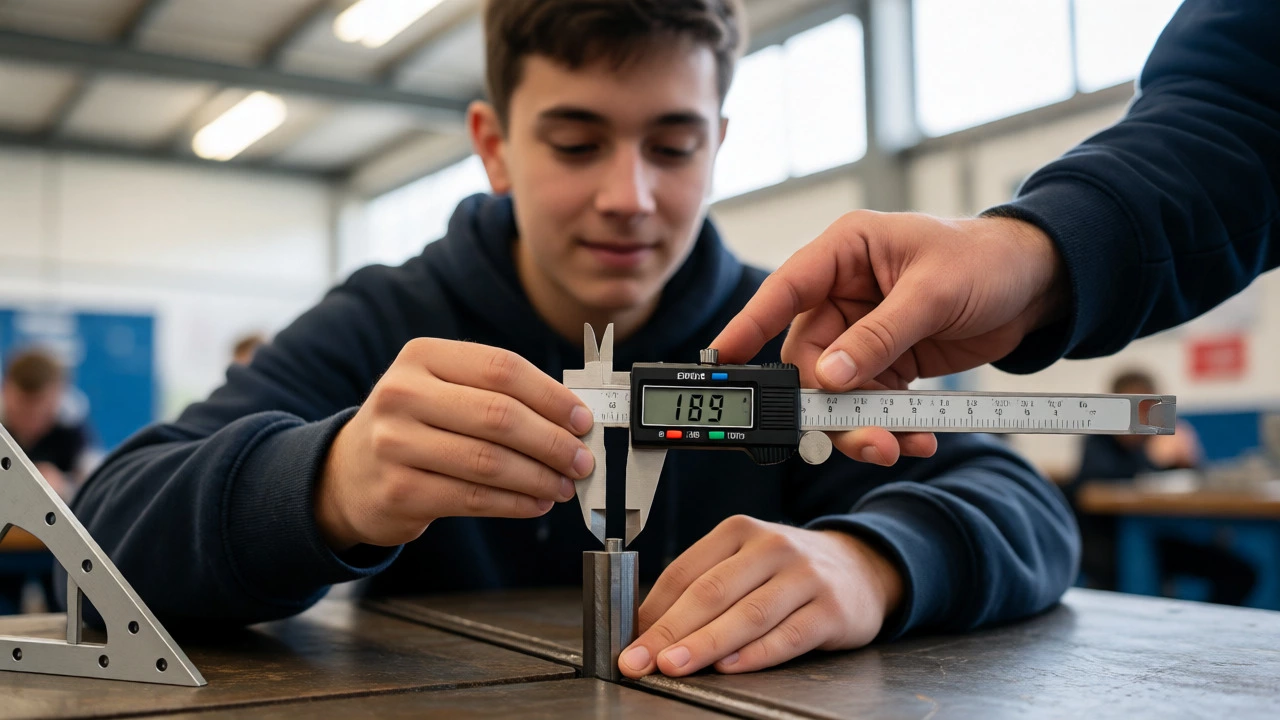
| Digital Calipers | Measuring thickness and gaps | Reading decimal points | Auto-switch between mm/inch |
| Tape Measure | Marking cut lines | Reading fractions | Magnetic hooks for solo work |
| Angle Grinder | Beveling edges | Estimating angles | Magnetic angle guides |
| Welding Machine | Setting power levels | Matching target numbers | Digital displays with presets |
| Smartphone Apps | Heat input & weight calc | Data entry only | Automated results |
As you can see, the reliance on manual calculation is low. The emphasis shifts to tool proficiency. If you can learn to operate a digital caliper, you can handle the measurement aspect of welding regardless of your academic history with math.
How Welding Courses Handle Math Anxiety
If you enroll in a vocational training program, such as an NVQ in Welding Skills, the curriculum is designed for learners who may not have strong academic backgrounds. Instructors know that many students come from diverse educational histories. They typically introduce math concepts gradually and in context.
For example, instead of teaching you geometry in isolation, an instructor will show you how to measure a joint gap. If you make a mistake, the consequence is immediate and visual-a bad weld-rather than a red mark on a test paper. This practical feedback loop helps cement understanding faster than abstract lectures.
Furthermore, many colleges offer support services specifically for numeracy. Tutors are accustomed to helping students who feel rusty with basics. Don’t hesitate to ask for clarification. Asking "How do I read this fraction?" is better than guessing and ruining a piece of expensive steel.
Career Progression and Advanced Roles
Does avoiding math limit your career growth? Not necessarily, but it does define your path. Entry-level production welding, where you repeat the same welds on assembly lines, requires minimal math. You become highly paid through skill, speed, and reliability.
However, if you aim to become a Certified Welding Inspector (CWI) or a Welding Engineer, the mathematical demands increase. Inspectors need to verify tolerances strictly, and engineers design structures based on stress loads. But remember, these are long-term goals. You don’t need to be good at math today to start your career tomorrow. You can develop those skills over years of experience, often picking up the necessary numeracy naturally as you take on more responsibility.
Practical Tips for the Math-Averse Welder
If you are ready to sign up for a course but still feel anxious, here are some actionable strategies to keep you confident.
- Master Your Tape Measure: Buy a decent 5-meter tape measure and practice reading it daily. Measure things around your house. Get comfortable seeing where 3/8ths of an inch falls next to 9mm.
- Use Visual Aids: Keep a small cheat sheet in your toolbox. Write down common conversions or standard weld sizes. There is no shame in referring to notes.
- Embrace Technology: Download a free welding calculator app. Practice using it to check weights of steel bars or heat inputs. Seeing the numbers processed for you builds trust in the process.
- Focus on Consistency: Welding is largely about motor skills. Spend your extra energy practicing your hand-eye coordination. A steady hand beats a quick calculator every time in the shop.
- Ask Questions Early: During your training, if a concept involves numbers, ask the instructor to demonstrate it physically. Seeing a 10-degree bevel made is easier to grasp than calculating tan(10).
Final Thoughts: Skills Over Sums
So, can you be a welder if you’re bad at math? Absolutely. The industry values precision, patience, and safety above all else. While you need basic numeracy, the level of difficulty is comparable to everyday life tasks. With the right tools, supportive training, and a willingness to learn, you can build a lucrative and satisfying career in welding without ever fearing a spreadsheet again.
Do I need GCSE maths to become a welder?
No, you do not strictly need a high grade in GCSE Maths to start vocational welding courses. Most entry-level NVQ or BTEC programs require basic functional skills in English and Maths, which focus on practical applications like reading measurements and following instructions rather than advanced algebra.
Is welding harder than other trades because of math?
Generally, no. Compared to electrical work or plumbing, which involve complex circuit diagrams or flow rates, welding relies more on physical dexterity and visual inspection. The math in welding is mostly linear and predictable, making it accessible for those who prefer hands-on learning.
What happens if I mismeasure a part?
In professional settings, a mismeasurement leads to rework or scrapped material. This is why "measure twice, cut once" is the golden rule. Using jigs, fixtures, and digital tools helps minimize human error. Mistakes are part of the learning curve, and employers expect trainees to learn from them.
Can I use a calculator at work?
Yes, absolutely. Most workshops allow calculators or smartphones for quick computations. In fact, using a calculator reduces errors compared to mental math. As long as you understand what the numbers mean, the method of calculation is irrelevant.
Are there welding jobs that require zero math?
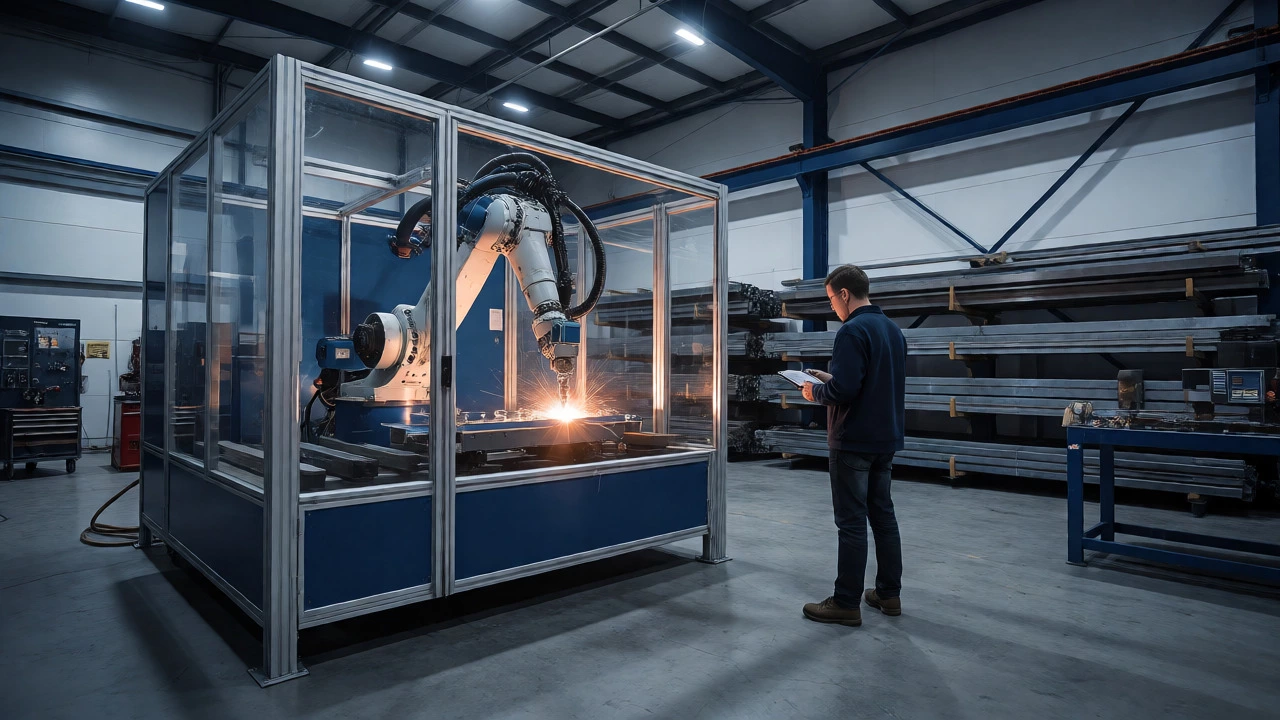
Very few jobs require literally zero interaction with numbers, but automated welding operations require the least. If you operate robotic welding cells, the robot handles the parameters, and your role focuses on loading parts and monitoring quality, minimizing direct calculation needs.



Write a comment