

Certification Salary Estimator
Not all online certifications are created equal. Some will get you a $50 bonus on your next paycheck. Others? They can land you a six-figure salary with no degree required. If you’re wondering which online certs actually move the needle on your income, you’re not alone. Thousands of people are asking the same question in 2026-and the answers might surprise you.
Cloud certifications dominate the top earners
If you want to make serious money with an online certification, start with cloud computing. The top three highest-paying certs in 2026 all come from Amazon Web Services (AWS), Microsoft Azure, or Google Cloud. Why? Because every company, from startups to banks to hospitals, is moving its data and apps to the cloud. And they’re desperate for people who know how to build and secure it.
The AWS Certified Solutions Architect - Professional consistently ranks as the highest-paid cert globally. Professionals with this credential earn an average of $142,000 per year in the U.S., and even more in London and Zurich. It’s not easy to get. You need at least two years of hands-on experience designing complex cloud systems. But if you’ve got the skills, this one cert can double your salary overnight.
Microsoft Azure’s AZ-305: Designing Microsoft Azure Infrastructure Solutions isn’t far behind. It’s the go-to for enterprises still running Windows Server and SQL Server but shifting to the cloud. In the UK, Azure-certified engineers make between £85,000 and £110,000 annually. Google Cloud’s Professional Cloud Architect rounds out the top three. It’s slightly less common in the UK market, but demand is growing fast-especially in fintech and healthcare.
Cybersecurity certs are the safety net for your career
Every year, cyberattacks cost businesses over $10 trillion globally. And every year, companies scramble to hire people who can stop them. That’s why cybersecurity certifications pay so well-even if they’re not cloud-based.
The Certified Information Systems Security Professional (CISSP) is still the gold standard. It’s not online-only, but you can prepare for it entirely online. The exam covers eight domains: security architecture, risk management, identity management, and more. CISSP holders in the UK earn an average of £95,000. In London, top roles pay over £120,000. The catch? You need five years of experience in two of those domains. But if you’re already working in IT, you’ve probably got more than half of that covered.
For those just starting out, the CompTIA Security+ is the best entry point. It’s cheaper, easier, and accepted by 90% of UK employers. After you get it, you can move up to the Certified Ethical Hacker (CEH) or the Offensive Security Certified Professional (OSCP). OSCP is brutal-only 30% pass on the first try-but those who do make £100,000+ working as penetration testers for banks and government agencies.
Specialized data and AI certs are the new wild card
Five years ago, data science certs were a nice-to-have. Today, they’re a requirement for anyone who wants to work with AI, automation, or big data. The top earners here aren’t the ones who know how to run Python scripts. They’re the ones who can build and deploy machine learning models at scale.
Google’s Professional Machine Learning Engineer cert is now one of the fastest-growing high-paying credentials. It tests your ability to design, build, and operationalize ML models using Google Cloud’s Vertex AI platform. Salaries for certified professionals in London start at £90,000 and go up from there. IBM’s Data Science Professional Certificate on Coursera is more beginner-friendly, but doesn’t pay as much. It’s a stepping stone, not a finish line.
Another rising star: the NVIDIA Certified Associate in AI and Data Science. It’s new in 2025, but companies like DeepMind and NHS Digital are already hiring for it. Why? Because NVIDIA’s GPUs power 80% of enterprise AI workloads. If you know how to train models on their hardware, you’re in high demand.

Network and infrastructure certs still matter
Don’t write off traditional IT infrastructure just because the cloud is hot. Companies still need people who can manage on-premises servers, hybrid networks, and legacy systems. The Cisco Certified Internetwork Expert (CCIE) remains one of the toughest and most respected certs in networking. Fewer than 5,000 people worldwide hold it. In the UK, CCIE-certified engineers earn between £90,000 and £130,000.
For a faster route, try the CompTIA Network+ or the Juniper Networks Certified Associate (JNCIA). These are cheaper, take less time, and open doors to roles in telecom, education, and public sector IT. You won’t make six figures right away, but you’ll get steady raises and real job security.
What certifications don’t pay well anymore?
Not every online cert is worth the time. Some have lost value as the market changed. The Microsoft Office Specialist (MOS) cert? It used to be a resume booster. Now, it’s seen as basic. Employers assume you know Excel. Paying for it? Not worth it unless you’re applying for a data entry job.
Entry-level ITIL certifications? They’re fading. ITIL Foundation is still taught in colleges, but most companies now use DevOps or Agile frameworks instead. The same goes for old-school CompTIA A+-it’s great for help desk roles, but it won’t get you past the first interview for a cloud or security job.
And avoid any certification that says “guaranteed job” or “earn $100k in 30 days.” Those are marketing traps. Real certifications require work. They require practice. They require you to understand the underlying tech-not just memorize flashcards.
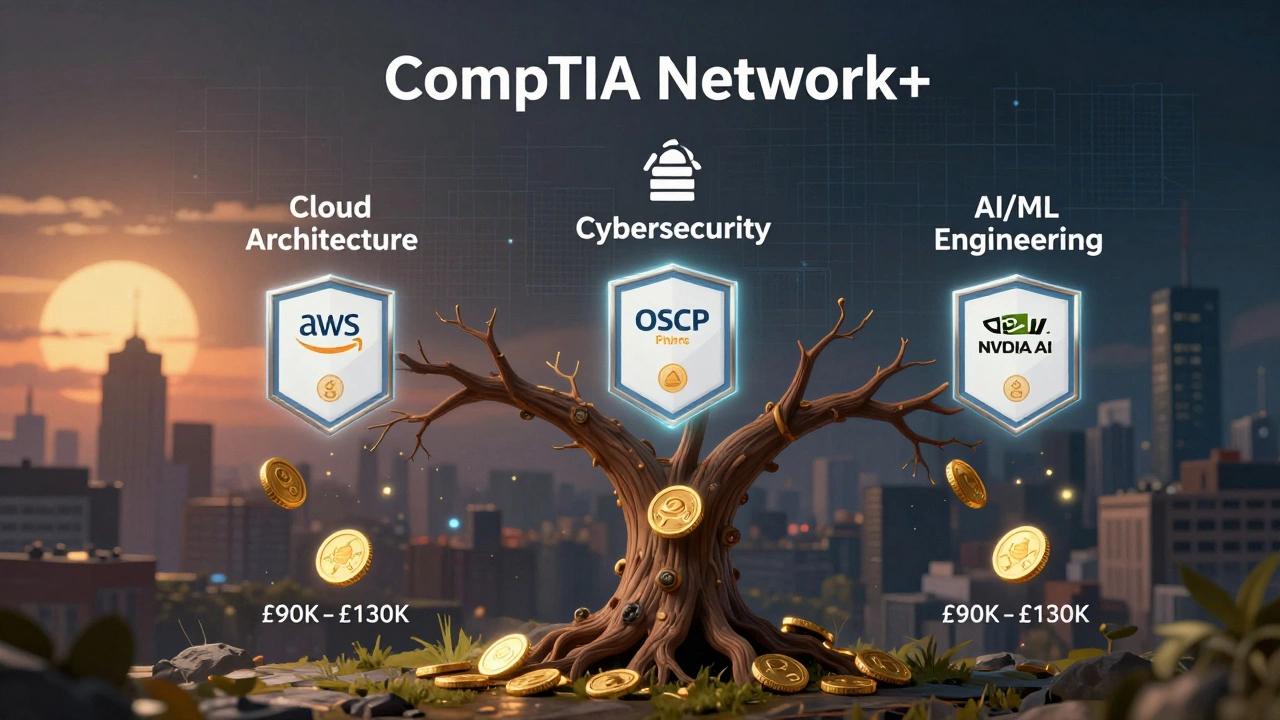
How to choose the right one for you
Don’t just chase the highest salary. Ask yourself: What do you actually enjoy doing?
- If you like building things → Go for cloud architecture.
- If you like breaking things (legally) → Try cybersecurity.
- If you like numbers and patterns → Dive into data and AI.
- If you like fixing networks and hardware → Stick with infrastructure.
Also consider your current job. If you’re already in IT support, start with CompTIA Security+ or Network+. If you’re in marketing and want to switch, try Google’s Data Analytics Certificate-it’s designed for career changers and leads to roles in analytics and BI.
Most importantly: get hands-on. You can’t learn cloud security by watching videos. You need to spin up a real AWS instance. Break it. Fix it. Do it again. Free tiers from AWS, Azure, and Google Cloud let you practice without spending a penny.
Real-world example: Sarah’s journey
Sarah worked in customer service at a bank in Bristol. She made £26,000 a year. She took a free course on cybersecurity basics from Cybrary. Then she studied for CompTIA Security+ for six months. She passed. Her boss noticed. She moved to the IT team. Two years later, she earned her CISSP. Today, she’s a security analyst at a fintech startup, making £88,000. No degree. Just certs and grit.
Bottom line
The highest-paying online certifications in 2026 aren’t magic. They’re tools. And like any tool, they only work if you know how to use them. Cloud, cybersecurity, and AI are the big three. Pick one that matches your interests, invest the time, practice relentlessly, and you won’t just earn more-you’ll build a career that can’t be outsourced or automated.
Are online certifications respected by employers?
Yes, but only if they’re from reputable providers like AWS, Microsoft, Google, CompTIA, or (ISC)². Employers don’t care if you took the course online-they care if you passed a tough, proctored exam and can prove you know the material. A certification from a recognized vendor signals you’ve met industry standards.
Do I need a degree to get a high-paying certification?
No. Most top-paying IT certifications don’t require a degree. What they do require is experience. For example, the CISSP asks for five years of work experience in two domains. But if you don’t have that yet, you can start with entry-level certs like Security+ and build up. Many people land six-figure jobs with just certs and hands-on practice.
How long does it take to earn a high-paying certification?
It varies. Entry-level certs like Security+ or Network+ can be done in 2-4 months with 10-15 hours a week. Advanced certs like AWS Professional or CISSP take 6-12 months, especially if you’re working full-time. The key isn’t speed-it’s depth. Rushing through material won’t help you pass the exam or land the job.
Can I get these certifications for free?
You can learn for free using YouTube, freeCodeCamp, or official vendor labs. But the exams themselves cost money. AWS exams start at $300, CISSP is $749, and OSCP is $1,499. Some employers pay for them. If you’re employed, ask if your company has a training budget. Otherwise, treat it as an investment-most people recoup the cost within the first month of their new salary.
Which certification should I get first?
If you’re new to IT, start with CompTIA Security+ or Google’s Data Analytics Certificate. They’re beginner-friendly, widely recognized, and open doors to entry-level roles. If you already work in IT, pick the cert that aligns with your goals: cloud if you want to build systems, cybersecurity if you want to protect them, or AI if you want to work with machine learning. Don’t chase the highest salary-chase the path that excites you.



Write a comment