

UK Qualification Level Explorer
Basic knowledge and simple tasks.
Common Examples:
- • Entry Level Diplomas
- • Basic customer service certificates
Typical Career Stage:
Entry-level roles, basic assistance, or initial training positions.
You’ve just finished your course. You have a piece of paper in your hand that says “Certificate.” But when you look at job descriptions, they ask for an “NVQ Level 3” or “Level 4.” You’re left wondering: what level is my certificate? The short answer is that a certificate doesn’t have a single fixed level. It can be anything from entry-level to master’s degree equivalent, depending on the subject and the awarding body.
This confusion happens because "certificate" is just a type of award, not a measure of difficulty. In the UK, we use the Regulated Qualifications Framework (RQF), which replaced the old National Qualifications Framework (NQF) in 2015, to standardize this. This framework assigns a numeric level to every qualification, telling employers exactly how hard it was to get and what skills you possess.
If you are trying to map your existing certificates to NVQ levels-or figure out which NVQ you should take next-you need to understand how these levels work. I’ll break down what each level means, how to find the level on your specific certificate, and why this matters for your career in Bristol and beyond. By the way, if you ever need to verify credentials or look up professional directories while managing your career logistics, resources like this directory can sometimes offer structured ways to navigate verified listings, though our focus here remains strictly on educational standards.
How the RQF Levels Work
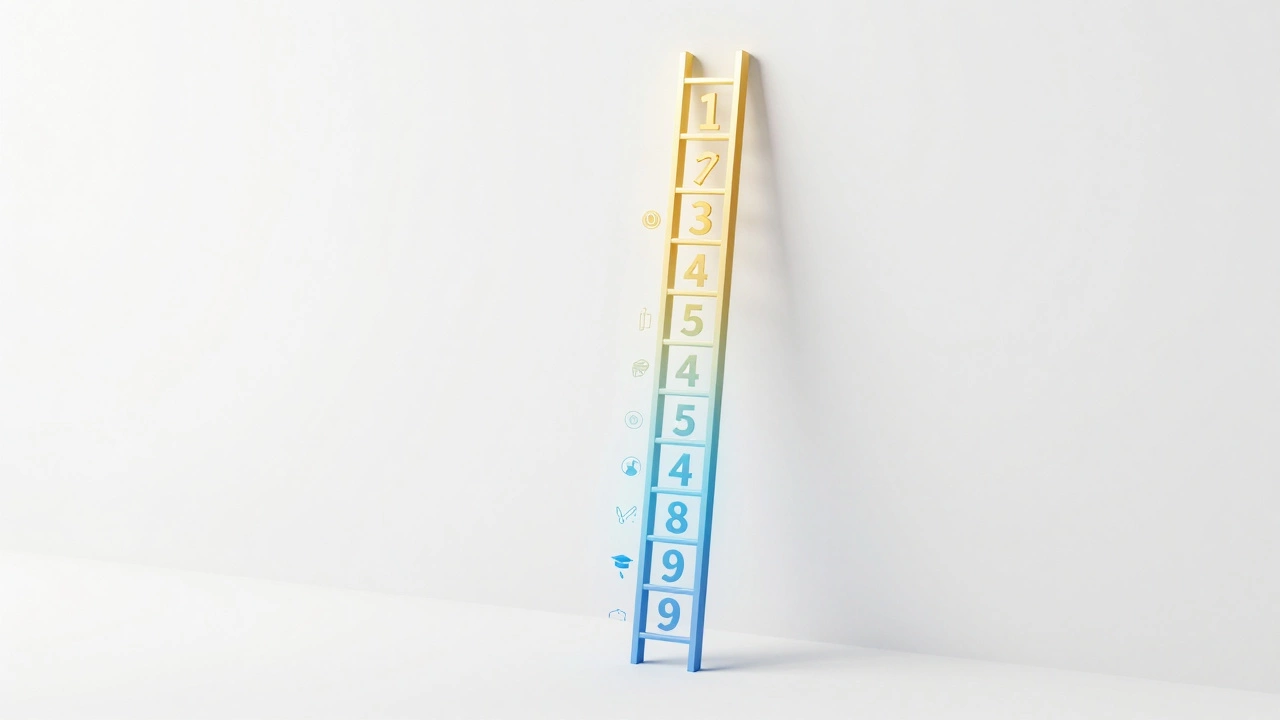
The Regulated Qualifications Framework divides all UK qualifications into nine levels. Think of it as a ladder. Level 1 is the bottom rung, and Level 9 is the top. An NVQ (National Vocational Qualification) sits within this same ladder. So, an NVQ Level 3 is broadly equivalent to A-Levels or an Advanced Diploma in terms of complexity and time commitment.
Here is what each level actually looks like in practice:
- Level 1: Basic knowledge and simple tasks. Equivalent to GCSEs graded D-G (or 1-3). Examples include Entry Level Diplomas or basic customer service certificates.
- Level 2: Intermediate knowledge. Equivalent to GCSEs graded A*-C (or 4-9). This is where most apprenticeships start. Examples include NVQ Level 2 in Health and Social Care or IT User Skills.
- Level 3: Broad knowledge and complex skills. Equivalent to A-Levels. This is often the minimum requirement for supervisory roles. Examples include NVQ Level 3 in Construction or Business Administration.
- Level 4: Specialized knowledge. Equivalent to the first year of a university degree (Certificate of Higher Education). Many senior technical roles require this.
- Level 5: Advanced specialized knowledge. Equivalent to the second year of a degree (Diploma of Higher Education) or a Foundation Degree.
- Level 6: Comprehensive knowledge. Equivalent to a full Bachelor’s degree with Honours.
- Level 7: Strategic management and innovation. Equivalent to a Master’s degree.
- Level 8: Cutting-edge knowledge. Equivalent to a PhD or doctorate.
- Level 9: Research leadership. Very rare, usually reserved for high-level academic research roles.
When someone asks “what level is your certificate?”, they are asking where it falls on this list. A “City & Guilds Certificate” could be Level 2, 3, or even 4. You cannot tell by the word “certificate” alone.
Finding the Level on Your Certificate
You don’t need to guess. Every regulated qualification in England, Wales, and Northern Ireland must display its RQF level clearly. Here is how to find it:
- Check the Physical Document: Look at the actual certificate or the digital PDF. There should be a section labeled “Qualification Level” or “RQF Level.” It will say something like “Level 3” or “Level 4.”
- Look for the Awarding Body Logo: Organizations like Pearson Edexcel, City & Guilds, NCFE, and BTEC issue certificates. Their logos are usually accompanied by the qualification title and level.
- Use the National Archives Register: If your certificate is old or unclear, go to the [National Archives’ Register of Regulated Qualifications](https://www.gov.uk). Search by the qualification name. The register will show you the exact level, the number of credits, and whether it’s still valid.
If you have an older NVQ (issued before 2015), it might reference the QCF (Qualifications and Credit Framework). Don’t worry-the levels are identical. An NVQ Level 3 under QCF is the same as an RQF Level 3 today.
NVQ vs. Other Certificates: What’s the Difference?
People often mix up NVQs with other types of certificates. Here’s a quick breakdown to clear the air:
| Qualification Type | Focus | Typical Levels | Assessment Method |
|---|---|---|---|
| NVQ (National Vocational Qualification) | Workplace competence | Level 1-6 | Portfolio of evidence, workplace observation |
| BTEC | Vocational study (classroom + practical) | Level 1-6 | Exams, assignments, projects |
| GCSE/A-Level | Academic knowledge | Level 2 / Level 3 | Final exams |
| Professional Certificate | Specific skill set (e.g., Project Management) | Varies (often Level 4-5) | Exam or coursework |
The key difference is assessment. NVQs are assessed entirely in the workplace. You prove you can do the job by doing it. A standard “certificate” from a college might involve sitting an exam in a classroom. Both can be Level 3, but the NVQ is prized by employers who want proof of practical ability.
Why Employers Care About NVQ Levels
In Bristol’s competitive job market, especially in sectors like construction, health and social care, and hospitality, NVQ levels act as a shorthand for trust. When a recruiter sees “NVQ Level 3 in Plumbing,” they know you have been observed working safely and correctly on real sites. They don’t have to guess if you’re just book-smart.
Many industries have mandatory minimum levels:
- Health and Social Care: Most support worker roles require at least NVQ/Certificate Level 2. Team leaders need Level 3.
- Construction: CSCS cards (the green cards you need on site) are tied to NVQ levels. A blue card needs Level 2; a gold card needs Level 3.
- Hairdressing & Beauty Therapy: Senior stylist roles typically demand Level 3 NVQs to prove advanced cutting and coloring techniques.
If you’re applying for a promotion, check the job description. If it says “Level 3 equivalent,” your NVQ Level 3 counts. If you only have a generic “Certificate in Customer Service” without a stated level, you might need to clarify its RQF status with HR.

Common Mistakes to Avoid
I see people make these errors all the time:
Assuming “Advanced” Means Level 3: Some awarding bodies use words like “Advanced Diploma” for Level 3, but others use them for Level 4. Always check the number, not the adjective.
Ignoring Credits: Within the same level, qualifications have different credit values. An NVQ Level 3 in Early Years Educator has many more credits than a short Level 3 Certificate in IT. More credits mean more learning hours. If you’re comparing two Level 3 certs, look at the credit count to gauge depth.
Confusing International Qualifications: If you studied abroad, your certificate might not map directly to the RQF. For example, an Australian TAFE certificate might be similar to an NVQ, but you’ll need a statement of comparability from Ecctis (formerly NARIC) to confirm the UK level.
Next Steps for Your Career
If you’re unsure about your current qualification’s level, take these steps:
- Locate your certificate and write down the full title and awarding body.
- Search the National Archives Register using that information. Note the RQF level and total credits.
- Compare with job requirements. Are you aiming for a supervisory role? Aim for Level 3 or higher. Looking to enter a new field? Start with Level 2.
- Consider progression. If you have an NVQ Level 2, look into Level 3 courses offered by local colleges in Bristol, such as South Gloucestershire and Stroud College or UWE Bristol’s continuing education programs.
Remember, a certificate is just a snapshot of your skills at one point in time. The level tells you how deep those skills go. Use the RQF framework to translate that snapshot into a language employers understand.
Is an NVQ Level 3 the same as A-Levels?
Yes, broadly speaking. Both are Level 3 qualifications on the RQF. However, A-Levels are academic, while NVQs are vocational. Employers value NVQs for practical roles because they prove you can perform tasks in a real work environment, not just pass written exams.
Can I convert my NVQ to university credits?
In many cases, yes. Many universities accept NVQ Level 3 qualifications for entry into foundation years or direct entry into certain degrees. NVQ Level 4 and 5 can often give you exemption from the first or second year of a bachelor’s degree. Check with the specific university’s admissions team for their policy.
What is the difference between NVQ and SVQ?
NVQ stands for National Vocational Qualification (England, Wales, Northern Ireland), and SVQ stands for Scottish Vocational Qualification. They are essentially the same thing but regulated by different bodies. Both follow the same level structure (1-8), so an SVQ Level 3 is equivalent to an NVQ Level 3.
How long does it take to complete an NVQ?
It varies widely. An NVQ Level 2 might take 6-12 months if you’re working part-time. An NVQ Level 3 can take 1-2 years. Since NVQs are assessed through your daily work, there are no fixed term dates. You progress as soon as you’ve gathered enough evidence for your assessor to sign off each unit.
Do NVQs expire?
Generally, no. Once you earn an NVQ, it’s yours for life. However, some industries require regular updates to keep your skills current (like health and safety training). While the qualification itself doesn’t expire, employers may expect you to undertake continuous professional development (CPD) to stay relevant.



Write a comment