

NVQ Level Equivalency Calculator
This tool helps you understand how NVQ levels correspond to other UK qualifications. Simply select your current or desired qualification level to see the equivalent NVQ level and what it means for your career.
Equivalent NVQ Level
What This Level Means
Next Career Steps
When you hear the term NVQ, it’s not just a random acronym-it’s a key part of how the UK recognizes real-world skills. If you’re thinking about a career in construction, hairdressing, health care, or any hands-on field, you’ve probably come across NVQs. But what does it actually stand for? And why does it matter?
What NVQ Really Stands For
NVQ stands for National Vocational Qualification. It’s a work-based qualification that proves you can do a job properly, not just talk about it. Unlike exams that test memory, NVQs focus on what you can actually do on the job. You’re assessed through real tasks, observations, portfolios, and sometimes interviews. There’s no sitting in a classroom for hours-your skills are measured where they count: in the workplace.
The system was introduced in the UK in the late 1980s to bring consistency to vocational training. Before NVQs, job qualifications varied wildly. One electrician’s certification might mean something in Manchester but not in Cardiff. NVQs changed that. They created a national standard everyone could trust.
How NVQs Work: No Theory, Just Proof
NVQs are built around units. Each unit covers a specific skill set. For example, if you’re doing an NVQ in plumbing, one unit might be about installing a bathroom, another about diagnosing pipe leaks. You complete these units as part of your normal job. Your assessor watches you, asks questions, and checks your work logs or photos. You don’t need to pass a written test-you need to show you can do the job, safely and correctly.
This makes NVQs different from academic qualifications like GCSEs or degrees. You’re not being tested on what you know in theory. You’re being tested on what you can do in practice. That’s why employers value them. If someone has an NVQ Level 3 in carpentry, you know they’ve already built real structures, not just read about them.
The NVQ Levels: What Each One Means
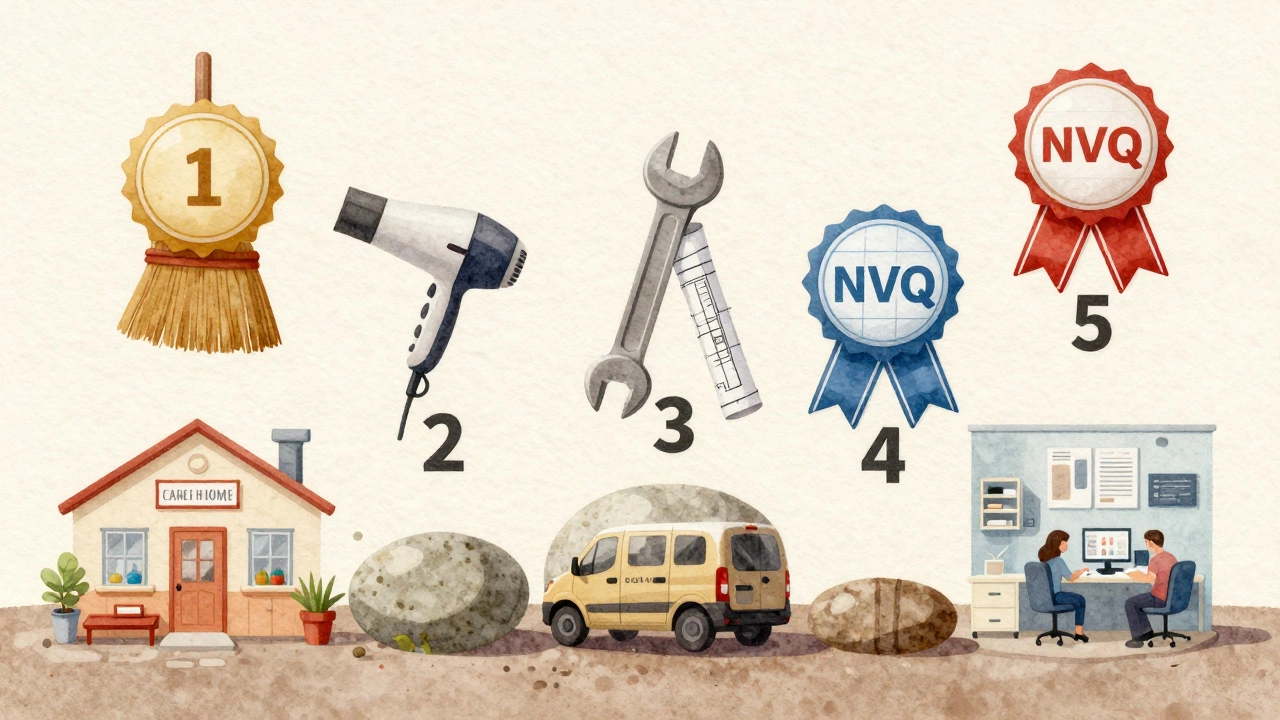
NVQs come in five levels, each matching a different level of responsibility and complexity:
- Level 1 - Basic tasks under close supervision. Think of it as an entry point-like helping in a kitchen or cleaning a construction site.
- Level 2 - Competent in routine tasks. This is where most people start their careers. Examples: hairdresser, care assistant, electrician’s assistant.
- Level 3 - Supervisory or skilled role. You’re expected to work independently and maybe train others. This level opens doors to senior positions.
- Level 4 - Management or technical specialist. You’re leading projects or teams. Common in fields like engineering, IT support, or nursing.
- Level 5 - Senior management or strategic roles. Think department heads, project managers, or senior clinicians.
These levels line up with other UK qualifications. For example, Level 2 is roughly equal to GCSEs at grades 9-4 (A*-C), and Level 3 matches A-levels. Level 4 and 5 are equivalent to the first years of university or foundation degrees.
Where NVQs Are Used
NVQs are everywhere in UK vocational training. You’ll find them in:
- Construction - Carpenters, plumbers, bricklayers
- Health and Social Care - Nurses, care workers, paramedics
- Hairdressing and Beauty - Stylists, nail technicians, spa therapists
- Public Services - Firefighters, police officers, prison officers
- IT and Business - Helpdesk technicians, project coordinators, HR assistants
Many of these fields require an NVQ to legally work. For example, you can’t become a qualified electrician in the UK without an NVQ Level 3 in Electrical Installation. The same goes for care workers-most employers now require Level 2 or 3 NVQs in Health and Social Care.
NVQs vs. Other Qualifications
People often confuse NVQs with BTECs, City & Guilds, or apprenticeships. Here’s how they differ:
| Feature | NVQ | BTEC | Apprenticeship |
|---|---|---|---|
| How you learn | On the job | In college or classroom | Combination of work and college |
| Assessment method | Observation, portfolio, questioning | Exams and coursework | Workplace tasks + exams |
| Who issues it | Awarding bodies (e.g., City & Guilds, Pearson) | BTEC (Pearson) | Employer + training provider |
| Best for | People already working | Students not yet employed | Young people entering a trade |
So if you’re already working and want to get certified, NVQ is your path. If you’re still in school, a BTEC might be better. And if you’re starting out with an employer, an apprenticeship usually includes an NVQ as part of the package.
Why NVQs Still Matter in 2026
You might think that in 2026, with online courses and digital badges everywhere, NVQs are outdated. But they’re not. In fact, they’re more relevant than ever.
Employers still trust them because they’re based on real performance, not just online modules. A certificate from a 10-minute YouTube course doesn’t prove you can handle a real-life emergency in a care home. But an NVQ does. It shows you’ve been observed, challenged, and validated by a trained assessor.
Also, many government schemes-like apprenticeship funding, trainee grants, or public sector hiring-still require NVQs. Even in tech-heavy fields like cybersecurity or data analysis, employers ask for NVQ Level 4 or 5 as proof of applied skills.

How to Get an NVQ
Getting an NVQ is simple if you’re already working:
- Find an approved training provider in your field. Many colleges, private trainers, and even employers offer them.
- Choose the right level based on your current role. Don’t jump to Level 5 if you’re just starting out.
- Work with an assessor. They’ll guide you through gathering evidence-photos of your work, witness statements, logs.
- Complete all required units. This can take weeks or months, depending on your job and level.
- Get certified. Once you’ve met all criteria, you’ll receive your official NVQ certificate.
Some people do NVQs part-time while working. Others do them as part of a full apprenticeship. The key is: you don’t need to quit your job to earn one.
What Happens After You Get Your NVQ?
Getting your NVQ isn’t the end-it’s the start. With an NVQ Level 3, you can apply for more senior roles. With Level 4 or 5, you can move into management or even teach others. Many people use NVQs as a stepping stone to higher education. For example, a Level 3 NVQ in Health and Social Care can give you credit toward a nursing degree.
Also, NVQs are recognized across the UK. If you move from London to Glasgow, your certificate still holds weight. That’s something online courses often can’t promise.
Final Thoughts
NVQ isn’t just a fancy acronym. It’s a trusted, practical way to prove you can do the job. Whether you’re a plumber in Bristol, a care worker in Cardiff, or a technician in Birmingham, your skills deserve recognition. And if you’re serious about your career, an NVQ gives you the proof employers respect.
Don’t think of it as another course to complete. Think of it as your official record of competence. It’s not about passing a test. It’s about proving you belong in the job.
Is NVQ the same as a degree?
No, an NVQ is not the same as a degree. Degrees are academic and focus on theory, research, and critical thinking. NVQs are practical and focus on job skills. However, NVQ Level 4 and 5 are equivalent to the first and second years of a university degree, so they can sometimes be used to enter higher education.
Can I get an NVQ if I’m not working?
It’s very difficult. NVQs require you to demonstrate skills in a real work environment. If you’re not employed, you won’t be able to complete the assessments. However, some training providers offer work placements as part of the course, especially for apprenticeships or career changers.
Do NVQs expire?
No, NVQ certificates do not expire. Once you earn one, it’s valid for life. However, some industries require ongoing training or updates-for example, first aid or health and safety standards-so you may need to take refreshers even after getting your NVQ.
Are NVQs recognized outside the UK?
NVQs are mainly recognized in the UK and some Commonwealth countries. In the US, EU, or Australia, employers may not be familiar with them. But if you’re applying for jobs in the UK or with UK-based companies overseas, your NVQ will carry weight. Some international employers will compare NVQ levels to their own qualifications.
How long does it take to complete an NVQ?
It depends on the level and your job. Level 2 might take 6-12 months. Level 3 usually takes 1-2 years. Level 4 and 5 can take 2-3 years, especially if you’re working full-time. The pace is flexible-you move at your own speed as long as you meet the requirements.


Write a comment