

NVQ Level Equivalency Checker
Click on a level on the left to see its academic equivalent, typical job roles, and career progression details.
Staring at a job description that asks for an NVQ can feel like trying to read a foreign language. You might have a degree, some apprenticeships, or years of on-the-job experience, but you’re left wondering: does my current qualification count? Is my NVQ Level 3 the same as A-Levels? Does an NVQ Level 4 mean I’m qualified for university entry?
The short answer is yes, but the details matter. The UK government standardized everything under one roof called the Regulated Qualifications Framework (RQF). This means your NVQ isn’t just a piece of paper; it’s a specific rung on a ladder that connects directly to academic degrees and other professional certifications.
Understanding these equivalencies helps you decide whether you need more training, if you’re ready for a promotion, or how to explain your skills to employers who only understand traditional school grades. Let’s break down exactly what each NVQ level equals in the real world.
The Big Picture: How NVQ Fits into the RQF
To understand what an NVQ equals, you first have to look at where it sits. The National Vocational Qualification (NVQ) was designed to measure your ability to do a job, not just your ability to pass a test. Unlike a written exam, an NVQ assesses your actual performance in the workplace over time.
In England, Wales, and Northern Ireland, all NVQs are now mapped onto the Regulated Qualifications Framework (a national system that ranks educational qualifications by difficulty and learning hours). Scotland uses a similar system called the Scottish Credit and Qualifications Framework (SCQF), which aligns closely with the RQF.
This framework runs from Entry Level (basic skills) up to Level 8 (doctorate-level research). When someone asks what an NVQ is equal to, they are usually asking about Levels 2 through 6, as these cover the vast majority of vocational careers, from hairdressing and construction to business management and healthcare.
NVQ Level 1: The Foundation
An NVQ Level 1 (entry-level vocational qualification focusing on basic tasks under supervision) is roughly equivalent to achieving 5 GCSEs at grades 1 to 3 (the old G-C grades).
At this stage, you are learning the basics. You aren’t expected to work independently yet. Think of it as the "learning to walk" phase of a career. If you are starting a career in care, retail, or hospitality, an NVQ Level 1 proves you can follow instructions, handle simple equipment, and understand safety protocols.
Real-world comparison:
- School equivalent: GCSEs at grades 1-3.
- Workplace role: Trainee, apprentice assistant, or junior support staff.
- Typical jobs: Retail assistant, kitchen porter, home care assistant (junior).
If you don’t have formal education, an NVQ Level 1 is a great way to prove you have the foundational skills to move forward. It shows employers you are reliable and capable of handling routine tasks.
NVQ Level 2: The Intermediate Step
This is where things get interesting. An NVQ Level 2 (intermediate vocational qualification demonstrating competence in routine tasks) is widely accepted as being equal to 5 GCSEs at grades 4 to 9 (the old C-A* grades).
Many employers consider Level 2 the minimum requirement for skilled manual trades or customer-facing roles. At this level, you can perform routine tasks confidently and without constant supervision. You know the rules, you know the tools, and you can solve minor problems on your own.
Real-world comparison:
- School equivalent: 5 GCSEs at grades 4-9 (Pass).
- Workplace role: Skilled worker, technician, or senior assistant.
- Typical jobs: Hairdresser, bricklayer, chef de partie, administrative assistant, car mechanic.
If you are looking at apprenticeships, most intermediate apprenticeships end with an NVQ Level 2. It is the standard benchmark for "skilled labor." Without this level, you might find yourself stuck in unskilled roles with little room for pay progression.
NVQ Level 3: The Advanced Professional
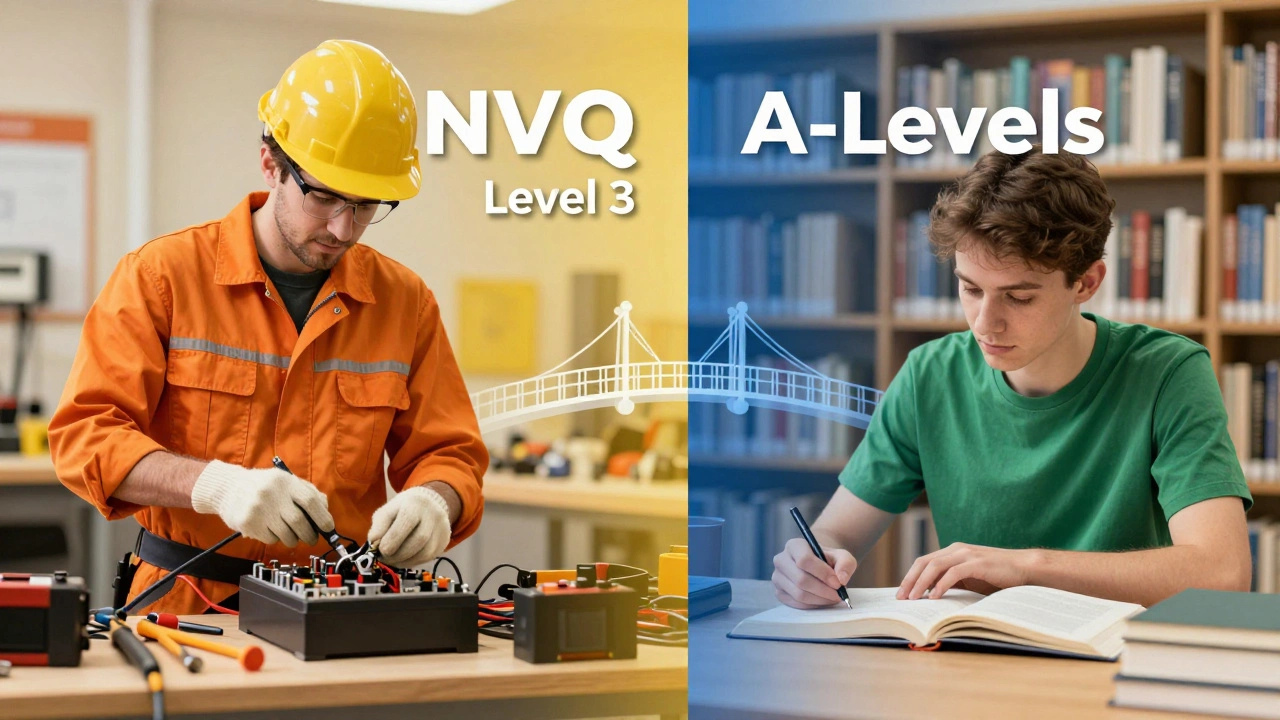
NVQ Level 3 is a major milestone. It is equivalent to A-Levels (advanced academic qualifications typically taken after secondary school) or two passes at BTEC Diploma level.
At Level 3, you are no longer just following instructions. You are making decisions. You might be supervising others, managing complex projects, or troubleshooting difficult technical issues. This is the level required for many supervisory roles and is often the gateway to higher education.
Real-world comparison:
- School equivalent: 2-3 A-Levels or a BTEC Extended Diploma.
- Higher Education: Allows entry into foundation degrees or HNDs (Higher National Diplomas).
- Workplace role: Supervisor, team leader, specialist technician.
- Typical jobs: Electrician, plumber, senior nurse associate, project coordinator, advanced beauty therapist.
Many people stop here because it opens doors to well-paid, stable careers. However, if you want to move into management or specialized consultancy, you will likely need to go higher. An NVQ Level 3 also gives you UCAS tariff points if you decide to apply for university later.
NVQ Level 4: The First Step into Higher Education
Crossing into Level 4 changes the game entirely. An NVQ Level 4 (higher education equivalent qualification focusing on broad knowledge and responsibility) is equivalent to the first year of a bachelor’s degree or a Higher National Certificate (HNC).
At this level, you are dealing with abstract concepts and non-routine problems. You might be responsible for planning resources, managing budgets, or developing policies. It is common to see NVQ Level 4 in sectors like business administration, health and social care management, and engineering leadership.
Real-world comparison:
- School equivalent: First year of University (Foundation Degree or Bachelor’s Year 1).
- Professional status: Often leads to associate membership in professional bodies.
- Workplace role: Manager, department head, senior specialist.
- Typical jobs: Health service manager, senior engineer, business operations manager.
If you have an NVQ Level 4, you can often enter the second year of a full bachelor’s degree program. This is known as "credit transfer." It saves you time and money while leveraging your practical experience.
NVQ Level 5: The Senior Management Tier
NVQ Level 5 is equivalent to the second year of a bachelor’s degree or a Higher National Diploma (HND). It represents a high level of autonomy and responsibility.
At this stage, you are likely managing teams, departments, or significant projects. You are accountable for outcomes, not just processes. In healthcare, for example, a Registered Nurse often holds an NVQ Level 5 qualification. In business, this level is comparable to a senior manager who sets strategy rather than just executing it.
Real-world comparison:
- School equivalent: Second year of University or HND.
- Workplace role: Senior manager, director, principal practitioner.
- Typical jobs: Practice nurse, site manager, marketing director, IT infrastructure manager.
Employers value Level 5 heavily because it proves you can handle pressure and make strategic decisions. It is often a requirement for promotions into upper-middle management.

NVQ Level 6 and Beyond: The Executive Level
NVQ Level 6 is equivalent to a full bachelor’s degree with honors. Level 7 equals a master’s degree, and Level 8 equals a doctorate. These levels are rare in pure vocational settings and are more common in professional fields like law, medicine, or executive leadership.
At Level 6, you are creating new knowledge or applying highly complex theories to unique situations. You might be running a large organization or leading a major public sector initiative.
Real-world comparison:
- Level 6: Bachelor’s Degree (Honors).
- Level 7: Master’s Degree.
- Level 8: Doctorate (PhD).
- Workplace role: Chief Executive Officer, Head of Department, Consultant.
While fewer people pursue NVQs to this level compared to academic routes, they are respected equally in the job market. They demonstrate that you have achieved academic rigor through practical application.
| NVQ Level | School Equivalent | Higher Education Equivalent | Typical Job Role |
|---|---|---|---|
| Level 1 | GCSEs (Grades 1-3) | Entry Level | Trainee / Junior Assistant |
| Level 2 | GCSEs (Grades 4-9) | N/A | Skilled Worker / Technician |
| Level 3 | A-Levels | Foundation Degree / HND (Part) | Supervisor / Team Leader |
| Level 4 | N/A | HNC / Year 1 Degree | Manager / Senior Specialist |
| Level 5 | N/A | HND / Year 2 Degree | Senior Manager |
| Level 6 | N/A | Bachelor’s Degree | Executive / Director |
Why NVQs Are Different From Academic Qualifications
You might wonder why you would choose an NVQ over a traditional college course. The key difference is assessment. Academic qualifications often rely on exams and essays. NVQs rely on evidence of your work.
To pass an NVQ, you must show your assessor that you can do the job consistently. This might involve portfolios, observations, witness testimonies, and professional discussions. For many adults returning to education, this is less intimidating than sitting in a classroom for three years.
Also, NVQs are recognized globally within the Commonwealth and increasingly in Europe due to their alignment with European Qualifications Framework (EQF) standards. If you plan to work abroad, an NVQ provides a clear, standardized proof of your competency.
Common Pitfalls to Avoid
When comparing qualifications, watch out for "fake" equivalencies. Some private colleges may claim their certificates are "equivalent" to NVQs without being regulated by Ofqual or Qualifications Wales. Always check that the qualification is on the Register of Regulated Qualifications.
Another mistake is assuming that higher level always means better pay. While Level 3 and above generally command higher salaries, the industry matters more. An NVQ Level 3 in electrical engineering will likely pay more than an NVQ Level 3 in general office administration. Focus on the demand in your specific sector.
Is an NVQ Level 3 the same as A-Levels?
Yes, broadly speaking. Both sit at Level 3 on the Regulated Qualifications Framework (RQF). However, A-Levels are academic and exam-based, while NVQs are vocational and work-based. Universities accept both, but some competitive courses may prefer A-Levels depending on the subject.
Can I go to university with an NVQ?
Absolutely. An NVQ Level 3 allows you to apply for foundation degrees and HNDs. An NVQ Level 4 or 5 can often get you direct entry into the second or third year of a bachelor’s degree program, saving you time and tuition fees.
Are NVQs still relevant in 2026?
Yes, they remain highly relevant. While newer formats like Technical Awards and T-Levels exist for younger students, NVQs are still the gold standard for adult learners and those already in employment. Many apprenticeships still use NVQs as the core qualification.
How long does it take to complete an NVQ?
It varies by level and individual pace. An NVQ Level 2 might take 6-12 months part-time. Level 3 can take 1-2 years. Higher levels (4-6) can take 2-4 years. Since there are no fixed deadlines, you progress as soon as you have gathered enough evidence.
Do employers value NVQs over degrees?
In vocational sectors like construction, healthcare, and hospitality, employers often prefer NVQs because they prove practical competence. In corporate or scientific fields, degrees may still be preferred. However, a combination of both (e.g., a degree plus an NVQ) is extremely powerful.



Write a comment