

NVQ Assessment Readiness Checker
Check the types of proof you can provide for your daily work tasks:
Your NVQ Profile
Evidence Strategy
Note: This tool provides guidance based on general UK vocational standards. Always consult with an accredited training provider for specific unit requirements.
You’ve heard the term NVQ thrown around in job ads, training centers, and career advice columns. It stands for National Vocational Qualification, a credential that proves you can actually *do* the job, not just talk about it. But when someone asks, “What is an NVQ example?”, they aren’t looking for a dictionary definition. They want to see what this qualification looks like in real life. Does it involve sitting in a classroom taking multiple-choice tests? Is it a massive stack of paperwork? Or is it something entirely different?
The short answer is: an NVQ example is a record of your daily work performance assessed against national standards. Unlike traditional exams, there are no final papers to pass. Instead, your assessor watches you, talks to you, and reviews the evidence you collect while working. This guide breaks down exactly what that looks like across different industries, levels, and assessment methods so you know what to expect.
Real-Life NVQ Examples by Industry
To understand what an NVQ feels like, you have to look at specific roles. The structure remains the same-competence-based assessment-but the tasks change drastically depending on whether you’re fixing a car or managing a team. Here are three concrete examples of NVQs in action.
1. Level 2 NVQ in Health and Social Care
This is one of the most common entry-level vocational qualifications in the UK. Imagine you are working as a care assistant in a residential home. Your NVQ isn’t tested by asking you to define ‘person-centered care.’ It’s tested by observing you delivering it.
The Scenario: Your assessor visits your workplace. You are tasked with helping a resident get dressed. The assessor doesn’t intervene; they watch. Did you check the resident’s care plan first? Did you respect their privacy? Did you encourage them to do as much as possible themselves? Afterward, you fill out a short logbook entry describing the interaction. The assessor signs off that unit as ‘achieved.’ That single observation is an NVQ example.
- Unit Example: Support individuals to meet personal health and wellbeing needs.
- Evidence Type: Direct observation + witness testimony from a supervisor.
- Outcome: Proof that you can safely support daily living activities.
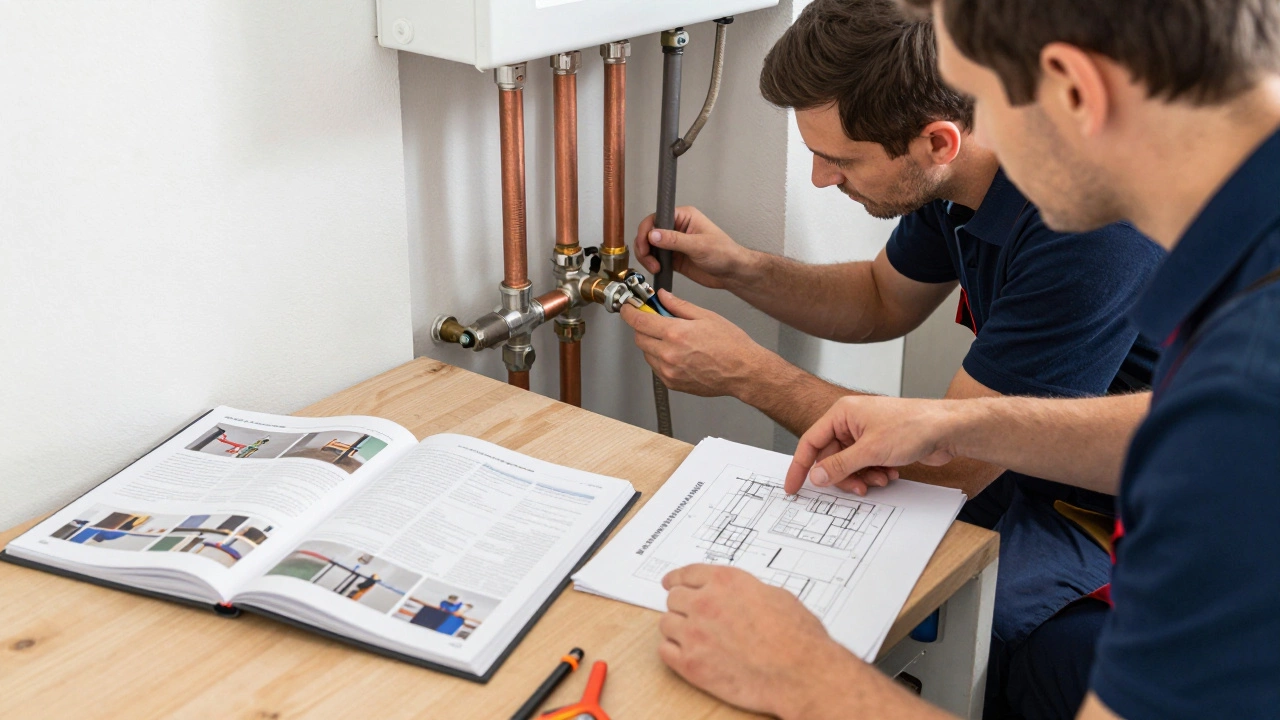
2. Level 3 NVQ in Plumbing
For tradespeople, the NVQ is often a requirement to join trade unions or gain full membership status. A plumber might already have years of experience but lacks the formal paper trail. Their NVQ example involves compiling a portfolio of past work.
The Scenario: You are installing a new central heating system. You take photos of the pipework before covering it up. You keep the method statements and risk assessments used for the job. Later, during a professional discussion with your assessor, you explain why you chose a specific type of valve for high-pressure zones. The assessor cross-references your explanation with industry regulations (like Building Regulations Part G). If your reasoning holds up and your physical work meets code, that unit is passed.
- Unit Example: Install and maintain hot water systems.
- Evidence Type: Photographic evidence + Professional Discussion + Technical Questions.
- Outcome: Validation of technical knowledge and practical skill compliance.
3. Level 4 NVQ in Management and Leadership
Higher-level NVQs focus less on manual tasks and more on decision-making, strategy, and team oversight. An NVQ example here looks very different from the hands-on care or plumbing scenarios.
The Scenario: You are a department manager. Your task is to demonstrate how you handle conflict resolution and resource allocation. You submit a case study of a recent project where budgets were cut. You detail how you reprioritized tasks, communicated changes to staff, and maintained output quality. The assessor interviews you to probe your understanding of leadership theories and legal responsibilities regarding employee rights. There is no ‘right’ answer in a textbook; the evidence must show successful application in your specific business context.
- Unit Example: Manage organizational resources.
- Evidence Type: Case studies + Reflective accounts + Witness testimonies from peers.
- Outcome: Demonstration of strategic thinking and operational management capability.
How NVQ Assessment Works: The Four Evidence Types
If you are wondering how to prove your competence without a written exam, you need to understand the four pillars of NVQ assessment. These methods ensure that the qualification reflects reality, not just theory.
- Direct Observation: An assessor watches you perform a task in your normal work environment. This is the gold standard for NVQs because it captures behavior, safety practices, and efficiency in real-time.
- Professional Discussion: A structured conversation with your assessor. You discuss complex decisions you’ve made. This fills gaps where direct observation isn’t possible, such as long-term planning or rare emergency responses.
- Portfolio of Evidence: A collection of documents. This includes emails, reports, signed-off checklists, client feedback, and photos. It serves as a timeline of your consistent performance over months or years.
- Witness Testimony: Statements from colleagues, supervisors, or clients confirming that you performed specific tasks. This adds credibility to your self-reported evidence.
An effective NVQ example combines these methods. For instance, a chef might be observed plating a dish (observation), discuss menu costing strategies (discussion), provide invoices for ingredient purchases (portfolio), and have the head chef sign off on their consistency (witness testimony).
NVQ Levels Explained: What Do They Mean?
NVQs are tiered into levels that correspond to complexity and responsibility. Understanding which level applies to your role is crucial for setting realistic expectations.
| Level | Complexity | Typical Role Examples | Assessment Focus |
|---|---|---|---|
| Level 1 | Basic, routine tasks under supervision | Junior Care Assistant, Retail Assistant, Apprentice Electrician | Following instructions safely and correctly |
| Level 2 | Standard tasks, some autonomy | Healthcare Worker, Plumber, Hairdresser | Consistent performance and problem-solving within known parameters |
| Level 3 | Complex tasks, responsibility for others | Senior Technician, Team Leader, Qualified Nurse | Handling non-routine situations and mentoring juniors |
| Level 4 | Management and strategic planning | Department Manager, Business Owner, Senior Engineer | Resource allocation, policy implementation, and long-term strategy |
| Level 5+ | Senior leadership and organizational direction | Director, Head of Department, Strategic Consultant | Organizational transformation and high-level decision making |
Note that in England, Wales, and Northern Ireland, NVQs have largely been replaced by RVTQs (Regulated Vocational Qualifications) and specifically Qualifications and Credit Framework (QCF) units, though many still refer to them colloquially as NVQs. In Scotland, the equivalent is the SQF (Scottish Qualifications Framework). The core principle-work-based assessment-remains identical.
Common Misconceptions About NVQs
Despite their widespread use, several myths persist about what these qualifications entail. Clearing these up helps you approach your assessment with confidence.
Myth 1: NVQs are only for people who failed school. This is false. Many professionals pursue NVQs alongside university degrees or as part of advanced apprenticeships. They are respected credentials that validate practical expertise, which academic exams often miss.
Myth 2: You need to go back to college full-time. Most NVQs are work-based. You continue your job while collecting evidence. Training providers offer evening or weekend workshops to cover theoretical gaps, but the bulk of the learning happens on the job.
Myth 3: It’s just paperwork. While portfolios are involved, the emphasis is on *doing*. Assessors are trained to spot genuine competence. If you can’t do the task, no amount of writing will pass the unit. The paperwork simply records what you already do.

How to Start Your NVQ Journey
If you recognize yourself in the examples above, you might be ready to start. Here is a practical checklist to begin the process.
- Identify your level: Look at job descriptions for roles you currently hold or aspire to. Note the required NVQ level.
- Find an accredited provider: Ensure the training center is approved by the relevant awarding body (e.g., City & Guilds, NCC Education, Pearson). Check their reputation for responsive assessors.
- Audit your current work: Before signing up, ask your employer if they support NVQs. Some companies pay for the assessment time. Review your daily tasks to see how much evidence you are already generating.
- Prepare your workspace: Create a dedicated folder (digital or physical) for evidence. Start saving emails, reports, and photos now. Consistency beats last-minute scrambling.
- Schedule regular reviews: Don’t wait six months to speak to your assessor. Monthly check-ins keep momentum going and allow for immediate feedback on weak areas.
Why Employers Value NVQs
From an employer’s perspective, an NVQ example provides tangible proof of capability. Unlike a CV claim that says “I am a good leader,” an NVQ certificate shows that an independent assessor verified that leadership through specific, observable actions. This reduces hiring risk and ensures standardized competency across teams. For regulated industries like healthcare, construction, and finance, holding an NVQ is often a legal or contractual requirement, making it essential for career progression.
Is an NVQ the same as a degree?
No. A degree focuses on academic theory and research, usually delivered in a university setting. An NVQ focuses on practical competence in a specific job role. However, Level 4 NVQs are often considered equivalent to a Foundation Degree, and Level 5 NVQs can equate to a Bachelor’s degree in terms of seniority and complexity, though the content differs significantly.
How long does it take to complete an NVQ?
There is no fixed timeframe. It depends on how quickly you can gather sufficient evidence. A Level 2 NVQ might take 6-12 months if you work full-time in the relevant role. Higher levels can take 12-24 months due to the complexity of evidence required. The key is consistent submission of evidence rather than rushing.
Can I retake an NVQ unit if I fail?
Yes. If your assessor determines that your performance did not meet the criteria, they will provide feedback on what was missing. You then repeat the task or discussion until you meet the standard. There is no limit to the number of attempts, provided you continue to work in the relevant role.
Do NVQs expire?
Generally, NVQs do not have an expiration date. Once achieved, the qualification is yours for life. However, some industries require periodic refresher training or CPD (Continuing Professional Development) to ensure skills remain up-to-date with current regulations and technology.
What is the difference between NVQ and SVQ?
NVQ stands for National Vocational Qualification (used in England, Wales, and Northern Ireland). SVQ stands for Scottish Vocational Qualification. They are structurally similar and both assess work-based competence, but they are governed by different regulatory bodies and qualification frameworks. An NVQ is not automatically recognized as an SVQ and vice versa, though many employers accept either.



Write a comment