

OSHA Exam Readiness Calculator
How prepared are you for the OSHA exam?
This tool helps you assess your knowledge of key OSHA safety topics. Answer the questions honestly to get an accurate readiness score.
Key Safety Topics
People often ask if the OSHA exam is hard. The truth? It’s not about how tough the test is-it’s about how well you prepared. If you’ve paid attention during your OSHA 10 or OSHA 30 course, passed the practice quizzes, and reviewed the key safety rules, you’ll likely walk out with a certificate in hand. But if you showed up just to get it over with, you might be in for a surprise.
What is the OSHA exam anyway?
The OSHA exam isn’t one single test. It’s a set of short, multiple-choice assessments tied to OSHA’s 10-hour and 30-hour outreach training programs. These aren’t college finals. They’re designed to make sure you actually learned how to spot hazards on a job site-like unguarded machinery, unsafe scaffolding, or missing fall protection. The questions are straightforward: what’s the correct safety procedure? Which OSHA regulation applies here? What should you do if you see a worker not wearing a hard hat?
OSHA doesn’t publish the exact questions. But if you’ve gone through the official training materials, you’ve seen them before. The test pulls from the same topics covered in class: hazard communication, electrical safety, fall protection, personal protective equipment, and emergency response. No trick questions. No obscure legal jargon. Just real-world safety scenarios.
OSHA 10 vs. OSHA 30: Which is harder?
The OSHA 10-hour course is meant for entry-level workers. The test has about 10 to 20 questions, depending on the provider. You usually need to score at least 70% to pass. Most people finish it in a day or two.
The OSHA 30-hour course is for supervisors, foremen, and safety coordinators. It’s longer, deeper, and yes-more challenging. The exam has 30 to 50 questions. You still need 70%, but now you’re expected to know more than just the basics. You’ll be tested on OSHA’s recordkeeping rules, accident investigation steps, and how to manage safety programs. If you’re in charge of others, you need to understand not just what to do, but how to make sure your team does it too.
Here’s a quick comparison:
| Feature | OSHA 10 | OSHA 30 |
|---|---|---|
| Length of course | 10 hours | 30 hours |
| Number of questions | 10-20 | 30-50 |
| Passing score | 70% | 70% |
| Who needs it | Entry-level workers | Supervisors, managers |
| Typical pass rate | 85-90% | 75-80% |
Most people pass the OSHA 10. The OSHA 30? A few more struggle-not because it’s impossible, but because they underestimate how much detail matters.
Why do people fail the OSHA exam?
Most failures aren’t because the test is hard. They’re because people treat it like a formality.
Some skip the training videos. Others rush through the materials on their phone while waiting in line. A few even try to memorize answers from random websites. That’s a mistake. OSHA providers update their tests regularly to prevent cheating. If you didn’t learn the material, you won’t recognize the right answer-even if you’ve seen it before.
The biggest pitfall? Ignoring the OSHA standards. You don’t need to quote the exact CFR number (like 1926.501 for fall protection), but you do need to know what the rule says. For example: “Fall protection is required at 6 feet in construction.” Not 5 feet. Not 4 feet. Six feet. Get that wrong, and you’ll miss the question.
Another common issue: not reading the full question. OSHA questions are worded carefully. “Which of the following is NOT a required PPE?” If you skim and pick the first thing that sounds right, you’ll get it wrong.
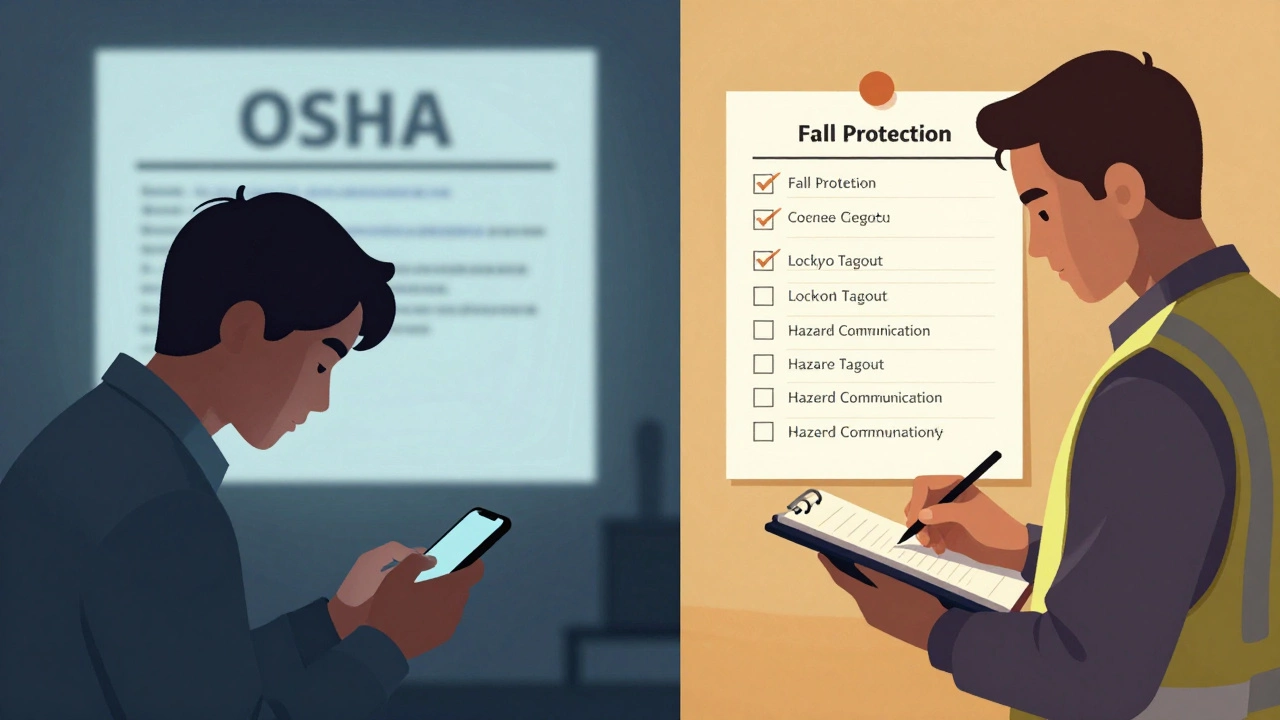
How to pass the OSHA exam-step by step
You don’t need to be a safety expert. You just need to be prepared.
- Take the training seriously. Sit down. Turn off distractions. Treat it like you’re learning how to save a life-because you are.
- Take notes. Write down the key numbers: 6 feet for falls, 15 feet for excavation, 120 volts for lockout/tagout. These show up again and again.
- Use the practice quizzes. Every legitimate OSHA provider gives you at least one. Do them all. If you score below 80%, go back over the sections you missed.
- Focus on the big topics: fall protection, hazard communication (GHS labels), electrical safety, and emergency plans. These make up 60% of the test.
- Don’t guess. If you’re unsure, eliminate the clearly wrong answers first. Then pick the one that best matches what you learned.
There’s no magic trick. No secret cheat sheet. Just pay attention, review, and trust what you’ve learned.
Real stories from people who passed (and failed)
A construction worker in Ohio failed his OSHA 30 test the first time because he thought “lockout/tagout” meant just turning off the machine. He didn’t realize it also meant physically disconnecting power and tagging it so no one could restart it. He retook it after watching the training video a second time-and passed.
A warehouse supervisor in Texas passed her OSHA 10 on the first try because she took notes during every video and reviewed them on her lunch break. She said, “I didn’t study. I just paid attention.”
Another guy in Florida tried to find the answers online. He got flagged for suspicious activity. His test was reset. He had to start over. He passed the second time-after actually doing the training.
The pattern? People who treat it like a chore fail. People who treat it like a skill they’re building? They pass.
What happens after you pass?
You get a wallet-sized card from OSHA. It’s valid for life. No renewal needed. Employers love it. Some won’t even let you on-site without it.
But here’s the real value: you’ll start seeing hazards you never noticed before. A frayed cord. A blocked exit. A coworker skipping their safety harness. That’s the point. The exam isn’t just a test. It’s the first step in becoming someone who keeps people safe.
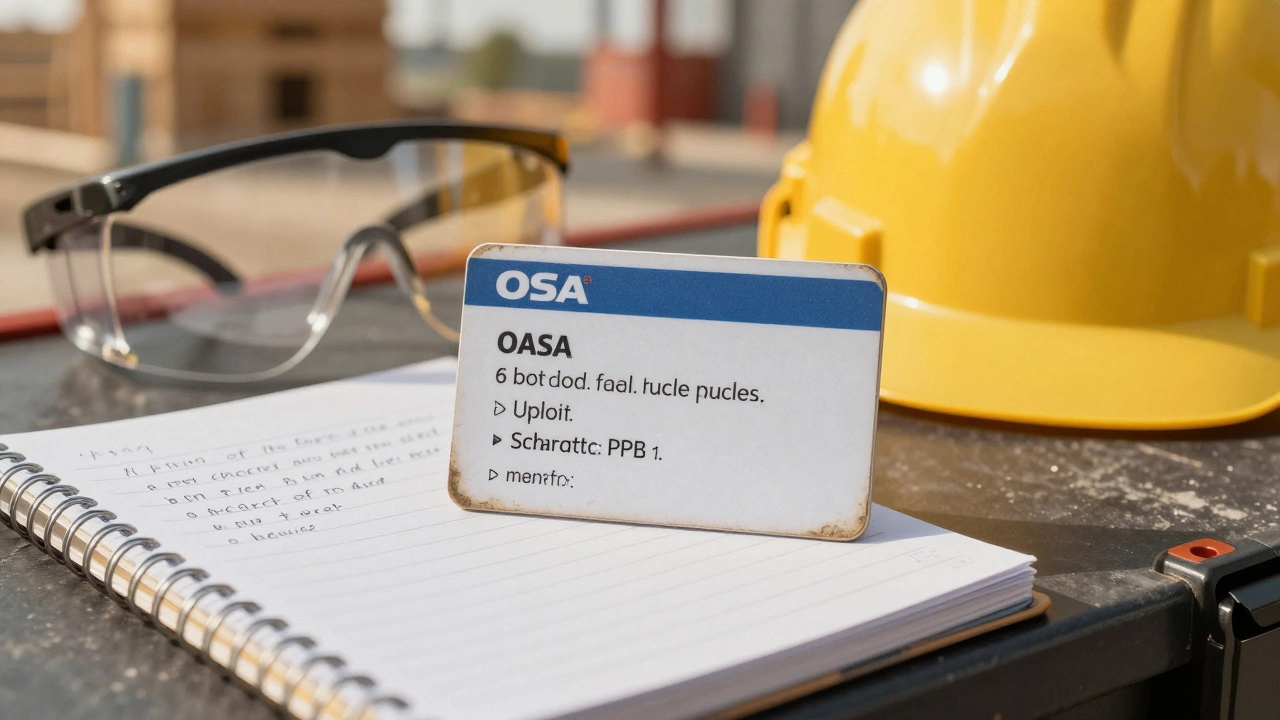
Can you retake the OSHA exam if you fail?
Yes. Most providers let you retake the test once or twice without extra cost. Some charge a small fee. But you can’t just keep retaking it until you pass. You usually have to wait at least 24 hours. And if you fail twice? You’ll need to retake the whole course.
That’s not a punishment. It’s a reminder: this isn’t a test you can game. It’s a safety requirement. And safety isn’t something you guess your way through.
Final thought: Is the OSHA exam hard?
No, it’s not hard-if you put in the time. It’s not a trick. It’s not a trap. It’s a check-in. A way to make sure you actually learned how to protect yourself and others.
If you’re reading this because you’re nervous, you’re already on the right track. The people who don’t care? They don’t ask questions. They just show up and hope for the best.
You’re not one of them. And that’s why you’ll pass.
Is the OSHA exam multiple choice?
Yes, all OSHA 10 and OSHA 30 exams are multiple choice. There are no essays, no fill-in-the-blanks. You’ll see questions like "What is the minimum height requiring fall protection?" with four possible answers. You just need to pick the correct one.
Do I need to memorize OSHA regulations?
You don’t need to memorize CFR numbers, but you do need to know what the rules say. For example, you should know that OSHA requires fall protection at 6 feet in construction, not 4 or 8. You should know that hazard communication includes labels, safety data sheets, and training. These are the kinds of facts the test checks.
How long does the OSHA exam take?
Most people finish the OSHA 10 exam in 15 to 30 minutes. The OSHA 30 exam can take 30 to 60 minutes, depending on how many questions your provider uses. There’s no strict time limit, but you usually have to complete it within the same session as your training.
Can I take the OSHA exam online?
Yes. OSHA 10 and OSHA 30 courses and exams are available online through OSHA-authorized providers. You’ll need to complete the full training hours before taking the test. Online exams are proctored in real time-you can’t pause and come back later. Some providers use webcam monitoring to ensure you’re the one taking the test.
Is the OSHA card accepted everywhere?
The OSHA 10 and OSHA 30 cards are widely accepted across the U.S. construction, manufacturing, and warehousing industries. Some states and employers require them by law. While not mandatory everywhere, having one gives you a clear advantage when applying for jobs. It’s not a license, but it’s a signal you take safety seriously.
What if I still feel unsure?
If you’re nervous, go back to the basics. Watch the training videos again. Redo the practice quizzes. Talk to someone who passed. Ask them what tripped them up. Most will tell you: "I thought it would be harder. I just didn’t expect them to ask about GHS labels."
OSHA doesn’t want you to fail. They want you to be safe. The exam is just a way to make sure you walked away with the right knowledge. So don’t stress. Do the work. You’ve got this.



Write a comment