
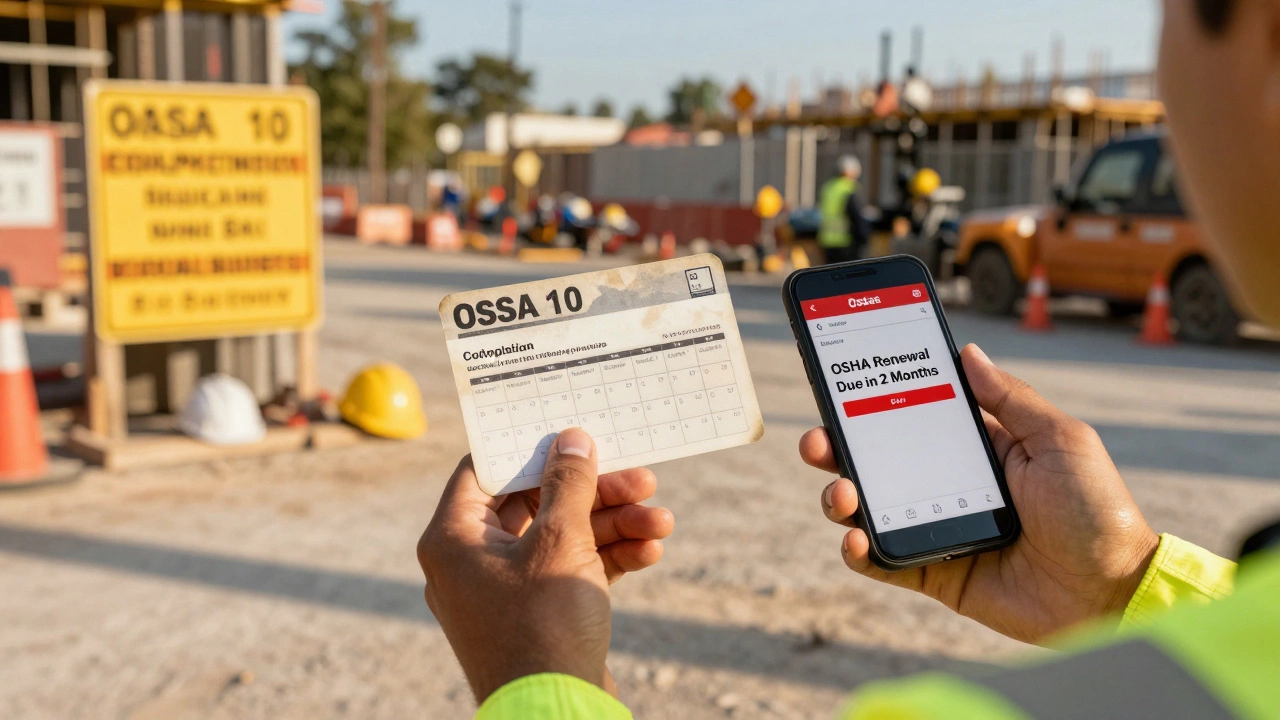
OSHA Certification Expiration Calculator
Calculate Your Certification Expiration
Many workers assume OSHA certification lasts forever. That’s a dangerous mistake. OSHA doesn’t issue a single, lifelong certificate. Instead, it sets standards for training, and OSHA certification typically expires after five years. But here’s the twist: it’s not always about the card in your wallet. It’s about whether your employer still considers you trained, competent, and up to date.
OSHA 10 and OSHA 30: The Two Most Common Certifications
If you’re in construction, manufacturing, or general industry, you’ve probably heard of OSHA 10 and OSHA 30. These aren’t licenses. They’re completion cards from outreach programs run by OSHA-authorized trainers. The OSHA 10-hour course covers basic safety awareness. The OSHA 30-hour course dives deeper into hazard recognition and employer responsibilities.
Neither card has an official expiration date printed on it. But OSHA itself says training should be refreshed periodically. Most employers and industries treat these cards as valid for five years. After that, they require you to retake the course. Why? Because safety rules change. New equipment comes out. New risks appear. Five years is long enough for knowledge to fade and practices to slip.
Why Five Years? The Real Reason Behind the Clock
Five years isn’t arbitrary. It’s based on how quickly safety knowledge decays. A 2022 study by the National Institute for Occupational Safety and Health (NIOSH) found that workers who hadn’t received refresher training in over four years were 37% more likely to miss basic hazard signs on the job. That’s not a small number. It’s a spike in preventable accidents.
OSHA doesn’t mandate renewal, but OSHA-authorized trainers and industry groups do. For example, the Construction Industry Institute recommends recertification every five years. The same goes for OSHA-authorized training providers. If you got your card in 2021, you’re already on the clock. By 2026, most companies will expect you to retake the course.
What About Specialized OSHA Training?
Not all OSHA-related training follows the five-year rule. Some programs have stricter timelines:
- Hazard Communication (HazCom): Must be repeated annually if you handle chemicals. OSHA requires retraining whenever new hazards are introduced.
- Lockout/Tagout (LOTO): Requires retraining every three years, or whenever new equipment changes the procedure.
- Respiratory Protection: Annual fit testing and retraining are mandatory. Your mask won’t work if you forget how to use it.
- Confined Space Entry: Typically renewed every three years, especially if you work in utilities, mining, or chemical plants.
These aren’t OSHA 10/30 cards. They’re job-specific certifications tied directly to OSHA standards. And yes - they have hard expiration dates. Skip your annual HazCom refresher? You can’t legally handle chemicals. Miss LOTO retraining? You can’t lock out machinery. Your employer can’t risk it.

What Happens When Your Certification Expires?
It’s not like losing a driver’s license. You don’t get fined by OSHA. But your job might get you fired.
Employers are legally required to ensure their workers are trained. If you can’t prove you’ve been trained in the last five years (or three, or one), your employer has two choices: retrain you or remove you from hazardous tasks. In many cases, they’ll just assign you to non-hazardous duties - or let you go.
Imagine this: You’re a warehouse worker. Your OSHA 10 card expired last year. A new safety inspector shows up. Your manager can’t prove you’re trained. The whole site gets shut down for a week. That’s not just your problem. It’s your team’s. And your boss will remember who caused it.
How to Stay Compliant: A Simple Plan
You don’t need to memorize every rule. Just follow this:
- Write down the date you got your OSHA 10 or OSHA 30 card.
- Set a calendar reminder for four years and ten months later. That gives you two months to schedule the renewal.
- Check your job description. If you handle chemicals, use respirators, or work with heavy machinery, find out if you need annual or triennial training.
- Ask your supervisor or safety officer what your company requires. Don’t assume.
- Keep digital and physical copies of your cards. Many providers now offer e-cards you can download.

OSHA Doesn’t Issue Certificates - So What’s the Real Value?
OSHA doesn’t issue certifications. Trainers do. That means the card is just proof you completed a course. The real value is in the knowledge. If you can’t explain how to identify a fall hazard or what a GHS label means, you’re not safe - even if your card is still in your wallet.
Some workers think they can skip renewal because they’ve been on the job for 15 years. Experience doesn’t replace training. OSHA standards evolve. New materials are used. New equipment has new risks. What was safe in 2015 might be illegal today.
What to Look for in a Renewal Course
Not all renewal courses are equal. Here’s what to check:
- Is the trainer OSHA-authorized? Ask for their trainer card number. You can verify it on OSHA’s website.
- Does the course cover changes since your last training? If it’s the same slides from 2020, it’s outdated.
- Is there hands-on practice? For LOTO or respirator use, theory isn’t enough.
- Do you get a new card? Reputable providers issue updated cards with a new date.
Avoid cheap online courses that just show videos and ask you to click "I agree." OSHA requires interactive training. You need to answer questions, demonstrate understanding, and sometimes simulate emergency responses.
Final Reality Check
OSHA certification doesn’t expire because of bureaucracy. It expires because lives depend on it. A single moment of forgetfulness - not knowing how to use a fire extinguisher, misreading a safety sign, skipping a lockout - can end careers. Or lives.
Don’t wait until your employer asks. Don’t assume you’re fine because you’ve "been doing this forever." Set a reminder. Take the renewal. It’s not just about the card. It’s about staying sharp.
Does OSHA certification ever expire?
Yes. While OSHA doesn’t set a federal expiration date, most employers and industries require renewal every five years for OSHA 10 and OSHA 30 cards. Specialized training like Hazard Communication, Lockout/Tagout, and Respiratory Protection often require renewal every one to three years.
Can I get fined for an expired OSHA card?
No, OSHA doesn’t fine individuals. But your employer can be fined if they allow untrained workers on hazardous jobs. That’s why most companies require you to renew - to avoid costly violations and shutdowns.
Do I need to retake the full OSHA 10 course if it expires?
Yes. There’s no partial renewal. You must complete the full 10-hour or 30-hour course again. Some providers offer condensed refresher versions, but they still meet the full OSHA requirements and include the same material.
Is online OSHA training valid?
Yes, if it’s from an OSHA-authorized provider and includes interactive elements like quizzes, simulations, or live Q&A. Passive video-only courses don’t meet OSHA’s training standards. Always verify the trainer’s authorization before enrolling.
What if I lose my OSHA card?
Contact the training provider you took the course with. Most will issue a replacement for a small fee. Keep a digital copy saved in your email or cloud storage. Many providers now send e-cards automatically.



Write a comment