

NVQ Timeline Calculator
How Long Will Your NVQ Take?
Enter your details to get a realistic estimate based on actual industry data
Your Estimated Timeline
Based on real industry dataMinimum Time
Maximum Time
Key Factors Affecting Your Timeline
Work Hours: Your weekly hours directly impact how quickly you accumulate evidence
Organization: Systematic evidence collection saves 30-50% of your time
Level: Higher levels require more complex evidence and responsibility
Employer Support: 40% of delays come from missing employer sign-offs
Tips to Speed Up Your NVQ
- 1 Collect evidence daily using your phone (photos/videos)
- 2 Schedule bi-weekly check-ins with your assessor
- 3 Use digital portfolio tools (like NVQ Pro)
People often ask, NVQ how long does it take to get one? The answer isn’t simple. It doesn’t work like a university degree with fixed semesters. An NVQ isn’t something you sit down and finish in a few weeks. It’s about proving you can do the job-really do it-day after day, on the job. That means the clock starts when you begin working and ends when your assessor is convinced you’ve got the skills down cold. For some, that’s three months. For others, it’s two years. It all depends on what you’re doing, how much time you’ve got, and how fast you learn.
What Is an NVQ, Really?
An NVQ-National Vocational Qualification-isn’t a test you study for in a classroom. It’s proof you can do the job. Think of it like a badge that says, ‘I’ve done this work, under real conditions, and I’ve been checked by someone who does this for a living.’ You don’t memorize facts. You gather evidence: photos of you installing a boiler, witness statements from your boss, written reflections on how you handled a tricky customer, or videos of you cutting hair with precision. Your assessor doesn’t grade you on theory. They grade you on what you actually do.
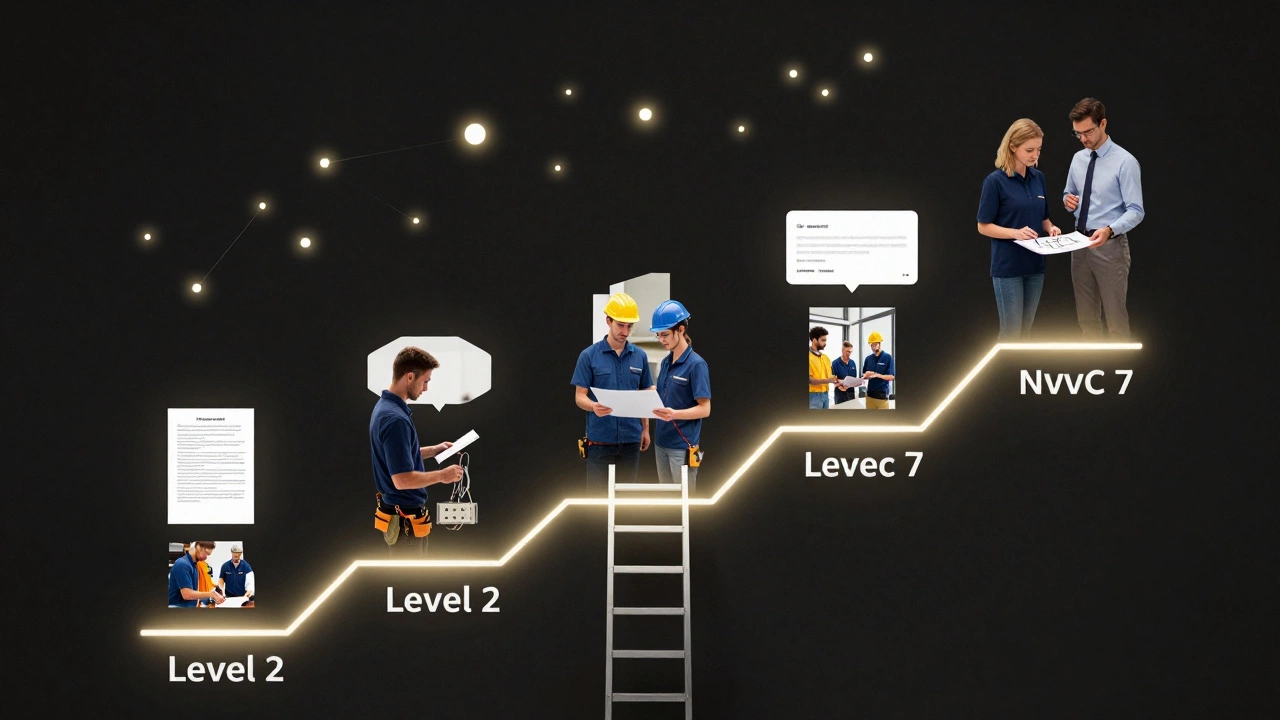
NVQs come in levels, from 1 to 7. Most people start at Level 2-think electrician’s helper, care worker, or kitchen porter. Level 3 is for supervisors, team leads, or senior technicians. Higher levels? Those are for managers, project leads, or specialists who train others. The higher the level, the more responsibility you need to show. And yes, that affects how long it takes.
Typical NVQ Timelines by Level
Here’s what most people actually experience, based on real case files from training providers in the West Country:
- Level 2 NVQ: 3 to 9 months. This is the most common. If you’re working 30+ hours a week in the role-say, as a junior carpenter or a care assistant-you’ll usually finish in six months. If you’re part-time or juggling other jobs, it might stretch to nine or even twelve.
- Level 3 NVQ: 6 to 18 months. You’re now expected to lead small teams, handle complex tasks, and make decisions without constant supervision. If you’re already working in a senior role, you might finish in eight months. If you’re trying to move up while still learning the basics, plan for a year or more.
- Level 4 and above: 12 to 24 months. These are rare outside of management, engineering, or health services. You’re documenting processes, mentoring others, and improving systems. One electrician I spoke to in Bath took 20 months because he was balancing the NVQ with running his own small business.
These aren’t guesses. They’re averages pulled from data collected by City & Guilds and OCR over the last three years. The fastest Level 2 NVQ I’ve seen was completed in 11 weeks-by a chef who worked 60-hour weeks in a busy hotel kitchen and had a very organized assessor.
What Slows Things Down?
It’s not always about how hard you work. Often, it’s about how well you keep track of your evidence. Here’s what trips people up:
- Not collecting evidence early. One bricklayer waited until month five to start taking photos of his work. By then, he’d forgotten details and couldn’t find the right jobs to document. Start now. Even a quick phone note or photo helps.
- Waiting for your assessor to push you. Assessor visits happen every 4-6 weeks. If you don’t have anything ready, you’re wasting time. Don’t wait for them to ask. Send updates every two weeks.
- Changing jobs or roles. If you switch from kitchen work to cleaning during your NVQ, your evidence might not match anymore. You’ll need to start over on new tasks. Stick to one role if you can.
- Missing deadlines. Some employers delay signing off witness statements. If your manager doesn’t respond, follow up. Don’t assume they’ll remember.
One care worker in Bristol told me she spent six extra months because her employer didn’t know what an NVQ was. She had to explain it to them, then train them on how to fill out the forms. That’s not your fault-but it’s something you need to plan for.

What Speeds Things Up?
If you want to finish fast, here’s what works:
- Work full-time in the role. If you’re doing the job daily, you’re collecting evidence naturally. No extra effort needed.
- Use a digital portfolio. Apps like NVQ Pro or AssessNET let you snap photos, record voice notes, and upload documents on your phone. No more lost papers.
- Ask for feedback weekly. Don’t wait for your assessor. Ask your manager: ‘Did I handle that call right?’ or ‘Was that installation up to standard?’ Write it down. That’s evidence.
- Start with a short NVQ. Some courses offer ‘micro-qualifications’-smaller chunks you can finish in 4-6 weeks. These count toward your full NVQ and give you momentum.
A plumber in Weston-super-Mare finished his Level 2 in 10 weeks because he used his phone to record every job he did. He’d say, ‘Today I replaced a shower valve, checked for leaks, and explained the warranty to the customer.’ He saved those clips. His assessor said it was the most complete portfolio they’d seen in years.
Does Your Employer Help-or Hurt?
Big companies like B&Q, NHS, or local councils often have NVQ programs built in. They give you time off for assessor visits. They pay for your course. They have internal mentors. That’s a huge advantage.
Small businesses? They might not even know what an NVQ is. You might be doing all the admin yourself. That’s okay-but it means you need to be more organized. Set reminders. Keep a folder (digital or physical) for every piece of evidence. If your employer won’t help, don’t wait for them to change. Take control.
Can You Do an NVQ Without a Job?
No. Not really. NVQs are work-based. You can’t do them from a classroom. If you’re not working in the role, you can’t prove you can do it. Some colleges offer ‘work placements’ as part of the course. That’s the only exception. If you’re unemployed, you might qualify for a government-funded placement through the Skills Bootcamps program. But you still need to be doing real work-just under supervision.
Don’t waste time looking for an NVQ you can do online without a job. Those are usually fake or just certificates of attendance. An NVQ means you’ve done the job.
What Happens After You Finish?
You don’t get a diploma in the mail. You get a certificate that says you’ve met the national standard for your role. That’s it. But here’s the real value: employers know what an NVQ means. It’s not just another piece of paper. It’s proof you can do the job without being micromanaged.
Many people use their NVQ to get promoted. Others use it to switch employers. Some even use it to start their own business. One hairdresser I met in Bristol used her Level 3 NVQ to open her own salon. She showed the council her portfolio during her license application. They didn’t ask for anything else.
Don’t treat your NVQ like a chore. Treat it like your career insurance. The longer it takes, the more you’ll learn. And the more you learn, the more valuable you become.
Can I finish my NVQ in 3 months?
Yes, but only if you’re working full-time in the role and you’re very organized. Level 2 NVQs can be done in 3 months if you’re collecting evidence every day and your assessor is responsive. It’s rare, but it happens-usually with people in fast-paced jobs like hospitality, retail, or cleaning.
Do I need to go to college for an NVQ?
No. NVQs are work-based. You don’t attend classes. You work, you gather evidence, and your assessor visits you at your workplace-or sometimes remotely. Some colleges offer NVQs as part of a course, but you still need to be employed in the role. The training is done on the job.
Is an NVQ better than a GCSE or A-level?
It’s not better or worse-it’s different. GCSEs and A-levels test knowledge. NVQs test ability. Employers in trades, care, and hospitality often value NVQs more because they show you can actually do the job. For university, you’ll still need academic qualifications. For jobs, NVQs speak louder.
Can I get funding for my NVQ?
Yes. If you’re under 24, unemployed, or on a low income, you might qualify for government funding. Check the Skills Bootcamps program or your local adult education service. Many employers also pay for NVQs if you’re working in a skilled role. Ask your manager-it’s more common than you think.
What if I change jobs halfway through my NVQ?
It depends. If your new job is in the same field, you might be able to carry on with the same NVQ. If it’s completely different, you’ll likely need to start over. Always tell your assessor before you switch. They might be able to adjust your portfolio or suggest a different qualification.
Are NVQs still valid in 2026?
Yes. NVQs are still the gold standard for work-based qualifications in the UK. They’re regulated by Ofqual and recognized by employers across the country. Some new qualifications have been introduced, like T Levels and Skills Bootcamps, but NVQs remain the most common and trusted route for skilled trades and care roles.
Next Steps: What to Do Now
If you’re thinking about starting an NVQ, here’s your first move: Find out if you’re already doing the work that counts. Look at the official standards for your job. For example, if you’re a care worker, search for ‘Level 2 Diploma in Care - Knowledge and Practice’. Read the units. Do you already do those things? If yes, start documenting today. Take a photo. Write a note. Ask your manager for a quick sign-off.
You don’t need to wait for permission. You don’t need to wait for a course to start. The clock starts when you start proving you can do the job. And that’s today.



Write a comment