

NVQ Completion Time Estimator
Not sure when you'll finish? Use this tool to estimate your realistic completion time based on the factors that actually matter.
You quit your job, enrolled in a course, and now you are staring at a calendar wondering when you can actually put those letters on your CV. The honest answer? There is no single number. But there is a realistic range, and knowing it stops you from panicking halfway through.
Most people assume an NVQ is like a university degree-fixed semesters, rigid exams, and a graduation date set years in advance. That’s wrong. An National Vocational Qualification is a competency-based award that measures what you can do, not how long you sat in a classroom. This distinction changes everything about the timeline. If you work fast and prove your skills early, you finish early. If you struggle with evidence gathering, it drags on.
| NVQ Level | Target Audience | Fastest Possible Time | Average Duration | Max Typical Time |
|---|---|---|---|---|
| Level 2 | Entry-level workers, apprentices | 3-6 months | 9-12 months | 18 months |
| Level 3 | Supervisors, senior technicians | 6-9 months | 12-18 months | 24 months |
| Level 4 | Managers, specialists | 9-12 months | 18-24 months | 36 months |
| Level 5+ | Directors, advanced practitioners | 12+ months | 24-36 months | 48+ months |
The Myth of the Fixed Course Length
Here is the biggest misconception: people think they are paying for a year of teaching. They aren’t. You are paying for assessment. In traditional education, time dictates progress. You spend twelve weeks on Module A whether you understood it in week two or week eleven. With an NVQ, progress dictates time. If you demonstrate competence in three units in month one, you move on. You don’t wait for the rest of the class.
This flexibility is why timelines vary so wildly. A hairdresser working full-time might complete a Level 2 qualification in four months because they cut hair every day and just need to document it. A construction manager doing a Level 4 might take two years because their role involves complex project management decisions that only happen during specific phases of a build. You cannot rush real-world experience if your job doesn’t provide the opportunities to demonstrate certain competencies.
Why Your Job Speeds Up or Slows Down Your NVQ
Your current employment status is the single biggest factor in your completion speed. Assessors need evidence. Lots of it. If you are employed in the sector you are studying, you have a massive advantage. You generate evidence daily. Every email, every completed task, every safety check you sign off becomes part of your portfolio.
But here is the catch: your employer has to cooperate. If your boss refuses to let you shadow a senior colleague, or won’t sign off on your observation sheets, you hit a wall. I’ve seen students stall for six months simply because their workplace was too busy to schedule assessments. Conversely, supportive employers who understand the value of qualifications often accelerate the process by actively seeking out tasks for the student to perform.
- Full-time employees: Typically fastest route (6-12 months for L2/L3) due to constant access to workplace evidence.
- Part-time employees: Moderate pace (12-18 months) as evidence generation takes longer.
- Unemployed/College students: Slowest route (12-24 months) because you rely on simulated environments or short placements which lack the depth of real work.
Breaking Down the Levels: What to Expect
Let’s look at the specific tiers. Each level adds complexity, not just volume.
Level 2: The Foundation
This is where most people start. Think bricklayers, junior IT support, or care assistants. The focus is on routine tasks and following instructions. Because these roles involve repetitive, high-volume activities, you can gather evidence quickly. If you are motivated and your assessor is responsive, finishing in six months is entirely possible. The main bottleneck here is usually administrative-getting the paperwork signed by supervisors who are too busy to read it.
Level 3: The Supervisor Step-Up
Level 3 requires you to handle non-routine problems. You need to show you can adapt when things go wrong. This takes time to observe. You can’t fake "problem-solving under pressure"; you have to capture it. For many, this means waiting for a crisis at work to occur naturally. Consequently, Level 3 often stretches to 18 months. It’s less about learning new facts and more about proving judgment.
Level 4 and Above: Management Complexity
At Level 4, you are likely managing people or budgets. Evidence isn’t just "I fixed the sink"; it’s "I led a team through a difficult quarter." These cycles take time. You might need to wait for a fiscal year-end report or a completed project cycle to use as evidence. This is why Level 4 rarely finishes in under 18 months, even for dedicated professionals. The strategic nature of the work means fewer opportunities for quick wins.

Apprenticeships vs. Standalone NVQs
If you are considering an apprenticeship, the timeline is different. Apprenticeships combine NVQs with technical knowledge courses (like BTECs or T-Levels). While the NVQ part could theoretically be finished in six months, the mandatory knowledge component and the End-Point Assessment (EPA) lock you into a minimum timeframe.
Government funding rules often dictate that an apprentice must stay in the program for a minimum period, regardless of how fast they learn. So, while a standalone NVQ learner might finish in nine months, an apprentice doing the same qualification might still be in the program for 18-24 months because they are also completing functional skills in English and Maths, plus the EPA preparation. Always check if your funding stream imposes a minimum duration.
Five Ways to Cut Your Completion Time
You want to finish sooner? Stop treating the NVQ like homework and start treating it like a project management task.
- Batch your evidence. Don’t send one photo to your assessor every week. Collect ten pieces of evidence over a month, organize them, and submit them in a bulk upload. This saves your assessor admin time and gets them to review your work faster.
- Pre-schedule observations. Don’t wait for the assessor to call. Look at your work diary. See when you will be performing a key task next Tuesday? Book the assessment slot now. Proactivity prevents scheduling gaps.
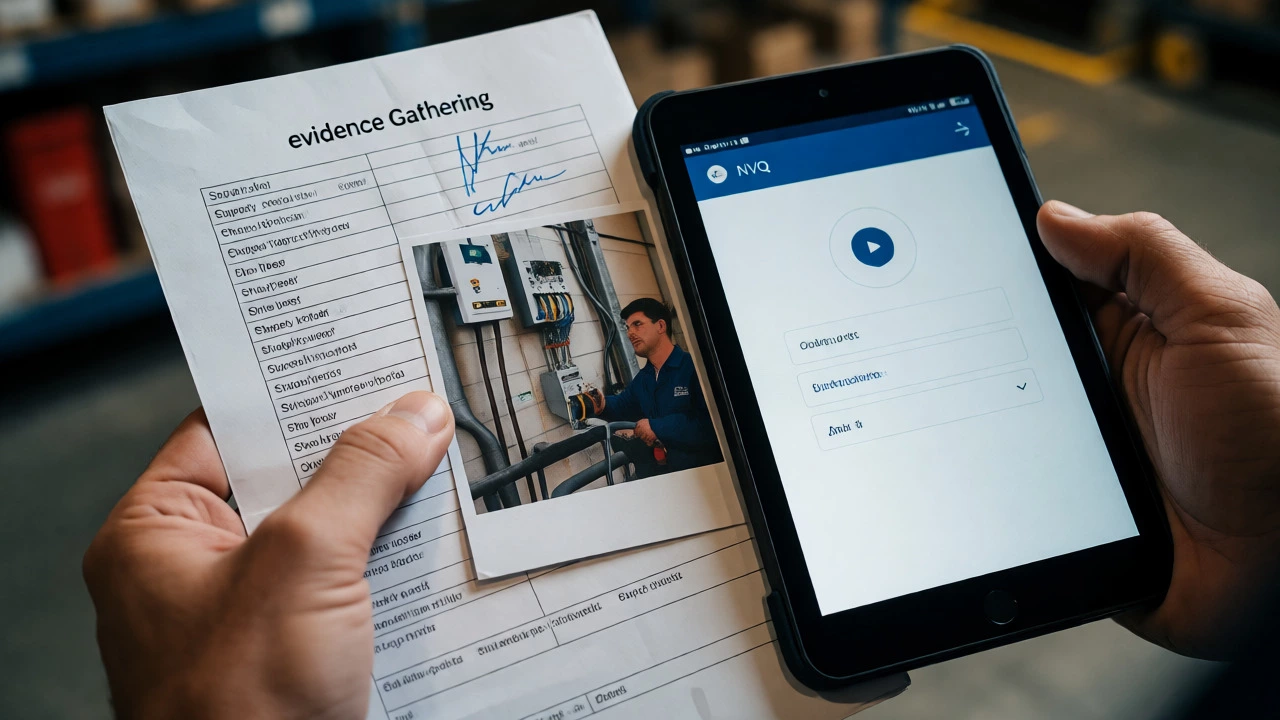
- Use digital portfolios. Paper-based portfolios are slow. Physical folders get lost, signatures get forgotten. Digital platforms allow instant uploading and tagging. Many providers offer apps specifically for this. Use them.
- Identify transferable evidence. Did you solve a conflict in your personal life that mirrors a workplace scenario? Did you manage a budget for a family holiday? Ask your assessor if these count. Often, they do, saving you from having to manufacture artificial workplace scenarios.
- Communicate barriers immediately. If your boss says "no" to an observation, tell your assessor that same day. Don’t wait until the monthly review. Quick communication allows the provider to intervene or adjust your plan before you lose momentum.
When Things Go Wrong: Common Delays
It’s not all smooth sailing. Here are the real reasons people exceed their estimated timelines.
Assessor Turnaround: Some providers have assessors handling 40+ students. If they take two weeks to return feedback on a simple unit, you are stalled. Check reviews of the provider’s responsiveness before signing up. A cheap course with slow feedback costs more in lost time than a pricier course with rapid turnaround.
Evidence Quality: Submitting poor-quality evidence leads to re-submission. If you upload a blurry photo of a certificate, you’ll be asked to retake it. Then wait for review again. This loop kills momentum. Read the assessment criteria carefully. If it asks for a "detailed account," don’t send a bullet point list.
Life Interference: Sickness, holidays, or job changes disrupt the flow. If you change jobs mid-course, you may need to restart some evidence collection if the new role doesn’t cover the same competencies. Try to align your NVQ with a stable period in your career.
Is It Worth Rushing?
There is a temptation to rush. To tick boxes just to say you’re done. But an NVQ is a professional credential. Employers know that a Level 3 in Health and Safety implies you can spot hazards and act on them. If you rushed through the evidence without truly understanding the principles, you might pass the paper but fail the practical expectation.
However, dragging it out for three years because you procrastinate on writing reflective accounts is equally bad. The sweet spot is consistent, steady progress. Aim to submit something small every week. Small steps prevent the mountain from looking unclimbable.
Can I do an NVQ without a job?
Yes, but it is harder and slower. Without a workplace, you rely on college workshops or short-term work placements to generate evidence. This limits the variety and realism of your examples, often extending the completion time by 6-12 months compared to someone employed in the sector.
Do I have to pay per module or for the whole course?
Most providers charge a flat fee for the entire qualification, regardless of how long it takes. However, some private providers may charge extension fees if you exceed a certain timeframe (e.g., 24 months). Always check the terms regarding "time-limited" enrollments.
What happens if I leave my job halfway through?
You can usually continue, but you will need to find alternative ways to gather evidence. This might mean volunteering, using a previous employer's references, or doing simulated tasks. Contact your provider immediately to discuss a revised plan, as your original evidence strategy may no longer apply.
Is an NVQ recognized internationally?
NVQs are primarily UK-based qualifications. While respected in Commonwealth countries and some international companies operating in the UK, they are not automatically equivalent to US Associate Degrees or European Baccalaureates. If you plan to move abroad, check if the destination country recognizes RQF (Regulated Qualifications Framework) levels.
Can I study for multiple NVQs at once?
Technically yes, but it is rarely recommended unless the subjects overlap significantly (e.g., Leadership and Project Management). Managing two sets of evidence, deadlines, and assessor communications doubles your administrative workload. Most people finish one before starting another to maintain quality.



Write a comment