

Cybersecurity Certification Timeline Calculator
Your Study Plan
Recommended Certification
Enter your study hours to see your personalized timeline
Want to get a cyber security certificate but don’t want to wait months? You’re not alone. With cyber attacks rising every year-over 2,200 breaches daily according to the University of Maryland-companies are scrambling to hire anyone with even basic security skills. The good news? You can walk out with a real, respected cyber security certificate in as little as three weeks. But how? And what’s the catch?
Three Weeks to a Certificate? Here’s How
The fastest path to a cyber security certificate isn’t a degree. It’s a focused, bootcamp-style program. Organizations like CompTIA, (ISC)², and EC-Council offer entry-level certs designed for career changers and early-career tech workers. The CompTIA Security+ exam, for example, is the most common starting point. It’s vendor-neutral, globally recognized, and accepted by the U.S. Department of Defense.
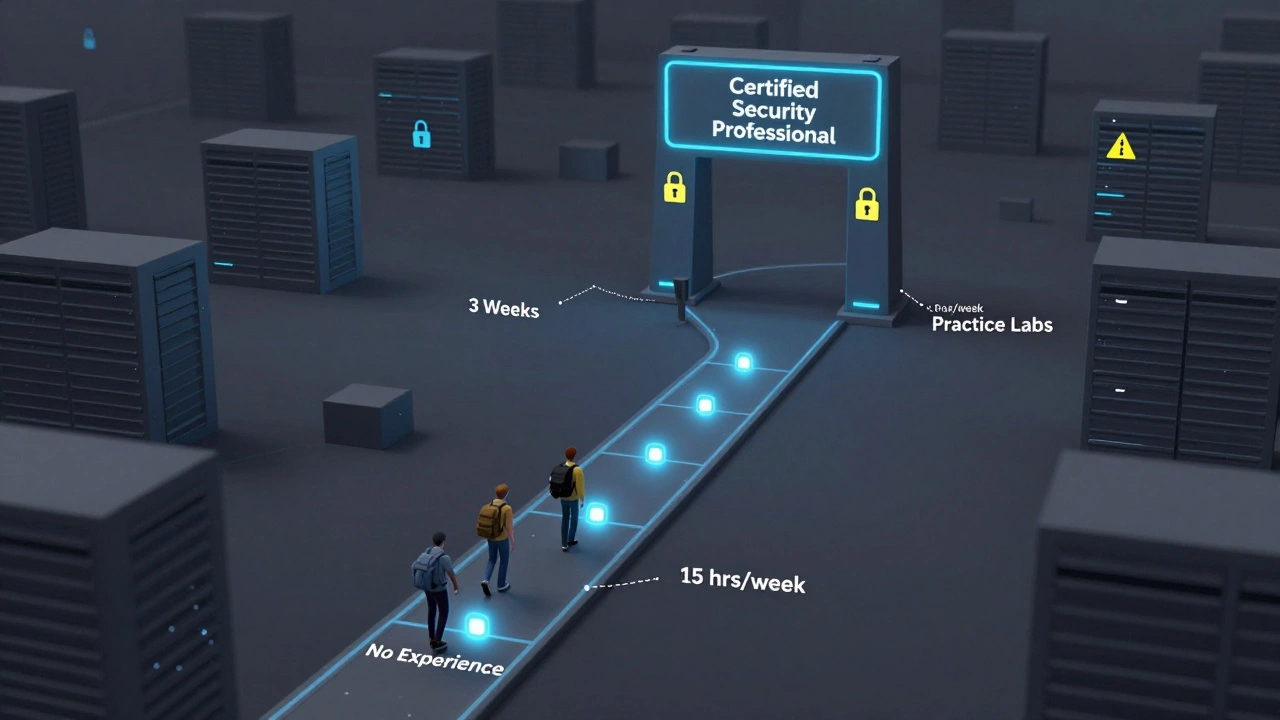
If you study 15-20 hours a week, you can be exam-ready in 3-4 weeks. That means:
- Week 1: Learn core concepts-threats, vulnerabilities, risk management, identity and access control
- Week 2: Practice hands-on labs-firewall rules, log analysis, basic penetration testing
- Week 3: Take practice tests until you consistently score above 85%
- Week 4: Schedule and pass the exam
Online platforms like Cybrary, Udemy, and Pluralsight have full Security+ prep tracks under 30 hours total. Some even include the exam voucher. You don’t need prior IT experience-but you do need discipline. No one’s sitting beside you. You show up for yourself.
What Certificates Can You Actually Get Fast?
Not all certs are created equal. Here’s what’s actually doable in under a month:
| Certificate | Exam Length | Typical Prep Time | Cost | Best For |
|---|---|---|---|---|
| CompTIA Security+ A vendor-neutral certification validating foundational cybersecurity skills | 90 minutes | 3-4 weeks | $392 | Entry-level roles: SOC analyst, help desk, network admin |
| Google Cybersecurity Certificate A beginner-friendly program from Google on Coursera covering SIEM, threat analysis, and incident response | Not a traditional exam | 3-5 weeks | $49/month | Career switchers, no prior IT background |
| ISC² Certified in Cybersecurity (CC) An entry-level cert from the world’s largest cybersecurity nonprofit, designed for newcomers | 120 minutes | 3-4 weeks | $249 (free for first 100,000) | Those seeking a globally recognized credential with no experience required |
| Microsoft Security, Compliance, and Identity Fundamentals (SC-900) A cloud-focused intro to Microsoft’s security tools like Azure AD and Defender | 60 minutes | 2-3 weeks | $99 | Users working with Microsoft 365 or Azure environments |
The Google and ISC² certs are especially good if you’ve never touched a command line. They teach you the language of security without assuming you know what a firewall is. The CompTIA Security+ is the gold standard for job postings. If you want to be hired, start there.
What You Can’t Do in Three Weeks
Don’t confuse speed with depth. You won’t become a penetration tester or incident responder in a month. Advanced certs like CISSP, OSCP, or CEH require:
- Years of hands-on experience
- 5+ years of work in security roles (for CISSP)
- Deep technical knowledge of networks, cryptography, and system architecture
These are not beginner certs. They’re for people who’ve already worked in the field. Trying to rush into them without the foundation is like trying to run a marathon before you’ve learned to jog. You’ll fail-and waste money.
Focus on the entry-level certs. They’re designed for people exactly like you: someone who wants to break in, not someone who already knows everything.

Real People, Real Timelines
Here’s what happened to three people who got certified fast:
- Maria, 28, former retail manager: Spent 18 hours a week on Google’s Cybersecurity Certificate. Passed in 3.5 weeks. Landed a SOC analyst job at a local healthcare provider within 6 weeks of certification.
- James, 35, ex-military: Used his GI Bill to pay for CompTIA Security+ bootcamp. Studied 2 hours a night after his kids went to bed. Took the exam on day 28. Got hired by a defense contractor within 3 weeks.
- Lisa, 42, stay-at-home mom: Took the ISC² CC exam after 25 hours of free YouTube videos and a $50 practice test bundle. Passed on her first try. Now works remotely for a cybersecurity startup doing vulnerability scanning.
They didn’t have degrees. They didn’t have years of experience. They had focus, a plan, and a deadline.
What You Need to Succeed
Speed doesn’t mean luck. It means structure. Here’s your checklist:
- Choose one cert. Don’t jump between them. Pick Security+ or ISC² CC if you’re unsure.
- Block out 15-20 hours per week. Treat it like a job.
- Use free resources first: Professor Messer’s YouTube videos, Cybrary’s free modules, and the official CompTIA practice exams.
- Do labs. Reading isn’t enough. Use TryHackMe or Hack The Box’s beginner paths.
- Schedule your exam before you feel “ready.” Deadlines create momentum.
- Apply for jobs the day you pass. Don’t wait to feel like an expert.
Most people fail because they keep studying. They think they need more time. But you don’t need to know everything. You just need to know enough to pass the test-and enough to say you’ve got the cert.
What Happens After You Get Certified?
Getting the certificate is step one. The real work starts after.
Most entry-level security jobs pay between $50,000 and $70,000 in the UK and US. That’s more than many people make after 5 years in retail or food service. And it’s a gateway.
After Security+, you can go for:
- CompTIA Network+ (if you skipped it)
- CompTIA CySA+ (for security analytics)
- PenTest+ (for ethical hacking)
- CISSP (after you gain 5 years of experience)
But you don’t need to plan five steps ahead. Just get the first one. Then let your next move be shaped by what you actually enjoy-whether it’s analyzing logs, responding to alerts, or teaching others.
Frequently Asked Questions
Can I get a cyber security certificate with no experience?
Yes. Certifications like Google’s Cybersecurity Certificate and ISC² Certified in Cybersecurity are designed for people with zero IT background. They teach you everything from scratch. You don’t need a degree, prior job history, or technical skills to start.
Is a cyber security certificate worth it?
Absolutely. The U.S. Bureau of Labor Statistics projects a 32% growth in information security analyst jobs through 2032-much faster than average. Employers ask for certs before they even look at resumes. A certificate proves you’ve got the basics, and it gets your foot in the door.
Do employers recognize online certificates?
Yes-if they’re from reputable providers. CompTIA, (ISC)², and Google are trusted by Fortune 500 companies, government agencies, and small businesses alike. What matters is the cert’s name, not whether you took it online. Employers care that you passed the exam, not how you studied.
Can I study for a cyber security cert while working full-time?
Yes. Most people do. You need about 3-5 hours a week for 6-8 weeks, or 15-20 hours a week for 3-4 weeks if you’re pushing hard. Many use lunch breaks, early mornings, or weekends. It’s not easy, but it’s doable.
What’s the cheapest way to get certified?
The ISC² Certified in Cybersecurity (CC) exam is currently free for the first 100,000 people (as of 2026). Pair it with free resources like Professor Messer’s videos and the official practice tests, and you can get certified for under $50 total. Google’s certificate on Coursera costs $49/month-you can finish in a month and cancel after.
Next Steps
If you’re serious about getting certified fast:
- Go to CompTIA’s Security+ page and download the exam objectives.
- Sign up for a free account on Cybrary or TryHackMe and start the "Introduction to Cybersecurity" path.
- Set a date for your exam-30 days from now.
- Block out your study time in your calendar like a doctor’s appointment.
You don’t need to be the smartest person in the room. You just need to be the one who showed up.


Write a comment