

Vocational Pathway Finder 2026
Confused by the changes to NVQs? Answer these 3 questions to find the best qualification route for your situation in 2026.
Loading...
Description goes here.
Why this fits:
Key Features:
If you have been looking for an NVQ is a work-based vocational qualification that was the standard for practical skills assessment in the UK for decades recently, you might be confused. You type it into a search engine, and instead of course listings, you get news articles about "T Levels" or "Apprenticeships." It feels like the system has vanished overnight. But did it really disappear?
The short answer is: yes and no. The brand name "NVQ" is largely gone from new courses, but the actual method of assessing your skills on the job remains very much alive. In fact, it has just changed its clothes. Understanding this shift is crucial if you are trying to upskill, hire staff, or validate your experience in 2026.
The End of an Era: What Happened to NVQs?
To understand where we are now, we need to look at why the National Vocational Qualification (NVQ) framework was dismantled. For years, NVQs were the gold standard for trades like plumbing, hairdressing, and construction. They were unique because they didn't rely on exams. Instead, assessors watched you work. If you could do the job safely and to standard, you passed.
However, by the early 2020s, the government and industry leaders felt the system had become outdated. Critics argued that NVQs were too focused on paperwork rather than actual skill demonstration. There was also a desire to align vocational training more closely with technical education found in other countries. This led to a massive overhaul of the English qualification system.
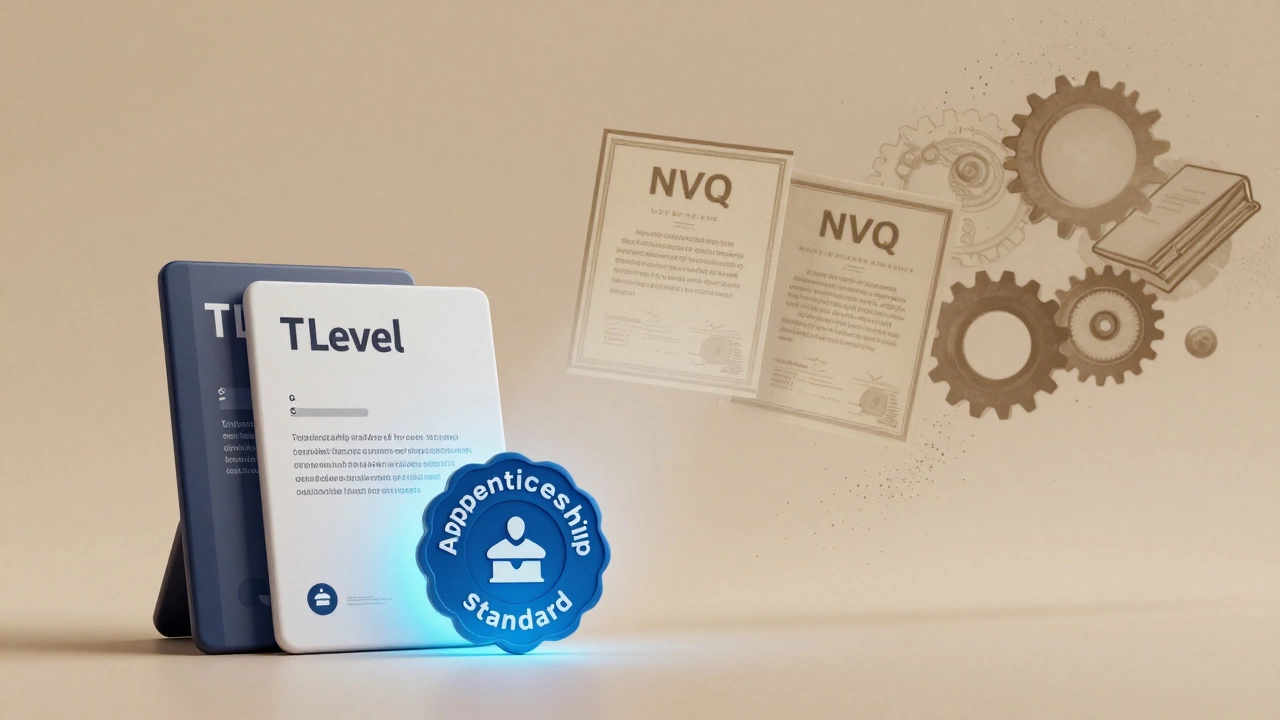
In 2023 and 2024, many awarding organizations stopped issuing new NVQ certificates. Existing holders still keep their qualifications-they don't expire-but if you are starting fresh today, you will rarely see "NVQ" on the syllabus. Instead, you will encounter two main replacements: T Levels are technical qualifications equivalent to three A-levels, combining classroom learning with industry placements and reformed Apprenticeships are work-based training programs that combine paid employment with study towards a recognized qualification.
T Levels: The Classroom-Based Successor
If you are a school leaver or someone returning to education, you have probably heard about T Levels. Launched fully across England by 2025, these are designed to replace many of the older vocational diplomas and some NVQ pathways. Think of them as the technical equivalent of A-Levels.
A T Level takes two years to complete. About 80% of your time is spent in college or a training provider learning theory, while the remaining 20% is a substantial industry placement-usually lasting 45 days or 315 hours. This isn't a shadowing internship; you are expected to contribute to real projects.
Why does this matter for the NVQ question? Because T Levels often include an end-point assessment (EPA) that tests your practical competence. While the structure is different from the old NVQ portfolio model, the outcome is similar: you prove you can do the job. T Levels are available in sectors like digital, construction, health, and engineering. They are highly respected by employers because they guarantee both theoretical knowledge and hands-on experience.
Apprenticeships: Where the Spirit of NVQ Lives On
If you prefer learning directly on the job without spending two years in a college setting, apprenticeships are your best bet. In many ways, modern apprenticeships are the true spiritual successors to NVQs. They retain the core principle of the NVQ: assessment happens in the workplace.
Under the current system, apprenticeships are structured around "standards" rather than "frameworks." Each standard defines the knowledge, skills, and behaviors required for a specific role. For example, a Level 3 Electrical Installation apprenticeship replaces what used to be an NVQ Level 3 in Electrical Installations.
The key difference is the rigor. Modern apprenticeships require a dedicated end-point assessment plan. An independent assessor evaluates your performance against national standards. This ensures that every electrician, plumber, or chef who completes an apprenticeship meets the same high bar, regardless of where they trained. For employers, this consistency is a huge advantage over the fragmented NVQ landscape of the past.
| Feature | Old NVQ System | T Levels | Modern Apprenticeships |
|---|---|---|---|
| Primary Setting | Workplace | College + Placement | Workplace |
| Assessment Method | Portfolio & Observation | Exams + EPA | End-Point Assessment (EPA) |
| Duration | Variable (often 1-2 years) | 2 Years Fixed | 1-5 Years (Role Dependent) |
| Theory Focus | Low | High (80%) | Moderate (Integrated) |
| Best For | Existing workers proving skills | School leavers seeking career path | Employees gaining paid experience |
What If You Already Have an NVQ?
This is a common worry. If you earned an NVQ in 2015, 2020, or even last year, rest assured: your qualification is still valid. Employers recognize NVQs, and they hold the same weight they always did. You do not need to retake a T Level or start an apprenticeship just because the branding has changed.
However, if you want to progress further, you might need to bridge the gap. For instance, if you have an NVQ Level 3 in Health and Social Care, you might choose to top it up with a specialized certificate or move into a management apprenticeship. Many providers offer "recognition of prior learning" (RPL) assessments. This means you can show evidence of your existing NVQ and potentially skip certain modules in a new course, saving you time and money.
Other Vocational Options: BTECs and City & Guilds
While T Levels and Apprenticeships dominate the headlines, other qualifications still play a vital role. BTECs are vocational qualifications offered by Pearson that focus on coursework and practical assignments rather than final exams remain popular in colleges, especially for creative industries and business studies. They are being streamlined to ensure quality, but they are not disappearing entirely.
Similarly, City & Guilds is a leading awarding organization that provides technical and professional qualifications across various industries continues to issue certificates. Many City & Guilds courses are now aligned with apprenticeship standards or T Level curricula. If you see a City & Guilds certificate, check whether it maps to a current T Level or apprenticeship standard. This alignment ensures your qualification is relevant to today's employers.

How to Choose the Right Path in 2026
With so many options, how do you decide? Here is a simple guide based on your current situation:
- You are under 19 and finishing school: Look at T Levels. They provide a broad foundation and a guaranteed industry placement. They are the most direct route into higher education or skilled employment.
- You are already working in your field: Consider an apprenticeship. You can earn while you learn, and your employer may fund the entire cost. It’s the closest experience to the old NVQ model.
- You want to change careers completely: A T Level or a full-time vocational diploma might be better. These allow you to immerse yourself in a new sector without the pressure of immediate workplace performance.
- You have informal experience: Ask your employer about RPL (Recognition of Prior Learning). You might be able to convert your years of on-the-job experience into a formal qualification without studying from scratch.
The Future of Vocational Training
The shift away from the NVQ brand reflects a broader trend toward clearer, more standardized outcomes. Employers no longer want to guess what an NVQ holder can do; they want to know that a T Level graduate or an apprentice has met a nationally agreed standard. This clarity benefits everyone.
As we move through 2026, expect to see even more integration between technical education and university degrees. Some universities now accept T Levels for entry into related degree programs, recognizing the depth of practical knowledge students bring. The stigma once attached to vocational training is fading, replaced by respect for the specialized skills these pathways deliver.
So, does the NVQ still exist? As a label, mostly no. As a concept-proving your worth through practical ability-it is stronger than ever. The tools have changed, but the goal remains the same: ensuring you have the skills to succeed in your chosen career.
Can I still get an NVQ in 2026?
Generally, no. Most awarding bodies have stopped issuing new NVQ certificates. Instead, you should look for T Levels or Apprenticeships that cover the same skills. However, some niche sectors may still offer legacy NVQ routes, so it is worth checking with specific training providers.
Is a T Level better than an NVQ?
It depends on your needs. T Levels are more rigorous academically and include a significant classroom component. If you want a broader education plus practical experience, a T Level is excellent. If you prefer pure on-the-job training, an apprenticeship might be closer to the traditional NVQ experience.
Do employers still value NVQs?
Yes, absolutely. Existing NVQs are still recognized and respected by employers. They demonstrate that you have proven practical competence. You do not need to replace an old NVQ unless you want to gain additional skills or meet specific new regulatory requirements.
What is the difference between an NVQ and an Apprenticeship?
An NVQ was a qualification focused solely on demonstrating skills in the workplace, often without a salary. An apprenticeship is a job contract where you are paid to work while studying towards a qualification. Modern apprenticeships include both practical assessments and theoretical learning, making them more comprehensive than standalone NVQs.
Are T Levels available in Scotland, Wales, or Northern Ireland?
No, T Levels are currently only available in England. Scotland, Wales, and Northern Ireland have their own vocational qualification systems, such as SVQs in Scotland or QCF qualifications in Wales. If you live outside England, check local government websites for the current vocational standards in your region.



Write a comment