

NVQ Level & Cost Estimator
Recommended NVQ Level:
Level 3 (Advanced)
Estimated Cost Range:
£1,000 - £1,800
Funding Options Available:
Employer Funding Government Skills Bootcamps Local Council GrantsGetting an NVQ certificate isn’t about passing a written exam. It’s about proving you can do the job-right now, on the job. If you’re working in construction, hairdressing, health care, or any hands-on trade, an NVQ is your passport to recognition, higher pay, and better opportunities. But how do you actually get one? It’s not like signing up for an online course and clicking submit. There’s a process. And if you don’t know it, you could waste months-or even years-going in circles.
What Exactly Is an NVQ?
An NVQ stands for National Vocational Qualification a work-based award in England, Wales, and Northern Ireland that recognizes skills and competence in a job role. It’s not theory. It’s proof you can perform tasks to industry standards. You don’t study for it in a classroom-you prove it where you work.
NVQs come in levels, from 1 to 7. Level 1 is for basic tasks, like sweeping a floor or assisting with client care. Level 3 is what most tradespeople aim for-think electrician, plumber, or senior hair stylist. Level 6 and 7? That’s for managers and supervisors running entire teams or departments.
Unlike GCSEs or degrees, NVQs don’t care how old you are or where you studied. They care if you can do the job. And if you’re already working in the field, you’re already halfway there.
Step 1: Pick the Right NVQ Level and Sector
You can’t just say, “I want an NVQ.” You need to pick which NVQ. There are hundreds, each tied to a specific job role. A Level 3 NVQ in Electrical Installation is totally different from a Level 3 NVQ in Childcare.
Start by asking yourself:
- What job do you actually do every day?
- What’s your official job title?
- What industry are you in-construction, hospitality, health, beauty?
For example:
- If you’re fitting boilers, you need an NVQ in Heating and Ventilation.
- If you’re cutting hair in a salon, you need an NVQ in Hairdressing.
- If you’re managing a care home, you need an NVQ in Social Care.
Don’t guess. Look up your job title on the Skills for Health or Skills for Industry websites. They list all approved NVQs by sector. If you’re unsure, call a local training provider-they’ll ask you the right questions.
Step 2: Find an Approved NVQ Provider
You can’t register for an NVQ on your own. You need an approved centre. These are training providers registered with awarding bodies like City & Guilds, NCFE, or OCR. They’re the ones who send assessors to your workplace.
Look for providers that:
- Are listed on the Ofqual Register (the official UK regulator)
- Have good reviews from past learners
- Offer free initial advice
- Work with employers in your industry
Many providers work directly with employers. If you’re employed, ask your boss. They might already have a training partner. Some companies even pay for your NVQ if it helps their business.
In Bristol, providers like Bristol City College and South Gloucestershire and Stroud College run NVQs for construction, health, and beauty. But you don’t need to go to a college. Many providers come to you-especially if you’re working on-site.
Step 3: Your Assessor Will Visit You at Work
This is the heart of the NVQ. You don’t sit exams. You get visited by an assessor-usually once every 2-4 weeks. They’ll watch you work, ask questions, and check your portfolio.
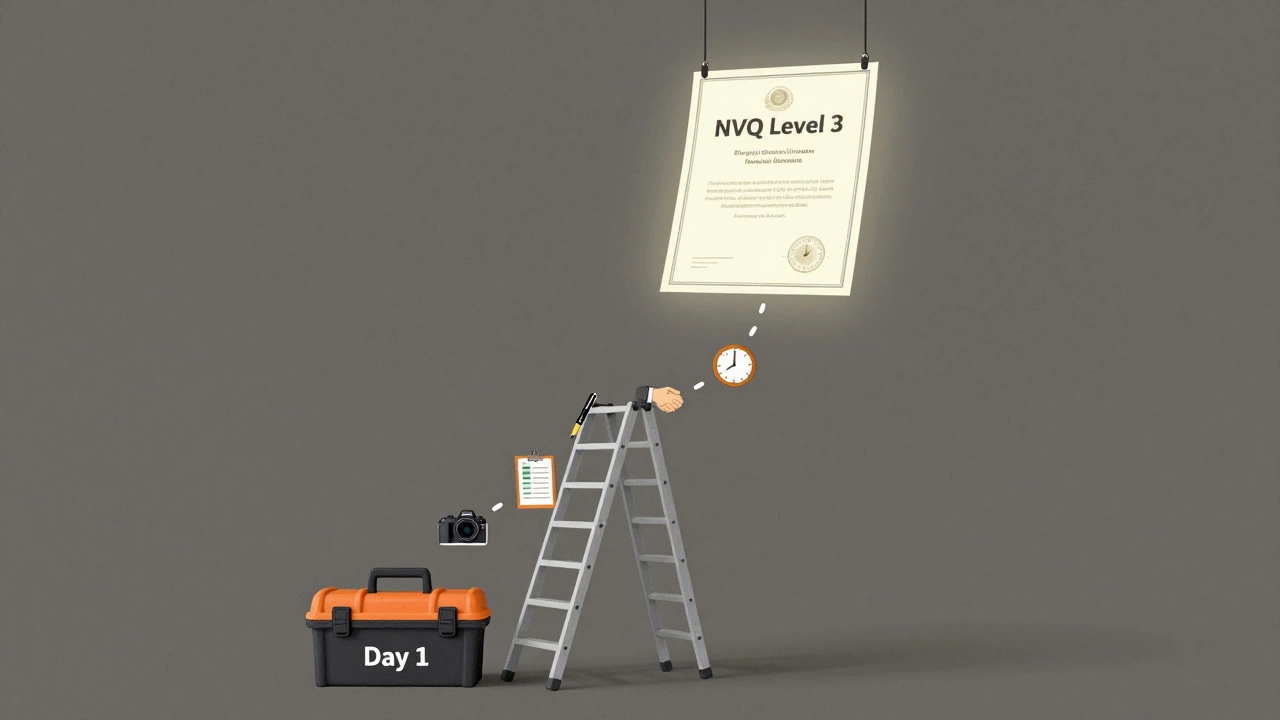
Your portfolio is your proof. It includes:
- Photos or videos of you doing tasks (e.g., installing a sink, giving a shampoo, checking blood pressure)
- Witness statements from coworkers or supervisors
- Work records, checklists, or risk assessments you’ve completed
- Answers to written questions that link your work to industry standards
Your assessor doesn’t just check boxes. They want to know why you did something a certain way. Did you follow safety rules? Did you adapt to a client’s needs? Did you spot a problem before it got worse?
One electrician I spoke to in Cardiff got his Level 3 NVQ by recording every job he did for six months. He took a photo of every circuit he wired, wrote down what he learned, and got his foreman to sign off. He finished in 10 weeks.

Step 4: You Might Need to Top Up Your Skills
Here’s the thing: most people already do 80% of what’s required. But NVQs demand proof of every single competency. That last 20% trips people up.
For example:
- A care worker might be great at helping clients dress, but never documented their risk assessments.
- A kitchen porter might handle food safely every day but never filled out the hygiene logs.
- A landscaper might know how to use a chainsaw but hasn’t completed the required safety training paperwork.
Your assessor will point out gaps. Don’t panic. It’s not a test. It’s a checklist. If you’re missing a skill, you’ll be asked to do it under supervision. Then you’ll document it. Simple.
Some providers offer short workshops-like a 2-hour session on “Writing Risk Assessments” or “Using Digital Logs”-to fill those gaps. These cost £50-£150 and take half a day. Worth it.
Step 5: Wait for Your Certificate
Once your assessor says you’ve met all the criteria, they submit your portfolio to the awarding body. That’s when the paperwork begins.
Processing time varies:
- Level 1-2: 4-6 weeks
- Level 3-4: 6-10 weeks
- Level 5-7: 8-12 weeks
You’ll get an email or letter when it’s ready. Some providers send a physical certificate. Others give you a digital one you can download and print. Either way, it’s official. You can list it on your CV. You can use it to apply for a CSCS card, a DBS check, or a promotion.
One plumber in Manchester told me he got his Level 3 NVQ in 2024. Two months later, he was offered a team lead role-with a £4,000 pay rise. He didn’t change jobs. He just proved he was ready for more.
How Long Does It Take?
There’s no fixed timeline. Some people finish in 3 months. Others take a year. It depends on:
- How much time you can dedicate to documentation
- How often your assessor can visit
- How quickly you respond to feedback
If you’re working full-time and you’re organized, you can finish a Level 3 NVQ in 4-6 months. Just keep a folder (digital or physical) with everything you do. Take a photo of your work. Write down what you learned. Ask your boss to sign off. Do it weekly. Don’t wait until the end.
Waiting until you’ve done 20 jobs to write about them? That’s how people get stuck for a year.
How Much Does It Cost?
NVQs aren’t free, but they’re rarely expensive. Costs vary by level and provider:
- Level 1-2: £500-£1,000
- Level 3: £1,000-£1,800
- Level 4-7: £1,800-£3,000
But here’s the catch: many people pay nothing.
If you’re employed, your employer might cover it. If you’re unemployed or on benefits, you might qualify for government funding through the Adult Education Budget or Skills Bootcamps. Some local councils in England-like Bristol City Council-offer grants for residents pursuing NVQs in high-demand sectors like construction and health care.
Always ask: “Is there funding available?” Don’t assume it’s all on you.
Can You Do an NVQ Without a Job?
No. Not really.
NVQs are based on real work. You need to be doing the job to prove you can do it. If you’re not employed, you can’t get an NVQ.
But here’s the workaround: if you’re training to enter a trade, you can do a work placement or apprenticeship. Many colleges offer NVQs as part of apprenticeships. You work 4 days a week and study 1 day. The employer pays you. The college handles the NVQ.
That’s the best path if you’re not yet employed. Look for apprenticeships on Find an Apprenticeship. Filter by your trade and level.
What’s Next After You Get Your NVQ?
Your certificate opens doors:
- Apply for a CSCS card (construction)
- Get licensed as a tradesperson
- Move into supervisory roles
- Apply for higher-level NVQs (Level 4+)
- Use it to get into university (some universities accept NVQ Level 3 as entry)
One nurse in Birmingham got her Level 3 NVQ in Health and Social Care. She used it to get into university part-time. Three years later, she’s a registered nurse.
Another electrician in Leeds got his Level 3 NVQ, then went straight for a Level 4 in Electrical Design. Now he runs his own company.
Your NVQ isn’t the end. It’s the foundation.
Can I get an NVQ online?
No. NVQs require proof of real-world performance. You can do some theory work online, but your assessor must see you do the job. There’s no shortcut. Any website claiming to give you an NVQ without work experience is selling a fake certificate.
Do NVQs expire?
No. Once you earn an NVQ, it’s yours for life. But some industries require ongoing training. For example, construction workers need to renew their CSCS card every 5 years, which requires proof of recent training. Your NVQ doesn’t expire, but your job may require you to keep learning.
Is an NVQ the same as a diploma?
No. A diploma is usually classroom-based and exam-focused. An NVQ is work-based and performance-based. Many people do both. For example, you might do a Level 3 Diploma in Plumbing (theory) and a Level 3 NVQ in Plumbing (practice). Together, they make you fully qualified.
Can I get funding for an NVQ if I’m self-employed?
Yes. If you’re self-employed in a priority sector like construction, health, or digital skills, you may qualify for government funding through Skills Bootcamps or local authority grants. Contact your local college or the National Careers Service (0800 100 900) to check eligibility.
What if I fail my NVQ?
You don’t ‘fail’ an NVQ. You either meet the criteria or you don’t yet. If your assessor says you’re missing something, they’ll tell you exactly what. You fix it. You resubmit. Most people get it on their second try. There’s no penalty. No retake fee. Just more work.
Final Tip: Start Today
You don’t need to wait for permission. You don’t need to quit your job. You don’t need to go back to school. You just need to start documenting your work.
Grab a notebook. Or open a folder on your phone. Take a photo of your work today. Write one sentence: “What I did. What I learned. Who saw me.” Do that once a week. In three months, you’ll have half your portfolio done.
That’s how people get NVQs. Not by studying. By doing. And by showing up.


Write a comment