

IT Certification Study Planner
CompTIA A+
BeginnerLet’s be honest: the phrase "IT certified" can mean anything from fixing a printer to managing cloud servers. So, how hard is it really? The short answer is that it depends entirely on which door you’re trying to walk through. For some, it’s a weekend project; for others, it’s a six-month grind. But here’s the good news-most entry-level certifications are designed to be accessible if you have a clear plan and consistent effort.
If you’ve ever stared at a syllabus and felt overwhelmed, you’re not alone. The barrier isn’t usually intelligence; it’s knowing where to start and how much time to budget. Let’s break down the actual workload behind the most common IT certification paths so you can decide if you’re ready to commit.
The Baseline: What "Entry-Level" Actually Means
When people ask about difficulty, they usually mean the foundational certs. Think of these as your driver’s license for the tech industry. They don’t make you an expert, but they prove you know the basics.
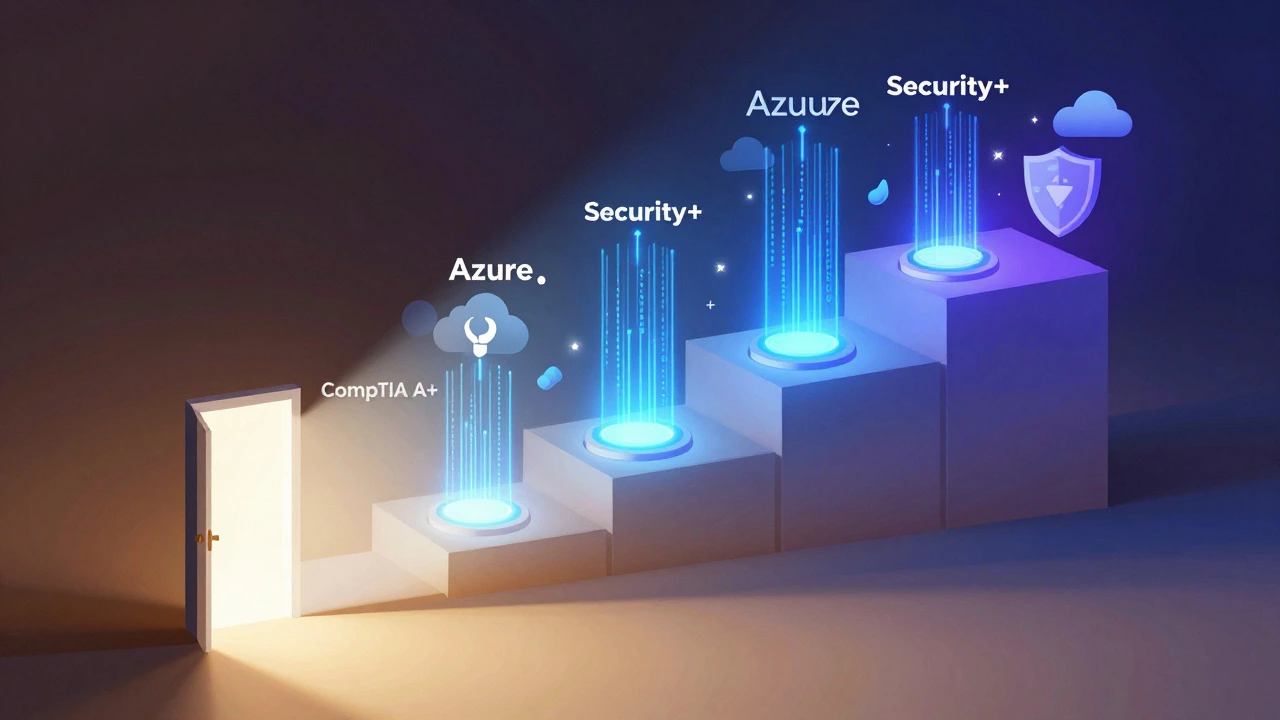
CompTIA A+ is the global standard for entry-level IT support professionals, covering hardware, software, and troubleshooting skills. It consists of two exams (Core 1 and Core 2). Most students spend between 40 and 80 hours studying. If you’re already comfortable with computers, you might breeze through in three weeks. If you’re starting from zero, expect two months of part-time study. The math is simple: 2-3 hours a day, five days a week. It’s manageable, but it requires discipline.
On the networking side, Cisco CCNA is a widely recognized certification that validates skills in network architecture, design, implementation, and troubleshooting. This one is generally considered harder than A+ because it deals with abstract concepts like IP addressing and subnetting. You’ll need around 60-100 hours of study. Many learners find the logical puzzles in subnetting tricky at first, but once it clicks, it becomes second nature.
Specialized Paths: Where the Difficulty Spikes
Once you move past the basics, the curve steepens. Specialized certifications target specific roles, and they demand deeper technical knowledge.
For those eyeing cloud roles, Microsoft Azure Fundamentals (AZ-900) is an introductory exam that tests basic knowledge of cloud concepts and core Azure services. Surprisingly, this is often easier than A+ for people with a business background, as it focuses more on concepts than hands-on repair. However, moving up to AZ-104 (Azure Administrator) jumps the difficulty significantly. That exam requires practical experience configuring virtual machines and storage accounts. Budget 80-120 hours for this level.
Cybersecurity is another hot field. CompTIA Security+ is a benchmark certification for information security professionals, covering threat management, identity, and access management. It’s broader than A+ but less technical than a CISSP. Expect 60-90 hours of study. The challenge here isn’t memorizing commands; it’s understanding how threats work and how to mitigate them. If you enjoy reading news about data breaches and figuring out what went wrong, this will feel natural.
Factors That Make or Break Your Success
It’s not just about the cert itself. Your personal context changes the difficulty dial.
- Background Knowledge: Do you build PCs? Do you understand what an IP address is? If yes, you skip the "what is this?" phase and jump straight into "how do I fix this?" That saves weeks.
- Study Style: Some people learn by reading PDFs. Others need video tutorials. Still, others only get it when they tinker with real equipment. Find your style early. If you force yourself to read when you’re a visual learner, you’ll burn out faster.
- Time Availability: Studying 5 hours a day for two weeks is different from studying 1 hour a day for ten weeks. Consistency beats intensity. Small daily doses stick better than cramming.
Realistic Timelines: From Start to Finish
Let’s put numbers on this. Here’s a rough guide for full-time vs. part-time learners.
| Certification | Part-Time (10 hrs/week) | Full-Time (40 hrs/week) | Difficulty Level |
|---|---|---|---|
| CompTIA A+ | 4-8 weeks | 1-2 weeks | Beginner |
| Cisco CCNA | 6-10 weeks | 2-3 weeks | Intermediate |
| Microsoft AZ-900 | 3-5 weeks | 1 week | Beginner |
| CompTIA Security+ | 6-9 weeks | 2-3 weeks | Intermediate |
| Microsoft AZ-104 | 8-12 weeks | 3-4 weeks | Advanced |
Notice the pattern? Full-time study compresses the timeline but doesn’t necessarily reduce the total effort. In fact, cramming can lead to retention issues. Part-time study allows concepts to sink in over time, which often leads to better long-term recall.

Common Pitfalls to Avoid
Why do some people fail their first attempt? Usually, it’s not because the material was too hard. It’s because they underestimated the preparation.
- Skip Hands-On Practice: Reading about routing tables is fine, but actually configuring a router in a simulator (like GNS3 or Packet Tracer) is where learning happens. Don’t skip this.
- Ignore Exam Objectives: Every cert has a list of objectives. Use it as your checklist. If you can’t explain every bullet point, you’re not ready.
- Underestimate the Question Style: IT exams love scenario-based questions. They won’t just ask "What is DNS?" They’ll ask "A user can’t load a website, and the error code is 1006. What is the likely cause?" Practice with sample questions that mimic this format.
Is It Worth the Effort?
Here’s the bottom line. Getting IT certified is not a sprint; it’s a series of small, manageable steps. The hardest part is often the mental shift from "I’m not technical" to "I can learn this." Once you cross that threshold, the rest is just practice.
Start with a baseline cert like A+ or AZ-900. Build your confidence. Then move to specialized areas. You don’t need to master everything at once. Just focus on the next step. And remember, even if you fail an exam, you now know exactly where your gaps are. That’s progress.
Do I need prior IT experience to get certified?
No. Entry-level certifications like CompTIA A+ and Microsoft AZ-900 are designed for beginners. They assume little to no prior professional experience. Self-study is perfectly viable if you have strong discipline.
Which IT certification is the easiest to pass?
Microsoft AZ-900 is often cited as the easiest because it focuses on high-level concepts rather than deep technical configuration. However, "easiest" is subjective. If you love hardware, A+ might feel easier. If you prefer theory, AZ-900 wins.
How long does it take to prepare for the CCNA?
Most candidates spend 6 to 10 weeks studying part-time (10 hours per week). Full-time bootcamps can cover the material in 2 to 3 weeks, but self-paced learners should allow extra time for hands-on lab practice.
Are IT certifications valid forever?
Not always. CompTIA certs are valid for three years. Cisco certs are valid for three years. Microsoft role-based certs are valid for one year. You’ll need to renew them by taking a recertification exam or earning continuing education units.
What is the best way to study for IT exams?
Combine video tutorials with hands-on labs. Use official study guides for structure, but supplement with third-party resources for different explanations. Always finish with timed practice exams to simulate test conditions.



Write a comment