

First Aid vs. CPR Skill Coverage Checker
Select your role or scenario below to see which certification provides the most relevant skills for your needs. Hover over any skill to see details.
Recommendation
Based on your selection...
You need broad coverage for common injuries like cuts, burns, and choking in addition to cardiac events.
Imagine this: you’re at a family barbecue, and someone suddenly collapses. Their face turns pale, they stop breathing. In that split second, your mind races. Do you call an ambulance? Do you start compressions? Or do you check for bleeding? This is where the confusion between first aid and CPR often trips people up. They sound similar because both deal with emergencies, but they are actually two distinct skill sets with different scopes, durations, and goals.
Many people assume that if you know how to do chest compressions, you have full first aid knowledge. But in reality, CPR is just one tiny piece of the much larger puzzle that is first aid. Understanding the difference isn't just academic; it determines whether you can handle a broken arm, a severe burn, or a cardiac arrest effectively. Let’s break down exactly what each certification covers, why they are not interchangeable, and which one you should prioritize based on your life situation.
The Core Distinction: Scope and Focus
To understand why these certifications differ, we need to look at their primary objectives. CPR (Cardiopulmonary Resuscitation) is a specific life-saving technique used when a person's heart stops beating or they stop breathing normally. Its sole purpose is to keep oxygen flowing to the brain and vital organs until professional medical help arrives. It is narrow, intense, and focused entirely on one catastrophic event: sudden cardiac arrest or respiratory failure.
In contrast, First Aid is the immediate care given to an injured or ill person before professional medical treatment is available. It is broad. It covers everything from treating minor cuts and sprains to managing shock, choking, burns, and yes, performing CPR if needed. Think of CPR as a specialized tool in your toolbox, while First Aid is the entire toolbox itself.
If you only know CPR, you are prepared for one specific worst-case scenario. If you know First Aid, you are prepared for dozens of common emergencies, including the ones that happen far more frequently than heart attacks, like falls, kitchen accidents, and allergic reactions.
What Does Each Certification Actually Teach?
The content of these courses varies significantly. A standard CPR course, often called Basic Life Support (BLS) for healthcare providers or simply CPR/AED for laypeople, focuses heavily on hands-on practice. You will spend most of your time practicing chest compressions on mannequins, learning the correct depth and rate, and using an Automated External Defibrillator (AED). The goal is muscle memory. When panic sets in, you want your hands to know what to do without your brain having to think about it.
A First Aid certification course, however, covers a wider range of scenarios. While it does include CPR and AED usage, it also teaches you how to:
- Assess a patient’s condition using the DRABC method (Danger, Response, Airway, Breathing, Circulation).
- Treat external bleeding with pressure bandages and tourniquets.
- Manage shock by keeping the casualty warm and still.
- Treat burns correctly, avoiding common myths like applying ice or butter.
- Handle fractures and dislocations by splinting limbs properly.
- Respond to anaphylaxis (severe allergic reactions) using epinephrine auto-injectors.
This breadth makes First Aid certification more versatile for everyday life. You might never perform CPR in your lifetime, but you are likely to treat a cut, a bruise, or a minor burn within the next few years.
Duration and Depth of Training
Another key difference lies in the time commitment. CPR-only courses are typically shorter. Many providers offer two-hour online modules or four-hour in-person workshops. These are designed to get you certified quickly, often focusing on adult CPR and AED use. Some even allow you to renew your certification annually with a brief refresher.
First Aid certifications usually require more time. In the UK, for example, a Level 3 Award in Emergency First Aid takes about 4 hours, while a Level 3 Award in First Aid at Work can take three days (18 hours). The longer duration allows for deeper instruction on complex topics like spinal injuries, multiple casualties, and workplace-specific hazards. The extra time ensures that you don’t just memorize steps but understand the reasoning behind them.
Does this mean CPR courses are less valuable? Not necessarily. If you work in a high-risk environment where cardiac arrest is a known hazard, such as construction or heavy industry, a focused BLS course might be sufficient initially. However, for most office workers, teachers, parents, and general public members, the broader scope of First Aid offers better value for money and peace of mind.
Which One Should You Choose?
Choosing between the two depends on your role and risk profile. Here is a simple guide to help you decide:
| Feature | CPR / BLS Only | Full First Aid Certification |
|---|---|---|
| Primary Focus | Cardiac Arrest & Respiratory Failure | All Immediate Medical Emergencies |
| Typical Duration | 2-4 Hours | 4 Hours - 3 Days |
| Skills Covered | Chest Compressions, AED Use, Rescue Breaths | Bleeding Control, Shock, Burns, Fractures, Choking, Anaphylaxis + CPR |
| Best For | Healthcare Workers, High-Risk Industrial Roles | Teachers, Parents, Office Workers, General Public |
| Renewal Frequency | Every 1-2 Years | Every 3 Years (UK Standard) |
If you are a teacher, a parent, or someone who works in an office, go for the full First Aid certification. You are more likely to encounter a child who has swallowed a toy or a colleague who has cut themselves on paper than someone who suffers a heart attack. Having the skills to manage those common incidents is practical and useful.
However, if you are already a nurse, paramedic, or doctor, you might focus on BLS updates to maintain your clinical proficiency. Even then, many healthcare professionals appreciate the refresher on non-cardiac first aid skills, especially if they work in community settings rather than hospitals.
Common Myths About First Aid and CPR
Misconceptions can lead to hesitation in emergencies. Let’s clear up a few popular myths.
Myth 1: CPR is dangerous if done wrong. While it is true that excessive force can cause rib fractures, the risk of death from cardiac arrest is far higher than the risk of injury from compressions. The American Heart Association and UK Resuscitation Council both emphasize that bystanders should not hesitate to start CPR. The potential harm is minimal compared to the benefit of restoring blood flow.
Myth 2: You need to be a doctor to give First Aid. No. First Aid is designed for laypeople. The techniques are simplified to be safe and effective for anyone after a short training period. You do not need medical jargon or advanced equipment to save a life or stabilize an injury.
Myth 3: AEDs are too complicated for regular people. Modern AEDs are voice-guided. They tell you exactly what to do step-by-step. If you have had any basic training, you can operate one confidently. The device prevents incorrect shocks automatically, making it very user-friendly.
Practical Tips for Choosing a Course
When selecting a provider, look beyond the price. Consider the following factors to ensure you get a quality education:
- Accreditation: Ensure the course is recognized by a major body like the Red Cross, St John Ambulance, or Health and Safety Executive (HSE) standards in the UK. This matters if your employer requires a specific qualification.
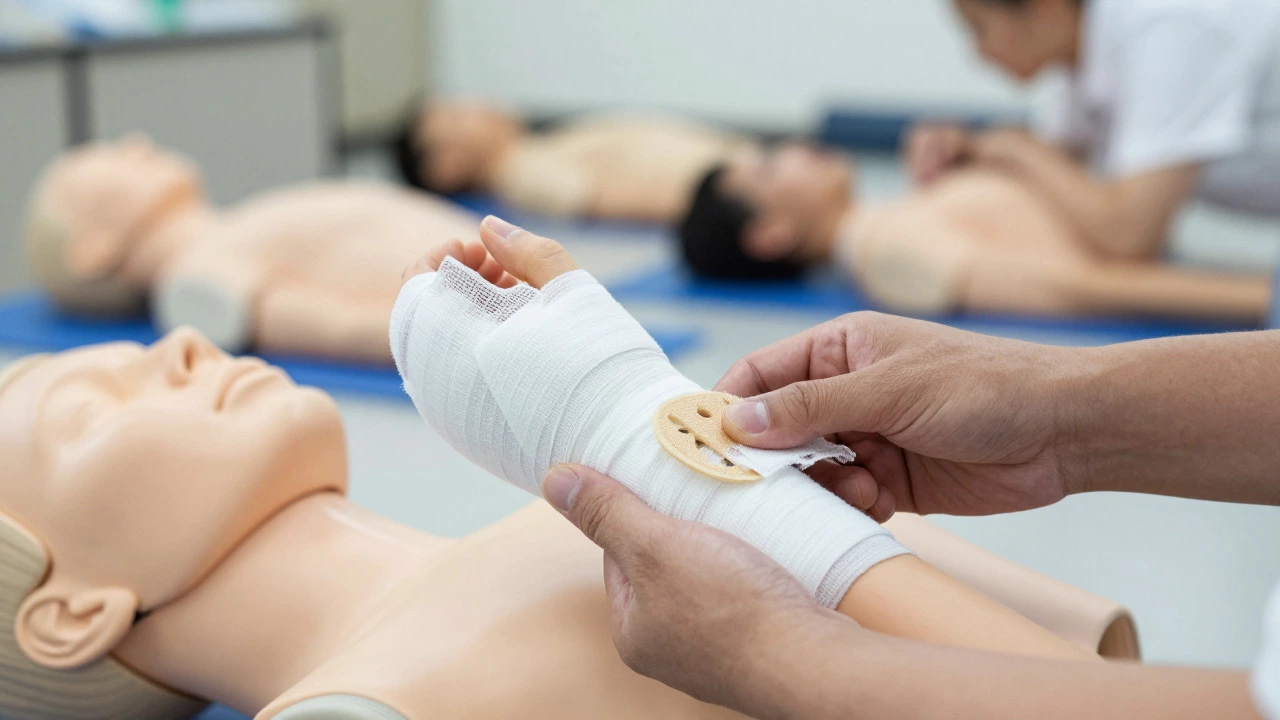
- Class Size: Smaller classes mean more hands-on time. You want to practice compressions and bandaging repeatedly, not just watch a video.
- Instructor Experience: Ask about the instructor’s background. Do they have real-world emergency experience? This adds context to the theoretical parts of the course.
- Materials Provided: Good courses provide manuals, pocket guides, and sometimes home practice kits. These resources help reinforce learning after the course ends.
Also, consider the format. Online courses are convenient for theory, but for First Aid, in-person practice is crucial. Hybrid models, where you learn theory online and practice in a lab, can be a good compromise. However, for beginners, a fully in-person course often leads to greater confidence.
Frequently Asked Questions
Is CPR part of every First Aid course?
Yes, in most comprehensive First Aid certifications, CPR and AED use are mandatory components. However, the amount of time spent on CPR may vary. A dedicated CPR course focuses exclusively on resuscitation techniques, while a First Aid course integrates CPR into a broader set of emergency skills.
How long is a First Aid certificate valid?
In the UK, a standard First Aid at Work certificate is typically valid for three years. CPR-only certificates may have different validity periods, often one to two years, depending on the provider. Always check the specific requirements of your employer or local regulations.
Can I take a CPR course online?
You can complete the theoretical portion of a CPR course online, but most reputable providers require a hands-on assessment to verify your compression technique. Fully online certifications exist, but they may carry less weight with employers who prefer verified practical skills.
Which is harder to learn: First Aid or CPR?
CPR is physically demanding but technically straightforward once you master the rhythm and depth of compressions. First Aid involves more decision-making and variety of skills, which can make it feel more complex initially. However, the physical exertion of CPR is unique and requires practice to build stamina.
Do I need both certifications?
For most people, a full First Aid certification is sufficient because it includes CPR. You only need a separate CPR/BLS course if your job specifically requires it (like in healthcare) or if you want to refresh your resuscitation skills without retaking the entire First Aid curriculum.



Write a comment