

People often assume that to work in safety-critical jobs-like construction, manufacturing, or warehouse operations-you need a college degree. But when it comes to OSHA, that’s not true. OSHA doesn’t require a degree. Not for any of its training programs, certifications, or compliance requirements. This is a common myth that stops people from entering vital safety roles. Let’s clear it up.
What OSHA Actually Is
OSHA stands for the Occupational Safety and Health Administration. It’s a U.S. federal agency under the Department of Labor. Its job? To make sure workplaces are safe. It sets rules, does inspections, and gives out fines when companies cut corners. But OSHA doesn’t issue degrees. It doesn’t run colleges. It doesn’t even grade papers. What it does offer are training programs-short, practical, and focused on real-world hazards.
There are two main OSHA training courses most workers encounter: the 10-hour and the 30-hour. These aren’t college classes. They’re hands-on sessions, often done in a day or two, sometimes online. You learn how to spot falling objects, lock out machines, handle hazardous materials, and report unsafe conditions. At the end, you get a wallet card. Not a diploma. Not a transcript. Just proof you’ve been trained.
Who Needs OSHA Training?
You don’t need a degree to be a construction worker, electrician, forklift operator, or warehouse supervisor. But you do need OSHA training if your employer is subject to OSHA rules-which most are. Employers are legally required to train workers on safety procedures. That’s the law. And OSHA training is the easiest, most accepted way to meet that requirement.
Think about it: a 19-year-old starting out on a roofing crew doesn’t have a degree. But they need to know how to use fall protection. A 45-year-old warehouse manager might have a bachelor’s in business, but if they’ve never taken the 30-hour OSHA course, they’re not fully compliant. The requirement isn’t about education level. It’s about competence.
OSHA Cards: No Degree, No Problem
The OSHA 10-hour and 30-hour cards are the most recognized credentials in U.S. safety jobs. They’re accepted across industries-from oil rigs to hospitals. You can get them through authorized trainers: community colleges, unions, private safety schools, even some online providers.
Here’s how it works:
- You sign up for a course-no application, no transcripts needed.
- You attend the training (in person or online).
- You pass a short quiz (usually multiple choice).
- You get a card in the mail, usually within two weeks.
No GPA. No SAT scores. No letters of recommendation. Just proof you showed up, listened, and understood the basics.
Some employers even pay for your training. Why? Because it reduces accidents. Fewer accidents mean lower insurance costs and fewer lawsuits. It’s not about how much schooling you’ve had. It’s about whether you know how to keep yourself and others safe.

What About Higher-Level Safety Jobs?
What if you want to become a safety manager? Or an OSHA compliance officer? Do you need a degree then?
Here’s the nuance: OSHA still doesn’t require a degree. But many employers prefer one. That’s because management roles often involve writing reports, interpreting regulations, or training others. A degree in occupational safety, environmental health, or industrial hygiene can help you stand out. But it’s not mandatory.
Look at the data: According to the U.S. Bureau of Labor Statistics, nearly 40% of safety professionals in the U.S. entered the field without a bachelor’s degree. Many started with an OSHA 30-hour card, gained experience on the job, and moved up. Some even got certified through the Board of Certified Safety Professionals (BCSP) without a degree-by proving years of field experience instead.
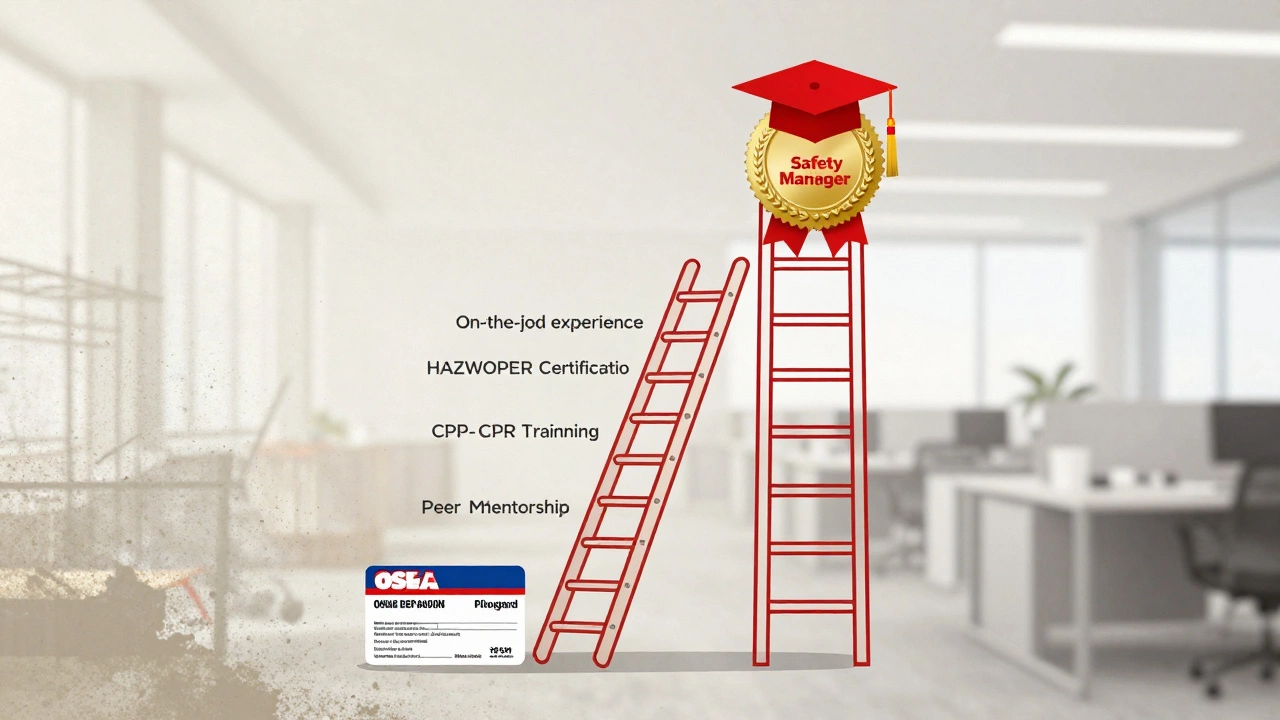
There’s a clear path: OSHA training → on-the-job experience → advanced certifications → management role. A degree can speed it up. But it’s not the only way.
Myths About OSHA and Degrees
Let’s bust a few myths you’ve probably heard:
- Myth: "You can’t get hired without a degree."
Reality: Many entry-level safety jobs list "OSHA 10 or 30-hour certification" as the only requirement. Some job postings don’t even mention education. - Myth: "OSHA checks your transcripts."
Reality: OSHA doesn’t look at your school records. They inspect workplaces, not resumes. - Myth: "A degree makes you safer."
Reality: A 2023 study by the National Institute for Occupational Safety and Health (NIOSH) found that workers with OSHA training had 32% fewer incidents than those without-even if they had degrees.
The real differentiator isn’t your diploma. It’s whether you’ve been trained, whether you follow procedures, and whether you speak up when something’s wrong.
Where to Start If You Don’t Have a Degree
If you’re wondering how to break into safety work without a degree, here’s your roadmap:
- Get your OSHA 10-hour card. It’s the minimum for most entry-level jobs.
- Apply for jobs that list "OSHA certification preferred" or "no degree required."
- Work in the field. Learn from experienced coworkers. Take notes.
- After six months to a year, get your OSHA 30-hour card.
- Look into additional certifications like First Aid/CPR, Hazardous Waste Operations (HAZWOPER), or Confined Space Entry.
- Once you have 2-3 years of experience, apply for safety coordinator roles.
Many people in safety roles today started exactly like this. No degree. Just grit, training, and a willingness to learn.
What OSHA Does Require
Let’s be clear: OSHA requires three things from employers and workers:
- Training: Workers must be trained on hazards they face.
- Documentation: Employers must keep records of who was trained and when.
- Compliance: Safety rules must be followed-no exceptions.
That’s it. No degree. No GPA. No application fee for a college. Just training, awareness, and action.
Why This Matters
Believing you need a degree to work in safety keeps good people out of the field. It’s a barrier built on misunderstanding. OSHA was created to protect workers-not to gatekeep them.
Every year, thousands of people start in safety roles without a degree. They become supervisors. They save lives. They build safer workplaces. And they did it by showing up, learning the rules, and doing the job.
If you’re reading this because you think you need a degree to get into safety work-you don’t. You just need to take the first step: find an OSHA 10-hour course near you. The rest follows.
Do you need a degree to get an OSHA 10-hour card?
No. You don’t need a degree, high school diploma, or any prior education to enroll in an OSHA 10-hour course. All you need is the ability to understand basic English and pay the course fee. The training is designed for entry-level workers, regardless of their academic background.
Can you get hired at a construction site without a degree?
Yes. Many construction companies hire laborers, helpers, and equipment operators with no degree at all. The only common requirement is an OSHA 10-hour card. Some sites may require additional certifications like fall protection or scaffold training-but never a college degree.
Is OSHA certification valid nationwide?
Yes. OSHA training cards issued by authorized providers are recognized across all 50 states. Even though OSHA is a federal agency, the training is delivered by state-approved trainers. As long as the provider is listed on OSHA’s website, your card is valid everywhere.
Do employers pay for OSHA training?
Many do. Especially in industries like construction, manufacturing, and logistics, where safety training is required by law. Some employers cover the full cost. Others reimburse you after you complete the course. Always ask before signing up.
Can you advance in safety without a degree?
Absolutely. Many safety professionals started with an OSHA 10-hour card and worked their way up. With experience, additional certifications (like HAZWOPER or CPR), and strong performance, you can become a safety coordinator, supervisor, or even a safety manager. A degree helps, but it’s not a requirement.



Write a comment