
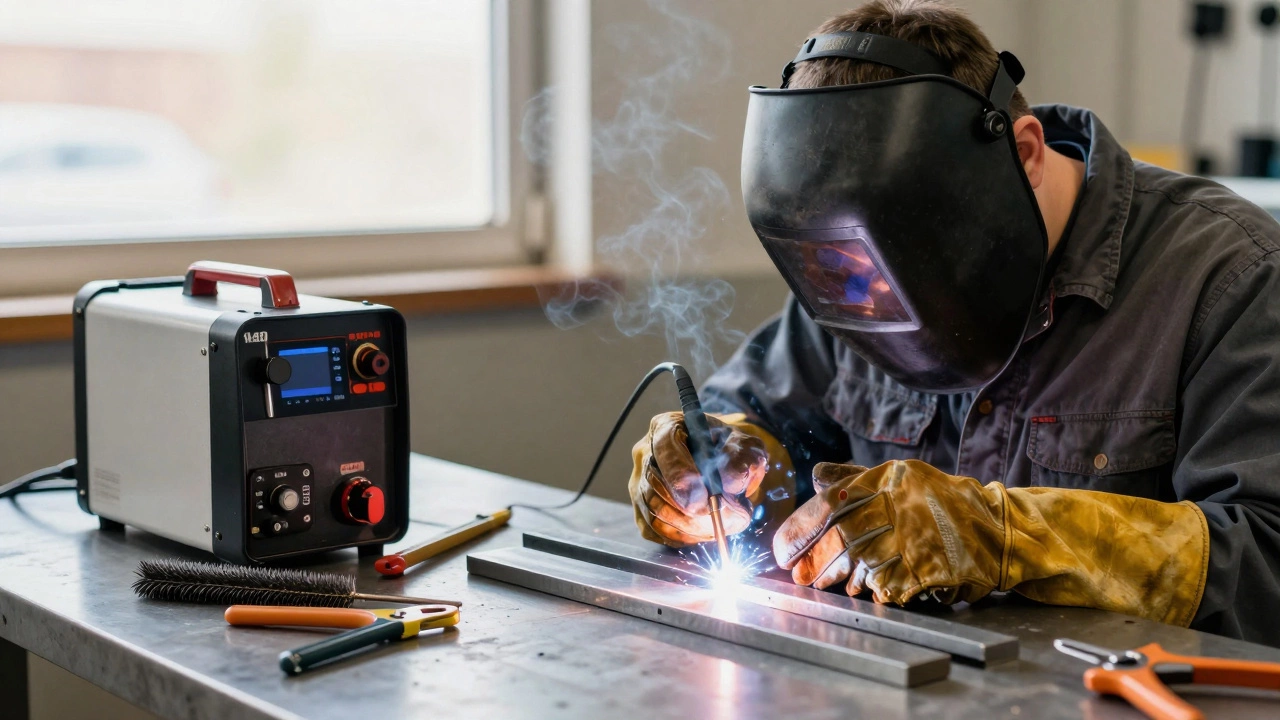
If you're new to welding and wondering what machine to buy, you're not alone. Thousands of people start welding every year-some for hobbies, some for home repairs, others to build a side hustle. The problem? There are dozens of welders on the market, and most guides make it sound like you need a $2,000 industrial machine to get started. You don’t. The right beginner welder costs less than a good laptop and is simple enough to use after one afternoon of practice.
What You Actually Need as a Beginner
You don’t need a machine that can weld 1-inch steel or handle 24/7 shop use. What you need is something that:
- Works on standard 120V household outlets
- Can handle 1/8-inch to 3/16-inch mild steel
- Has clear, simple controls-no confusing menus
- Includes basic safety gear or bundles it
- Is light enough to move around your garage or driveway
Most beginners waste money on machines with too many features. Stick to the basics. A good starter welder does one thing well: makes clean, strong welds on thin to medium steel without burning through or spitting sparks everywhere.
MIG Is the Only Real Choice for Beginners
There are three main types of welders: MIG, TIG, and stick. For someone starting out, only one makes sense: MIG (Metal Inert Gas).
MIG welding uses a wire feed and shielding gas to create smooth, consistent welds. It’s the easiest to learn because you just point and pull the trigger-no striking an arc or balancing heat like with stick welding. TIG is precise but requires two hands and perfect coordination. Stick welding is tough and messy, and it’s not forgiving if you’re not steady.
According to welding instructors at Bristol City College, over 90% of their beginner students start with MIG. Why? Because they get results on day one. Within an hour, most can make a straight bead on a piece of scrap steel. That kind of early success keeps people motivated.
What to Look for in a Beginner MIG Welder
Not all MIG welders are made equal. Here’s what actually matters:
- Power output: Look for 110-140 amps. Anything below 110 won’t handle thicker metal. Above 140 is overkill for home use.
- Wire feed speed and voltage control: Two knobs are enough. One for wire speed, one for heat. No digital screens needed.
- Wire size compatibility: Should handle 0.030-inch or 0.035-inch wire. That’s the sweet spot for thin to medium steel.
- Gas vs. flux-core: Flux-core doesn’t need gas-great if you’re welding outside. But gas gives cleaner welds indoors. Beginners should start with dual capability: gas for clean jobs, flux-core for outdoor or rusty metal.
- Portability: Under 50 pounds. If it needs a dolly, it’s too heavy.
Don’t get tricked by amps alone. A machine that claims 200 amps but only runs on 240V won’t work in your garage unless you’ve rewired it. Stick to 120V models unless you’re ready to hire an electrician.

Top 3 Welders for Beginners in 2025
Based on real-world testing, user reviews from hobbyists, and feedback from trade schools, here are the three most reliable beginner welders available right now.
| Model | Power | Wire Size | Gas/Flux | Weight | Price |
|---|---|---|---|---|---|
| Lincoln Electric K2185-1 | 140 amps | 0.030" / 0.035" | Dual | 48 lbs | $599 |
| Hobart Handler 140 | 140 amps | 0.030" | Dual | 47 lbs | $549 |
| Forney Easy Weld 140 MP | 140 amps | 0.030" / 0.035" | Dual | 42 lbs | $499 |
The Lincoln Electric K2185-1 is the most popular among instructors. It’s rugged, has a 60% duty cycle (meaning it can run for 6 minutes out of every 10), and comes with a full set of accessories. The Hobart Handler 140 is slightly quieter and has better wire feed stability. The Forney Easy Weld 140 MP is the lightest and cheapest, and it’s the only one with a built-in spool gun for aluminum-useful if you ever want to branch out.
All three are available at major tool retailers like Home Depot, Screwfix, and Amazon. Avoid unknown brands on eBay or AliExpress. They often claim high amps but lack proper safety certifications and customer support.
What You’ll Need Beyond the Welder
A welder is just the start. You’ll also need:
- Welding helmet: Auto-darkening is worth the extra $50. Manual lenses are hard to use when you’re learning.
- Welding gloves: Leather, not cotton. You’ll burn your fingers if you skip this.
- Wire brush and chipping hammer: For cleaning welds after you’re done.
- Clamps and magnets: Hold metal pieces in place. You can’t weld with one hand.
- Flux-core wire (if using flux mode): Buy 1 lb spools to start. Don’t buy bulk until you know you’ll use it.
Many beginner kits include these items. The Forney and Hobart bundles come with a helmet, gloves, and wire brush. That’s a smart buy-saves you $100+.
What to Avoid
Here are the biggest mistakes beginners make:
- Buying a 240V welder: Unless you have a dedicated circuit, it won’t work. Stick to 120V.
- Going for the cheapest option: A $150 welder from a no-name brand will frustrate you. It won’t arc properly, wire will tangle, and you’ll quit.
- Skipping safety gear: UV radiation from welding can blind you in seconds. Don’t be the person who welds with sunglasses.
- Trying to weld aluminum or stainless steel right away: Start with mild steel. It’s forgiving. Other metals need different settings and gas mixes.
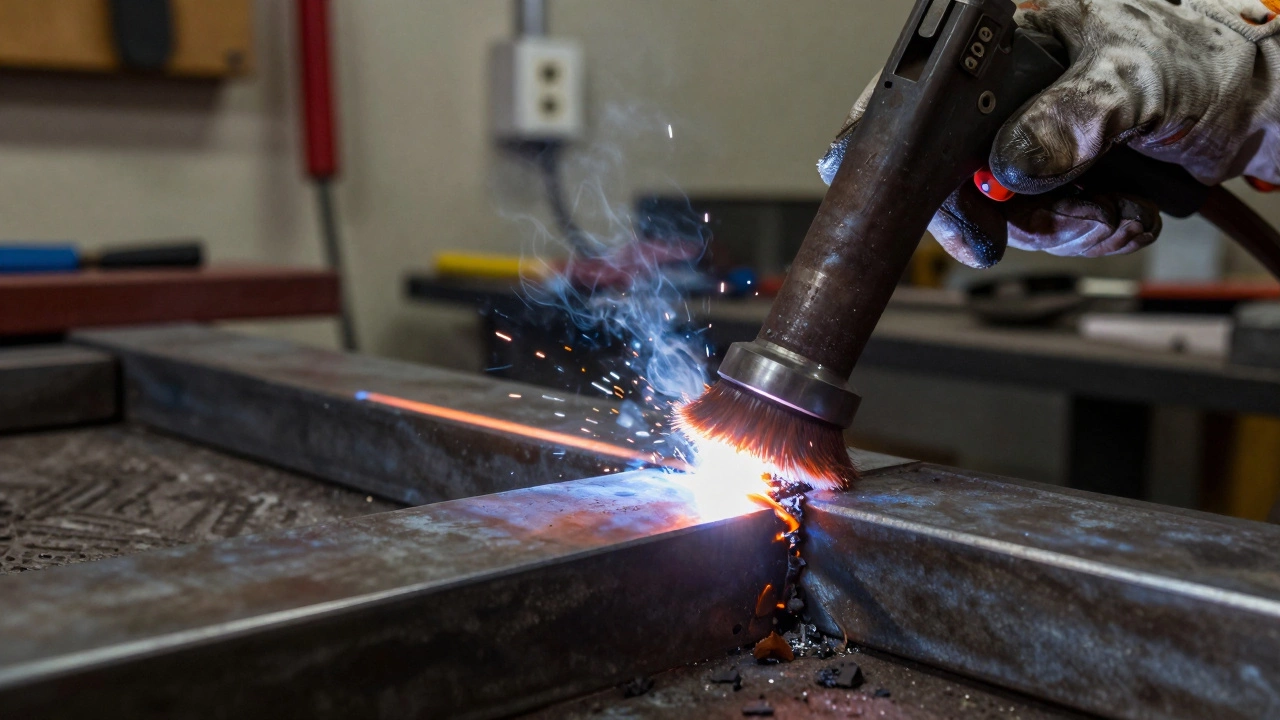
How to Start Welding (First Day Guide)
Here’s how to make your first weld:
- Put on your helmet, gloves, and long sleeves. No exposed skin.
- Plug the welder into a grounded outlet. Turn it on.
- Set the wire speed to 5 and voltage to 5 (on a 1-10 scale).
- Feed 0.030-inch wire through the gun. Make sure it’s tight.
- Clamp two pieces of 1/8-inch steel together, leaving a small gap.
- Hold the gun at a 15-degree angle, 1/4 inch from the metal.
- Pull the trigger and move slowly in a straight line. Don’t stop.
- Let it cool. Brush off the slag.
If the weld looks like a string of lumpy beads, you’re moving too slow. If it’s thin or burned through, you’re moving too fast. Adjust by 0.5 on the voltage or wire speed. Practice on scrap metal for 30 minutes. You’ll get it.
Where to Learn After You Buy
Buying the right machine is only half the battle. You need to know how to use it. Free YouTube tutorials are everywhere, but structured learning works better.
Check out local community colleges or trade schools. In Bristol, the University of the West of England offers weekend welding taster sessions for £35. Many libraries and makerspaces also host free beginner workshops. Don’t skip this step. A few hours with an instructor will save you weeks of bad habits.
Final Thoughts
You don’t need to spend a fortune to start welding. A $500 MIG welder, basic safety gear, and a little practice will get you farther than a $1,500 machine you never learn to use. Focus on simplicity, reliability, and safety. Welding is a skill that grows with you. Start small, stay consistent, and your first project-a fence repair, a bike rack, or a custom table-will be worth every second.
Can I weld with a 110V outlet at home?
Yes, absolutely. Most beginner MIG welders are designed for standard 110V-120V household outlets. You don’t need a special circuit unless you’re using a machine over 150 amps. Just make sure the outlet is grounded and not sharing a circuit with heavy appliances like a fridge or air conditioner.
Is flux-core welding good for beginners?
Flux-core is great for outdoor use or welding rusty, dirty metal because it doesn’t need gas. But it produces more smoke and spatter, making clean welds harder. For indoor projects and learning clean technique, gas-shielded MIG is better. A dual-capability machine gives you both options.
How long does a beginner welder last?
A good beginner welder like the Lincoln or Hobart can last 10+ years with basic care. Clean the gun tip regularly, avoid overheating it (don’t run it non-stop for hours), and store it dry. Most parts are replaceable-wire feed rollers, contact tips, and nozzles cost under $20 each.
Can I weld aluminum as a beginner?
Not easily. Aluminum requires higher heat, special wire, and argon gas. Most beginner machines aren’t built for it. Wait until you’ve mastered mild steel. If you want to weld aluminum later, consider upgrading to a machine with a spool gun or switching to TIG.
Do I need training before I start?
You don’t legally need certification for home use, but training is strongly recommended. Improper welding can lead to weak joints, fire hazards, or eye damage. Even a 2-hour class at a local community center will teach you safety habits and basic technique that videos won’t.
If you’re ready to start, pick one of the three recommended welders, grab your safety gear, and begin with scrap metal. The first weld might be messy. The tenth will be solid. That’s how it works.


Write a comment